The Parks/Archer barn is a familiar landmark in the Bodenburg Loop Road area, being two Colony barns placed end-to-end. In this photo the barn on the left is the Parks barn, built on tract no. 189, and the barn on the right is the Archer barn, moved from tract no. 193. (Photos by Helen Hegener/Northern Light Media)
The magnificent Parks-Archer barn which sat on the south side of Bodenburg Butte is gone now, another loss to Matanuska Valley history, but it was included in my 2013 book on the Matanuska Colony barns (see below for ordering). Comprised of two Colony barns moved together, it was a Valley landmark for decades.
In 1935 the U.S. Government transported 200 families from the Great Depression-stricken midwest to a valley of unparalleled beauty in Alaska, where they were given the chance to begin new lives as part of a federally-funded social experiment, the Matanuska Colony Project. As part of each family’s farmstead, a magnificent barn was raised, a sturdy square structure 32′ by 32′ and soaring 32′ high. Today these Colony barns are an iconic reminder of what has been called the last great pioneering adventure in America.
The Parks and Archer barns were built on adjoining 80 acre tracts, numbers 189 and 193, respectively. Local historian Lynn Sandvik explained to me in 2012, “They moved the Archer barn north and put them together and did quite a bit of work on them about 20 years ago, for some kind of centennial something, but then they forgot about them again.”
In a 2012 letter to me, Valley historian Jim Fox related a little of the Parks family history from an interview with daughter Bonita Parks Strong: “Many of the farmers in the Butte had sheep, selling their wool to Pendleton in Washington or Minnesota woolen mills, often getting blankets and winter clothes in exchange along with some cash. The Parks family had a big flock which they drove up into the mountains to the north in the summer, an 18 to 20 mile trip…”

In front of the Archer barn, the Parks barn can be seen in the distance, along with Bodenburg Butte. Glen Archer’s great grandmother Lillian Post wrote near it, “Perle Archer thinks he can handle his big bull. One day it took many to handle him.”
Glen Archer, a grandson of Colonists Perle and Dorothy Archer, wrote to me in 2012, “My sister and I grew up listening to our father, Floyd Archer, tell stories about growing up in the Matanuska Valley and homesteading there and how his parents, Perle and Dorothy Archer, moved the family from Wisconsin to Alaska. He was only 18 months old… there were six children including my father in the family. My father still has lots of memories of life in Alaska, going to school, playing with the Colony kids, and all the hard work and long winters.”

The barn in the foreground is the Otto Peterson barn, the one in the center of the photo would be the Archer barn. The Parks barn was just out of the photo on the left side.
“About 12 years ago, I inherited from my father the old family album filled with pictures of the homestead and family in Alaska. Among the pictures is a picture of the Archer barn, more pictures of the chicken coop, farm animals, the fields, as well as the house. All of the pictures appear to have been taken by my great grandparents (Dorothy’s parents) during their trip to visit Perle, Dorothy and the six kids, in 1939, which would have been well after Perle and Dorothy were selected as part of the 200 plus families and moved to Palmer.”
In another letter to me, Glen Archer shared some of the family history after a visit with his father: “Dad said yesterday that the original house was a nice fairly large two story log house which had a full basement. It had been insulated with what he remembers as oakum, which he described as fibers saturated with a tar like substance. Somehow, two or three years after being built, his older siblings Betty and Bob one day caught the insulation on fire and the house burned to the ground. Dad said that grandpa (Perle) was very sad about the whole experience as he had really put his heart and soul into building that place and was proud of it. According to Dad, Grandpa was one of the few individuals who truly knew how to build and taught others to build. He was a general contractor for decades after they returned to the states. Grandpa also apparently started a sawmill which employed others so they could have access to milled lumber and was instrumental in building Fort Richardson.”

Parks/Archer barn. Photo by Stewart Amgwert, Wasilla.
This post is edited from the book The Matanuska Colony Barns, by Helen Hegener, published by Northern Light Media in May, 2013. See below for ordering:
 The Matanuska Colony Barns

• The Matanuska Colony Barns: The Enduring Legacy of the 1935 Matanuska Colony Project, by Helen Hegener, photographs by Eric Vercammen, Stewart Amgwert, Albert Marquez, Dave Rose, Joanie Juster, Ron Day and others. Foreword by Barbara Hecker. Introduction by James H. Fox. 140 pages, full color. ISBN 978-0-9843977-4-7. Includes Colonist families listing, maps, bibliography, resources, index.
• Order directly from the author, Helen Hegener: $29.00 plus $5.00 postage and handling (via USPS Priority; US only, foreign orders please use Amazon). To order via credit card or Paypal, click the link above and send payment to helenhegener@gmail.com
• To order via check or money order, mail to Northern Light Media, PO Box 298023, Wasilla, Alaska 99629
• Locally the book is available at Fireside Books and the Colony House Museum in Palmer.
• Your local independent bookstore Support local independent booksellers, order my book through any of these fine independent bookstores by giving them the title of the book and the ISBN: 978-0-9843977-4-7 (Any bookstore, anywhere, can order the book with that information):
• Fireside Books, Palmer, Alaska
• Title Wave Books, Anchorage, Alaska
• Ordering online:
• Amazon The best option for foreign orders.
Share this page with your friends through social media:

 Now available in a print replica Kindle edition, Long Hard Trails and Sled Dog Tales is a memoir of sorts, an adventure story to be sure, and a look at what it’s like to follow a winning sled dog team across the Alaskan and Canadian wilderness.
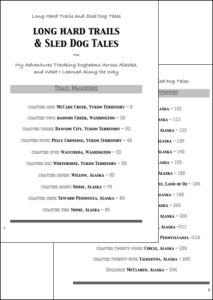 In this book Helen shares the life-changing adventures of her first few years spent paralleling the sled dog trails as a columnist for Alaska Dispatch, and a frequent contributor to several other publications, including Alaska Magazine, Last Frontier Magazine, Mushing Magazine and others.
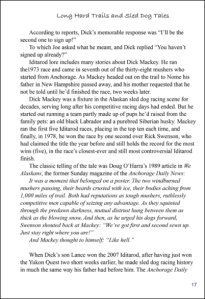 But going beyond the championship sled dog races, she also gives readers the backstory of her life as founder and co-publisher of an award-winning and widely-respected publication in alternative education, and the riveting nationally-watched lawsuit which set legal precedent, but cost her that business and much more; the ‘long hard’ part of the trail…
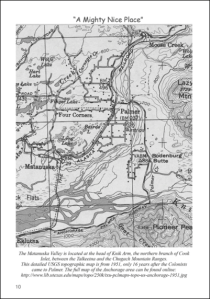
 “The valley looks great. It looks fine, fine. You got a mighty nice place here.” ~American humorist and commentator Will Rogers, Palmer, Alaska, August, 1935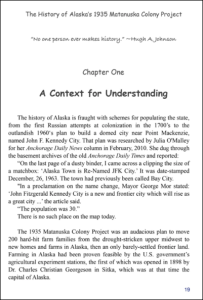
 The April 13, 1935 issue of the Ironwood Daily News, Ironwood, Michigan, noted: “Two hundred families–including 1,000 persons–have been selected from farms in northern Minnesota, Michigan and Wisconsin to form the colony. Each family will be lent $3,000 and will be furnished a 40-acre homestead. Thirty years will be allowed for repayment of the money. The 480 relief workers who help launch the project will return to the states in the fall, leaving the farmers to carry on.”
 The remarkable photos of Willis T. Geisman, A.R.R.C. official photographer for the Matanuska Colony Project, documented every aspect of the venture, from the kitchen help aboard the North Star to the colonists’ children playing in the tent city, from officials posing stiffly for portraits to farmers working together to build homes before winter. His photographs portray proud farm wives showing their neat tent kitchens, and a small girl sitting in an Alaskan berry patch grinning at the cameraman. Geisman’s compelling images tell the true stories, moments in time captured and preserved, of children laughing, women working, men building futures for their families, brought together here with the detailed history of the Matanuska Colony Project.
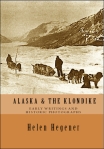 Alaska & the Klondike, Early Writings and Historic Photographs, by Helen Hegener, published May, 2018, by Northern Light Media. An engaging journey through the literary history of Alaska and the Klondike, and an introduction to some of the most compelling books ever written about the North. $24.95 (plus shipping), 320 pages, over 100 b/w photos, ISBN-13: 978-1717401991.




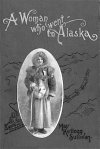
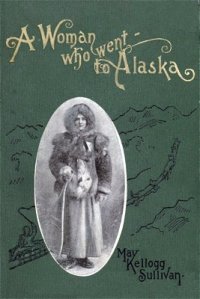 A Woman Who Went––to Alaska, by May Kellogg Sullivan, was published in 1902 by James H. Earle & Co., of Boston, Massachusetts. The book describes two trips in which the author journeyed to the Yukon and Alaskan goldfields in 1899, a year after the height of the Klondike Gold Rush. Her father and brother were working claims near Dawson City, and they were surprised to see her, and perhaps even more surprised when she continued her travels, eventually reaching Nome and Dutch Harbor. Regarding the reason for her adventurous trip, the author wrote: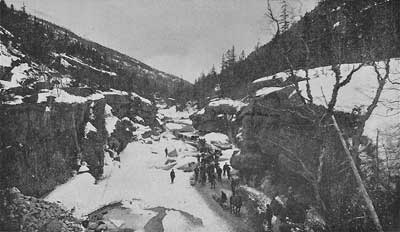
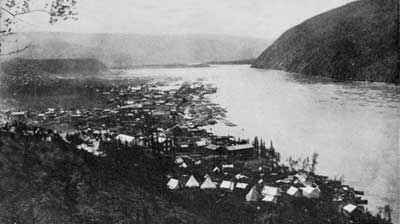
 Excerpts from May Kellogg Sullivan’s A Woman Who Went––to Alaska are included in the most recent book by Helen Hegener:


 The Alaska Railroad: 1902-1923, Blazing an Iron Trail Across The Last Frontier, by Helen Hegener, published in May, 2017 by Northern Light Media. 400 pages, over 100 b/w historic photos, maps, bibliography, indexed. The book can be ordered via PayPal for $24.00 plus $5.00 postage, by


 Selected excerpts are from the following books: