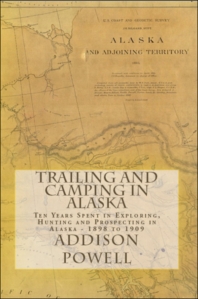
Trailing and Camping in Alaska, subtitled Ten Years Spent Exploring, Hunting and Prospecting in Alaska – 1898 to 1909, was written in 1909 by Addison M. Powell, an adventurer, prospector, hunter, and a former guide for Captain William R. Abercrombie’s 1898 Copper River Exploring Expedition, which was one of three military expeditions organized under the direction of the Secretary of War with directives for exploring the interior of the new territory of Alaska. Powell’s familiarity with the land made him a valuable addition to Abercrombie’s efforts over the next several years, and brought him into contact with many men who would help to shape the future of Alaska.
Pack train crossing a pole-bridge.
In the spring of 1898, Abercrombie was directed to organize his men and supplies at Valdez, on the coast, and to explore northward into the valley of the Copper River and its tributaries, and farther north to the Tanana River, seeking an all-American route from coastal Alaska to the Klondike gold fields . Powell’s sub-report, which was published in Abercrombie’s 1899 Government Report on the Copper River Exploring Expedition, appears as chapters of this book.
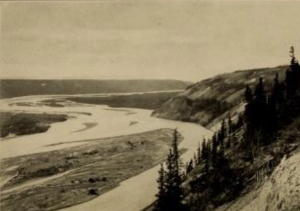
The banks of the Copper River.
The following year Abercrombie would be responsible for constructing a military road from Prince William Sound at Valdez to Eagle on the Yukon River, a route which became known as the Eagle Trail. Powell, who had been exploring and prospecting in the country, once again joined the effort as a guide and surveyor. The following years are filled with additional explorations and adventures, and a continuing search for a lost gold strike which enticingly begins the book.
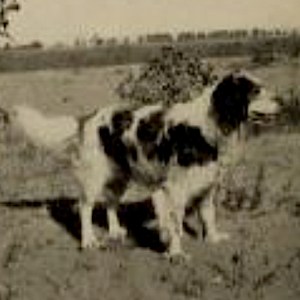
Powell’s little dog “Pete.”
Addison Monroe Powell was born November 25, 1856, in Clinton County, Indiana; he was 42 years old when he joined Abercrombie’s 1898 expedition. His book of verses, for which he was often compared to that Bard of the North, Robert Service, was titled Echoes from the Frontier, and was also published in 1909. Powell passed away in Santa Barbara, California, on January 29, 1932, at the age of 75.
Trailing and Camping in Alaska,Ten Years Spent Exploring, Hunting and Prospecting in Alaska – 1898 to 1909, by Addison M. Powell. Originally published in 1909 by Newold Publishing Company, New York, New York. 300 pages, 30 b/w photos, edited by Helen Hegener, published September, 2018 by Northern Light Media. $24.95 (plus shipping). Click here to order via PayPal.
Share this page with your friends through social media:
This story is excerpted from the book Alaskan Sled Dog Tales, by Helen Hegener, published May 14, 2016, by Northern Light Media. $24.95 plus $5.00 shipping & handling. 320 pages, 6′ x 9″ b/w format, includes maps, charts, bibliography, indexed. Click this link to order.
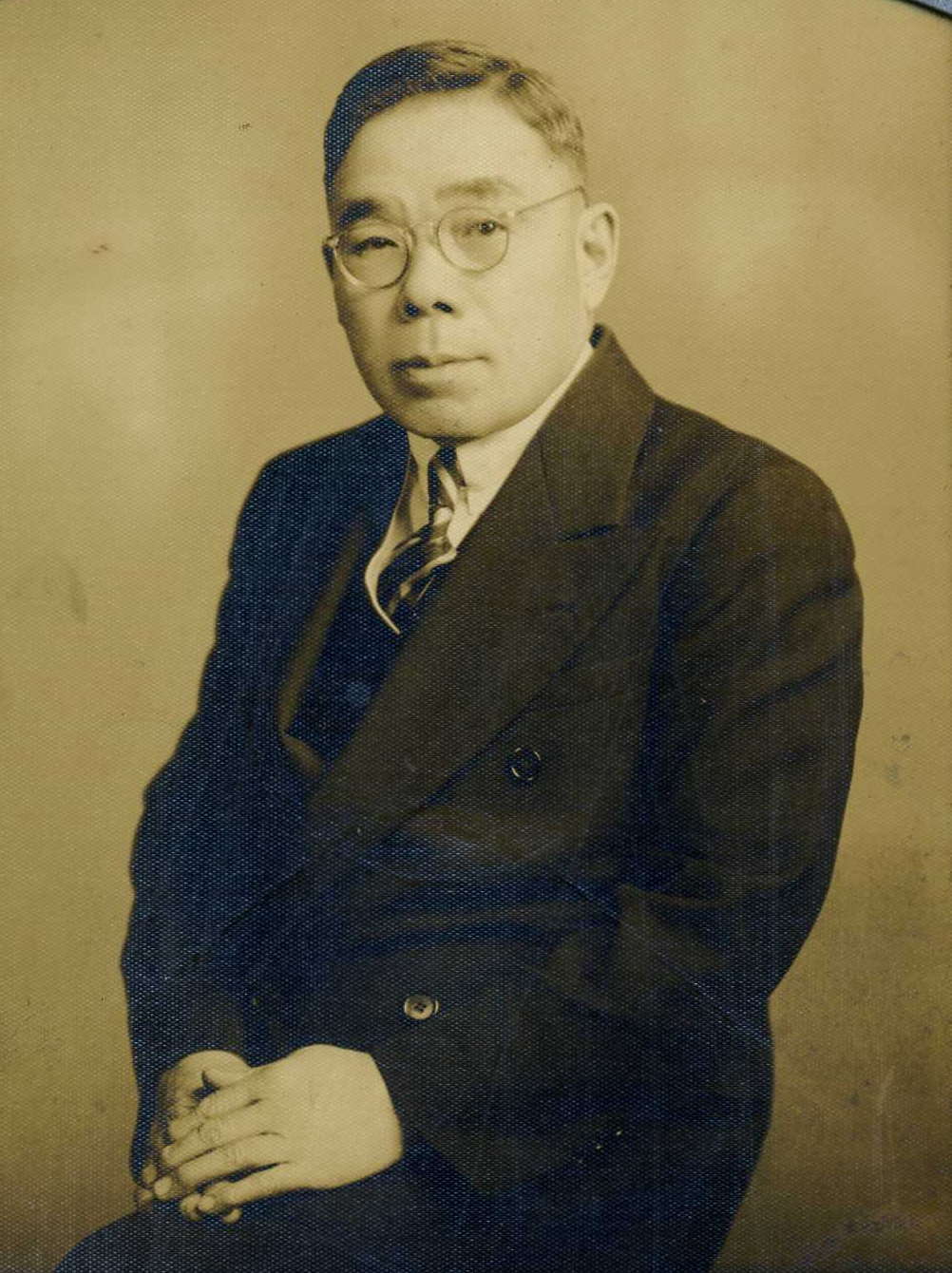
Jujiro Wada, 23 years old
There are many strange and unusual stories in the annals of northern sled dog travel, but one of the most fascinating concerns an enigmatic Japanese explorer and adventurer named Jujiro Wada. Born in Japan in the 1870s, the second son of a lower-class samurai warrior, he traveled to the U.S. in 1890 and worked as a cabin boy for the Pacific Steam Whaling Company and at Barrow for the renowned Charlie Brower, manager of the Cape Smythe Whaling and Trading Company, which history buffs agree was probably where he learned to handle sled dogs and began learning the Alaska Native languages.
Jujiro Wada was with E.T. Barnette when the businessman landed at what is now the site of Fairbanks. Hearing about the recent gold strikes nearby, Barnette dispatched Wada up the Yukon River with one of his own dogteams, taking the first news of the strikes to the miners at Dawson City. Wada drove Barnette’s team into Dawson City on Dec. 28, 1902, and upon interviewing him the Yukon Sun printed a front-page story with the bold headline, “Rich Strike Made in the Tanana.”
Several hundred miners quickly left Dawson City for Fairbanks, but most were disappointed to find the best sites were already staked. As the story goes, an angry mob gathered at Barnette’s store and threatened violence against both Barnette and Wada. An article in the Dawson Daily News, July 8, 1912, mentioned Wada’s legendary predicament:
Jujiro Wada and his dogs, Dawson City
“Jujiro Wada, the mushing Jap who brought the first news of the Fairbanks strike to Dawson, and has made numerous other trips in the North, recently blew into Fairbanks again with a new story about the placer country of Western Alaska. The Times says: Ten years in a placer camp is a long, long time, more than five or ten times that number of years in an older community, where things move more slowly and the population does not come and go with such kaleidoscopic changes. Thus, the return of Jujiro Wada to Fairbanks might be likened almost to the return of one of the Pilgrim fathers to Plymouth, in point of the changes that have taken place in Fairbanks and the generations (placer camp generations) that have come and gone since he first visited the section and then mushed overland to Dawson ten years ago, with the news that caused the Fairbanks stampede. True, when the Dawsonites moved over the winter trail and viewed Felix Pedro’s strike the majority of them were in favor of hanging Wada, but the hardy little brown musher has since been vindicated. His estimate of the camp was the correct one, and those of that first stampede who remained have mostly prospered. Thus is always gives him much satisfaction to drop back to Fairbanks and view the progress.”
Five years earlier, however, in a Dawson Daily News article dated September 1907, Wada had already explained what actually happened:
“The story that I was about to be hanged for causing a thought-to-be-fake stampede was not correct. The fact is that the miners held a meeting to decide as to the price of flour then being offered by one of the trading companies. They thought the price exorbitant. It was rumored that the miners had a rope on my neck, and were about to hoist me. Now that is not true. The other part of the story, that I showed a copy of the (Seattle) Post-Intelligencer saying that several years before I had rescued a party of shipwrecked whalers in the Arctic in dead of winter is true. I did show that paper to let some of the boys know I had been up North, but it was not in a plea to save my neck.”
Jujiro Wada, ready for the trail
For many years Jujiro Wada traveled widely across northern Alaska, the Yukon Territory, and beyond, leading an adventurous life and leaving his mark on the history of the north country. His exploits were the stuff of legend, as he traveled by dog team, hunting, trapping, prospecting, running marathons, and entertaining people wherever he went with his colorful stories. On one of his epic dog mushing trips he travelled from the headwaters of the Chandalar River to the Arctic Ocean, along the shore of the ocean to the Mackenzie River, and up that river and across the divide to the Porcupine River, taking more than a year, he and his dogs living on game hunted along the way.
Another of Wada’s lasting contributions to Alaskan history was helping to pioneer the Iditarod Trail after several gold strikes were made in the Iditarod area, although in most accounts of Wada’s travels the trip appears as something of a footnote to his other adventures. In a summary of Yuji Tani’s 1995 book, “The Samurai Dog-Musher Under the Northern Lights,” Fumi Torigai, who was documenting Wada’s travels for submission to the Historic Sites and Monuments Board of Parks Canada, wrote:
“In December of 1909, at the request of the town, Wada established a route from Seward to the newly discovered gold mine of Iditarod. Acting as the leader of a fleet of dogsled teams, Wada had a relatively uneventful trip to Iditarod. However, on the return trip to Seward, he and his three companions had to go through prolonged minus 60 F (minus 51 C) weather. Several dogs, including his lead-dog, became too weak to survive the extreme cold and had to be put to sleep. The hardships of Wada and his companions and the ensuing rush of prospectors into the Iditarod area were widely reported in many Alaskan papers.”
The Seward Museum has a marvelous three-part video series online telling the story of the Iditarod Trail expedition of Jujiro Wada in newspaper articles read by Lee Poleske, president of the Resurrection Bay Historical Society. Recorded earlier this year as part of the Iditarod Trail Centennial celebration, the free video series is fun and informative for all ages, and brings to light some of the history of this little-known Alaskan wanderer.
“An interesting and perhaps controversial question remains: Why don’t we know more about this remarkable individual? His feats and tenacity are exemplary although detractors question some of his motives and willingness to be manipulated by people like E.T. Barnette. Wada wished to become a U.S. citizen so he could own land and stake claims, but his application was denied. Later, during World War I he was accused of being a Japanese spy, but those charges were not confirmed.
“The newspaper accounts of those times, as now, are selective, likely reflecting the socio-economic conditions and attitudes of that era. Whereas Northerners then as now accept most individuals based on individual abilities, it has not always been so by federal standards. Alaska Natives were only accorded U.S. citizenship in 1915, and then only provisionally. Until 1922, non-whites weren’t allowed citizenship through naturalization. These factors might have obscured the presence and exploits of individuals like Wada.”
Jujiro Wada, 60 years old
The 2007 Yukon Quest honored Wada with an exhibit of his achievements in the north. The official press release read in part:
“‘Mr. Wada traveled by dog team along what is now the Yukon Quest Trail over 100 years ago when it was a traditional travel route. He learned his survival skills and travel routes through the assistance of the aboriginal people in the north,’ said Lillian Nakamura Maguire, educator for the Yukon Human Rights Commission. ”‘He was respected for his hardiness, dog care and good character, although, as a Japanese man he experienced racism due to the strong anti-Asian sentiments in the early 1900s,’ Nakamura Maguire said.
“‘The Yukon Quest is dedicated to honouring the traditions of travel by dog team in the North and the equal treatment of all dogs and people taking part in the race. Mr. Wada embodied the love and respect for his dogs that is one of the founding principles of the Yukon Quest,’ said Stephen Reynolds, Yukon Quest (Canada) Executive Director. ‘We are honoured to help bring Jujiro Wada’s incredible story to the world.’”
Wada, who promoted many mining ventures, traveled great distances across Alaska by dog team. He also helped blaze the trail from Seward to Iditarod.
In 1912, the News-Miner took note of the rocky reception given to Wada in early 1903.
“True, when the Dawsonites moved over the winter trail and viewed Felix Pedro’s strike the majority of them were in favor of hanging Wada, but the hardy little brown musher has since been vindicated. His estimate of the camp was the correct one and those of that first stampede who remained have mostly prospered.”
Wada had good times and bad, always sending money back to support his mother in Japan. He died broke in 1937 in San Diego and was buried in an unmarked grave.
A monument to him in Japan in Matsuyama City, established in 2007, celebrates the high points of his life.
This story is excerpted from the book Alaskan Sled Dog Tales, by Helen Hegener, published May 14, 2016, by Northern Light Media. $24.95 plus $5.00 shipping & handling. 320 pages, 6′ x 9″ b/w format, includes maps, charts, bibliography, indexed. Click this link to order.
Share this page with your friends through social media:
Seppala House Restoration Project. Left to Right: Jona Van Zyle, Media Director; Richard Benneville, Mayor of Nome; Urtha Lenharr, President; Martha Ethridge, Sec/Treasurer; Jon Van Zyle, Vice-President.
The Seppala House Project STILL needs funds for moving and restoration, please donate generously:
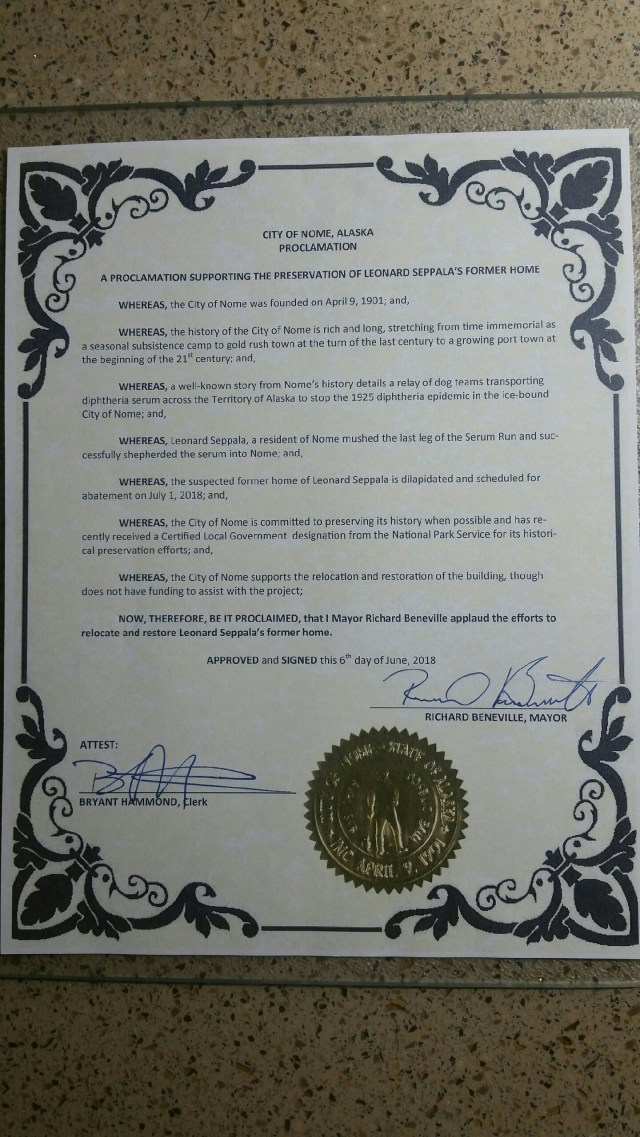
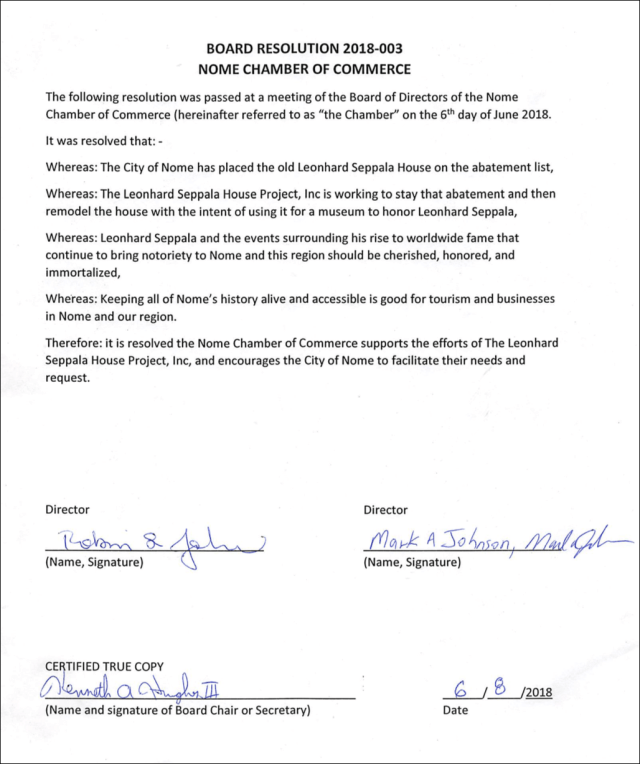
The Leonhard Seppala House Restoration Project is an effort to save what many believe to be a key piece of Alaskan history, the home of a legendary musher, three-time champion of the All Alaska Sweepstakes, who played a central role in saving the town of Nome during the 1925 diphtheria epidemic. A KNOM article details the story behind the restoration effort, spearheaded by former Nome teacher Urtha Lenharr.
Saving the one-time home of Leonard Seppala is no easy task, but the project has the support of another Alaskan legend, the official Iditarod artist Jon Van Zyle, who serves as the project’s vice-president. On the project’s Facebook page Jon outlines the urgency of securing enough donations to move the house outside of town by July 1st: “Please DONATE (any amount) to help save his home in Nome, before the city of Nome destroys it. We are saving it and creating a small museum to honor his legacy.”
22. LEONARD SEPPALA HOUSE, BERING STREET, SOUTH OF SECOND STREET, ON EAST SIDE, LOOKING NORTHEAST – City of Nome, Nome, Nome Census Area, AK. HABS AK,14-NOME,2–22
In May, 1981 the Historic American Buildings Survey (HABS) photographer Jet Lowe included the Seppala House in an index of 34 photos taken for the Historic American Landscapes Survey of the City of Nome, part of the nation’s first federal preservation program, begun in 1933 to document America’s architectural heritage.
Also included in the HABS Index were the Eric Lindblom cabin, the Sally Carrighar house, the Darling-Scott house, and the Carrie McLain house, among many other landmarks of Nome. The photographs were transmitted to the Library of Congress in 1985.
The Seppala House project needs funding for the move and the restoration, and those behind the effort are hoping sled dog clubs and historic associations will make donations to assist the project supporters in reaching the goal of $5,000 before the July 1 deadline. They need everyone’s help in spreading the word, to save this historic house at the end of the Iditarod Trail.
To guide and finance the project, Lenharr has established a non-profit with a seven-member board of directors. They are currently fundraising and doing research for the restoration. Lenharr says he hopes to have the house fully repaired within a year.
“It’s just a part of history that we hate to see torn back down and destroyed,” Lenharr said. “The city of Nome wants to get rid of some of the houses that are vacant because they are fire hazards.”
The small blue house at 207 Bering St. is associated in local lore with Leonhard Seppala, a Norwegian dog musher who played a pivotal part in the 1925 serum run to Nome during a diphtheria outbreak.
Welcome to the new Northern Light Media website, designed for easier access to the books I publish and a cleaner, clearer, and more compelling layout! I have revised how books are ordered, changed the sidebar, and reworked the tone and feel of the entire site to better showcase my books and share my love of Alaska’s history.
I have incorporated my new compass rose logo for Northern Light Media into the redesign (see the header above), and I hope you like this original graphic as much as I do!
Most of my long-time readers are familiar with the historic stained glass dog team logo which has graced my website since 2007. I loved that image, and even wrote a book about the history of it, but my research work and publishing have moved beyond a focus on sled dogs, and I think the new compass rose logo portrays a broader perspective and speaks to my work more accurately.
Share this page with your friends through social media:
“There were possibilities of an extensive business at this place for at least three years, as I saw it, and now I would be needing a dog team and dog kennels, a place for harnesses and a small building in which to cook dog food. On the mountain above the lodge I cut logs for the kennels and the cookhouse.” ~Nellie Neal Lawing in her autobiography, Alaska Nellie
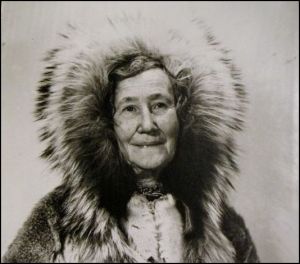
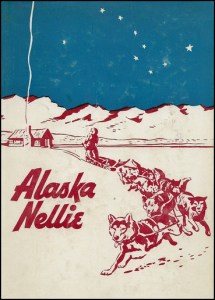
Nellie Neal Lawing, familiar to Alaskans as “Alaska Nellie,” lived a life much larger than most, even by Alaskan standards. She was a fisherman, a hunter, a trapper, a cook and a roadhouse keeper; she fed the crews building the Alaska Railroad, welcomed princes and presidents into her home, guided big game hunters and developed an impressive trophy collection of her own. She mushed a dog team, kept a pet bear cub, became famous for her strawberry pies, and saw a movie made about her adventures. She was one of a kind, an Alaskan original, and she lived life to the fullest.
Nellie arrived in Seward on July 3, 1915, just as construction of the Alaska Railroad was getting underway. She wrote in her autobiography, Alaska Nellie, that she set out to seek a contract “to run the eating houses on the southern end of the Alaska Railroad,” and she described her effort: “On my first time out on an Alaskan trail, I had walked one hundred fifty miles and as usual was alone. This accomplishment, in itself, might have satisfied some, but I was out here in this great new country to contribute something to others, and I felt this means could best be served by becoming the ‘Fred Harvey’ of the government railroad in Alaska.”
Nellie’s early life is succinctly described in an article written by Lezlie Murray, Visitor Services Director, Chugach National Forest, and published in Fall 2011 issue of SourDough Notes:
“The oldest of 12 children, Nellie Trosper was born into a farm family in Saint Joseph, Mo., where she dreamed of coming to Alaska. As a young child she learned to trap and hunt in the countryside around her parent’s farm, becoming a good shot and capable woods woman. She left home in her late twenties after she had helped to raise her brothers and sisters and could be spared. A diminutive woman barely five feet tall, Nellie began to work her way to Alaska in 1901, stair-stepping her way through the west. She spent the most time in Cripple Creek, Colorado, where she worked at a variety of jobs, owned her own hotel and married a prominent assayer. Unhappy in her marriage due to abuse at home, she made the decision to divorce and moved on to California, where she booked steerage to Seward, Alaska.”
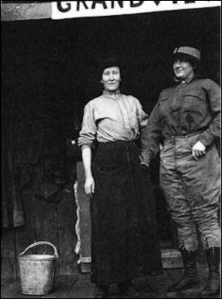
Nellie Neal with a mannequin on porch of the Grandview Roadhouse, 1915
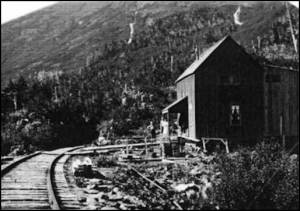
Likely due in part to her plucky approach, she was awarded a lucrative government contract to run a roadhouse at mile 44.9, a scenic location she promptly named Grandview. Her agreement with the Alaska Engineering Commission was to provide food and lodging for the government employees; her skill with a rifle filled out the menu, and her gifted storytelling kept her guests highly entertained. Nellie described the accommodations at Grandview in her book, ‘Alaska Nellie’:
“The house was small but comfortable. A large room with thirteen bunks, used as sleeping quarters for the men, was just above the dining room. A small room above the kitchen served as my quarters. To the rear of the building a stream of clear, cold water flowed down from the mountain and was piped into the kitchen. Nature was surely in a lavish mood when she created the beauty of the surroundings of this place. The timber-clad mountains, the flower-dotted valley, the irresistible charm of the continuous stretches of mountains and valleys was something in which to revel.”
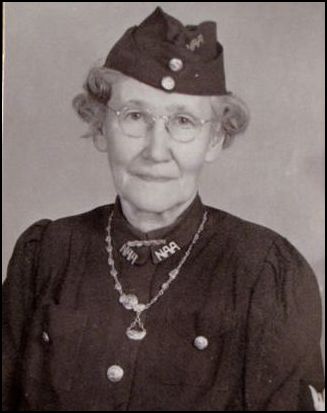
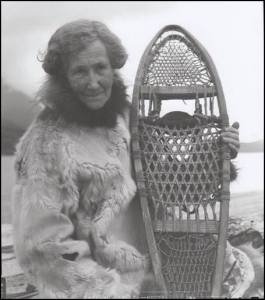
Nellie in her later years, with her treasured gold nugget necklace
Wiry and independent, Nellie was an excellent shot and a respected big game guide, and she rapidly accumulated an impressive array of wildlife trophies. She maintained a dog team in winter, and trapped along the corridor which would later become the Seward Highway. Once during a blizzard the local contract mail carrier, Henry Collman, didn’t arrive when he was expected, so Nellie hitched up her dog team and set out to find him. She located the mail carrier badly frozen in an area which had claimed several lives. Nellie took the young man back to her roadhouse to warm up, and then set off to finish delivering his mail sacks and pouches, which she later learned contained valuable goods, to the waiting train. For her courageous efforts the town of Seward declared her a hero and awarded her a gold nugget necklace, with a diamond set in its large pendant nugget. Nellie treasured her necklace to the end of her days.
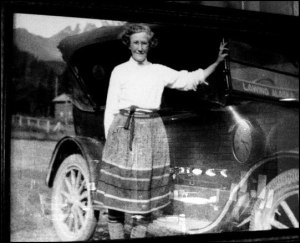
Nellie Neal
Nellie tells another dog team story in her book: “One cold winter day in December when the daylight was only a matter of minutes and the lamps were burning low, two U.S. marshals, Marshals Cavanaugh and Irwin, together with Jack Haley and Bob Griffiths, arrived at the roadhouse.
“The heavy wooden boxes they were removing from their sleds had been brought from the Iditarod mining district. They contained $750,000 in gold bullion.
“‘Where do you want to put this, Nellie?’ called the men, carrying their precious burden.
“‘Right here under the dining room table is as good a place as any,’ I answered.
And it was as simple as that. There it stayed until the men carried it back to the sleds, next day. They were able to go to sleep, for it was as safe right there in my dining room as it would have been in the United States Mint. No one would dare to touch it.”
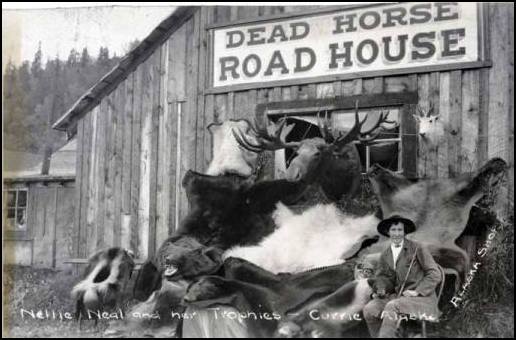
Nellie and her trophies in front of the Dead Horse Road House
As work on the government railroad progressed, Nellie moved north and operated a roadhouse near the Susitna River, at a railroad camp known as Dead Horse. Because Dead Horse Hill was such a key location in the construction of the Alaska Railroad, a large roadhouse was built at the site in 1917 to accommodate the construction workers, officials, and occasional visitors. Management of the new roadhouse was given to the intrepid roadhouse keeper who had proven herself at Grandview.
Nellie took on running the Dead Horse Roadhouse with all the pluck and dedication she’d shown at Grandview, cooking meals on two large ranges for the dining room which seated 125 hungry workers at a time, and filling 60 lunch-buckets each night for the construction crews to take on their jobs the following day. In her autobiography she wrote, “I dished out as many as 12,000 to 14,000 meals per month, having two cooks, two waitresses and several yard men as help.”
In his book about the era and the area, Lavish Silence, Kenneth Marsh described the roadhouse accommodations: “…spring-less wooden bunks, straw mattresses and oil- drum wood-burning stove, all in one large room at the top of a flight of rickety stairs, held together by a warped wooden shell (which, at times, put up an uneven fight against the elements).”
In July, 1923, President Harding, his wife, and Secretary of State Herbert Hoover stayed at the Dead Horse Roadhouse on their way to the Golden Spike-driving ceremony at Nenana. The next morning Nellie served heaping plates of sourdough pancakes in her warm kitchen, commenting, “Presidents of the United States like to be comfortable when they eat, just like anyone else!”
“Before the Curry Hotel was built, Curry featured a famous old building called the Dead Horse Roadhouse. The proprietor was the famous Alaska Nellie, who was known for her incredible cooking abilities and extraordinary hunting skills. It is said she killed the largest grizzly bear ever seen at that time.” ~Steve Mahay, in The Legend of River Mahay
Nellie’s last home, on Kenai Lake
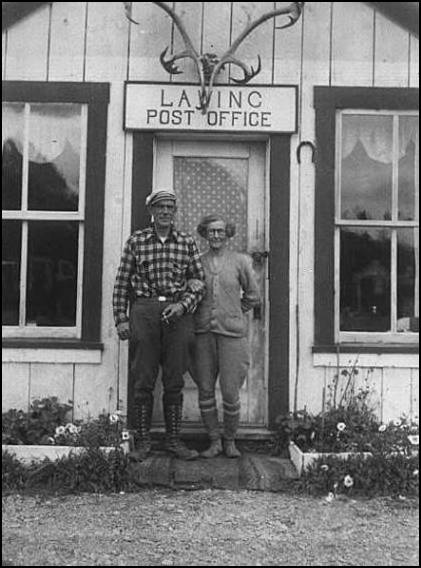
Finally in 1923, Nellie used her life’s savings to purchase her final home, a roadhouse on Kenai Lake. The railroad stop along the blue-green waters was renamed Lawing when Nellie Neal married Bill Lawing, and together they built the roadhouse into a popular tourist stop on the Alaska Railroad. Vegetables from Nellie’s garden were served with fresh fish from the lake or with game from the nearby hills, and Nellie’s stories, often embellished with her rollicking tall tales, kept her audiences delighted. Celebrities, politicians, tourists and even locals came to enjoy the purely Alaskan hospitality at the Lawings’ roadhouse on Kenai Lake.
Alaska Nellie became known far and wide, and the foreword to a 2010 reprinting of her autobiographical book, “Alaska Nellie,” by Patricia A. Heim, sums up her legendary status:
“Nellie Neal Lawing was one of Alaska’s most charismatic, admired and famous pioneers. She was the first woman ever hired by the U.S. Government in Alaska in 1916. She was contracted to feed the hungry crews on the long awaited Alaska railroad connecting Seward to Anchorage. The conditions were harsh and supplies were limited. She delivered many of her meals by dogsled, fighting off moose attacks and hazards of the trail, often during below-zero blizzards. She always brought with her a great tale to tell of her adventures along the trail, how she had wrestled grizzlies, fought off wolves and moose, and caught the worlds largest salmon for their dinner, always in the old sourdough tradition. The workers listened and laughed with every bite.
“Nellie was an excellent cook, big game hunter, river guide, trail blazer, gold miner, and a great story-teller! It wasn’t long before Nellie became legendary and was known far and wide as the female ‘Davy Crockett’ of Alaska, her wilderness adventures and stories of survival on the trail spread like wildfire. Letters addressed simply ‘Nellie, Alaska’ were always delivered.
Nellie at her Kenai Lake cabin
“Nellie finally established herself at “Lawing, Alaska” on Kenai Lake, and converted an old roadhouse into a museum for her multitude of big game trophies. It was a great railroad stop and the highlight of any Alaskan visit. Her guest register of over 15,000 read like the Who’s Who of the early twentieth century: two U.S. Presidents, the Prince of Bulgaria, Will Rogers, authors, generals and many silent-screen movie stars.
“Nellie would entertain them all. Colt pistol on her hip and a baby black bear by her side, Nellie was always ready with one of her outrageous tales of adventure. ‘I was just minding my own business on Kenai Lake when a huge grizzly showed up, I fired my Colt, but as luck would have it, somehow, it misfired, I then had to kick the heck out of the brute and he ran off, but before he ran off he bit me good, right on the wrist, see here.’ She would then fold back her sleeve to show a scarred arm.
“Nellie was so popular and loved that she was honored with an “Alaska Nellie Day” on January 21, 1956.”
Bill and Nellie Lawing at their cabin beside Kenai Lake.
Nellie’s happiest days were spent with the love of her life, Bill Lawing, in their log cabin on the shores of beautiful Kenai Lake. She fondly mentions it in the opening paragraph of her autobiography, ‘Alaska Nellie’:
“Glancing out through an open window of a large log home on the shores of Kenai Lake at Lawing, Alaska, the rippling waves had become glittering jewels in the full moonlight of a summer’s night.
Mountains covered with evergreen trees and crowned with snow were reflected in the mirror-like water of Kenai Lake. Was I dreaming, or was the curtain of the past rolling up, so that I might glance back over twenty-four years spent in the great North-land and say, ‘No regrets.'”
In 1939 a short movie clip, ‘The Land of Alaska Nellie,’ was produced by Metro-Goldwyn-Mayer Studios:
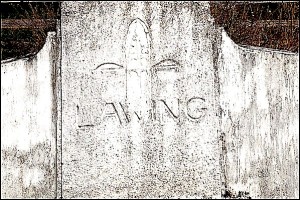
Alaska Nellie’s grave is in the city cemetery in Seward, Alaska, a pretty place at the base of the mountains, guarded by towering Sitka spruce trees. Her gravestone bears the image of a pineapple, a symbol of hospitality which began with the sea captains of New England, who sailed among the Caribbean Islands and returned bearing cargos of fruits, spices and rum.
According to tradition in the Caribbean, the pineapple symbolized hospitality, and sea captains learned they were welcome if a pineapple was placed by the entrance to a village. At home, the captain would impale a pineapple on a post near his home to signal friends he’d returned safely from the sea, and would receive visits. As the tradition grew popular, innkeepers added the pineapple to their signs and advertisements, and the symbol for hospitality was further secured as needle-workers preserved the image in family heirlooms such as tablecloths, doilies, potholders, door knockers, curtain finials and more. It seems a fitting final tribute to a legendary hostess of the north.
Nellie Lawing’s property on Kenai Lake, 1938.
For more information about Alaska Nellie, including resources for further reading and research and photos of her homesite in Lawing taken in recent years, visit the author’s website: Alaska Nellie | The Story of Nellie Neal Lawing
Share this page with your friends through social media:
Charting an unknown country, exploring a wondrous land, searching for gold, delivering freight and mail beyond where any roads would reach, these were the exciting topics of books which became northland classics, with titles such as Ten Thousand Miles with a Dog Sled, The Land of Tomorrow, and Along Alaska’s Great River.
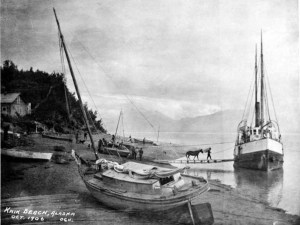
Wonderful photographs accompany the often colorful writings of Frederick Schwatka, Hudson Stuck, Robert Service, Josiah Edward Spurr, and many others as they tell of adventures, explorations, fortunes won and lost, and the magnificent promise of our great northern lands. Read the words of those intrepid travelers who accepted the challenge of the north and left an indelible mark in their writing of it. Their first-hand observations are invaluable to understanding the history, as when world traveller Frank Carpenter noted while touring the construction of the Alaska Railroad: “I was so fortunate as to see Anchorage in the stump, tent, and shack stage, though it was growing marvelously fast. I give you my notes just as I penned them when I was on the spot, seeing how Uncle Sam’s engineers and executives were putting through their big job.”
Selected excerpts are from the following books:
• Golden Alaska, by Ernest Ingersoll
• The Land of Tomorrow, by William B. Stephenson, Jr.
• The Spell of the Yukon & Other Verses, by Robert Service
• The Ascent of Denali, by Hudson Stuck
• From Paris to New York by Land, by Harry DeWindt
• Through the Yukon Gold Diggings, by Josiah Edward Spurr
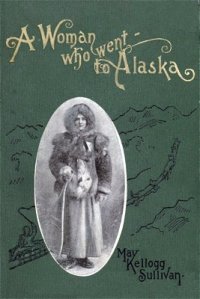
• A Woman Who Went––To Alaska, by May Kellogg Sullivan
• The Land of Nome, by Lanier McKee
• Ten Thousand Miles with a Dog Sled, by Hudson Stuck
• Along Alaska’s Great River, by Frederick Schwatka
• Alaska: Our Northern Wonderland, by Frank Carpenter
• A Dog-Puncher on the Yukon, by Arthur Treadwell Walden
Alaskan author Helen Hegener has compiled an engaging journey through the literary history of Alaska and the Klondike, and an introduction to some of the most compelling books ever written about the North.
The Kindle edition of this 2018 book is formatted as a print replica Kindle book, which maintains the rich formatting and layout of the print edition, while offering many of the advantages of standard Kindle books. Features include a pop-out and linked table of contents, page numbers matching the print edition, the ability to zoom in or pan out on a page, and search, copy, and paste features. Visit theKindle store on Amazon to preview a sample of the book or to order your own copy today for only $5.99 (Kindle MatchBook $2.99)!
Share this page with your friends through social media:
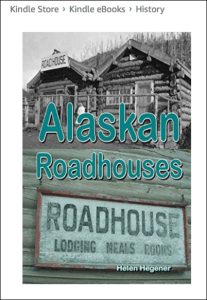
Alaskan Roadhouses: Finding Shelter, Food, and Lodging Along Alaska’s Roads and Trails
Now on Kindle, this book presents historic photos of dozens of individual roadhouses, and along with the colorful histories are first-hand accounts of those who stayed at the roadhouses while traveling the early trails and roads of Alaska, including the Reverend Samuel Hall Young, Frank G. Carpenter, Judge James Wickersham, Leonhard Seppala, Col. Walter L. Goodwin, and Matilda Clark Buller, who opened a roadhouse near Nome in 1901, at the height of the Nome Gold Rush.
From Haly’s Roadhouse at Fort Yukon to the Grandview Roadhouse near Seward, and from the Slana Roadhouse south of Tok to the Deering Roadhouse on Kotzebue Sound, these respected establishments made travel in territorial Alaska possible. From the chapter on the Black Rapids Roadhouse:
“The Orr Stage Company was one of the first businesses to carry passengers and freight over the Valdez-Fairbanks Trail. Rapids Roadhouse was described as a crucial stop for the company’s stages. At the roadhouse, southbound travelers changed from four- and six-horse stages to double-ender sleds pulled by single horses to go over Isabel Pass to Paxson. At some time the roadhouse was said to be a Northern Commericial Company (NCC) store. Later, hunters frequently stayed at the roadhouse. It was described in an early travel guide to the highway as ‘the hunter’s paradise….”
The book is divided into three parts. In Part One are the stories of those who traveled the trails and frequented the roadhouses. Part Two features in-depth histories and photographs of two dozen historic roadhouses. Part Three showcases photographs of another thirty roadhouses, including some rarely seen and hard to find. The References section shares many sources for those who wish to continue researching these historic structures.
The Kindle edition of this 2016 book is formatted as a print replica Kindle book, which maintains the rich formatting and layout of the print edition, while offering many of the advantages of standard Kindle books. Features include a pop-out and linked table of contents, page numbers matching the print edition, the ability to zoom in or pan out on a page, and search, copy, and paste features. Visit theKindle store on Amazon to preview a sample of the book or to order your own copy today for only $5.99 (Kindle MatchBook $2.99)!
CLICK THE LINK ABOVE TO VISIT THE AMAZON KINDLE STORE
Share this page with your friends through social media:
“These trustworthy creatures could be relied upon to do the heavy work, while remaining—as Hegener eloquently reminds us—our most treasured friends.” David Fox, for the Anchorage Press
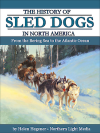
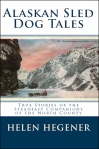
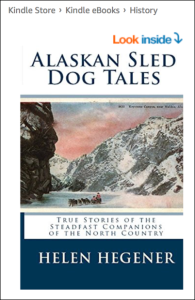
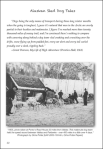
Alaskan Sled Dog Tales, by Helen Hegener, shares the important history of sled dogs in Alaska, highlighting the adventures of legendary mushers such as Leonhard Seppala, Scotty Allan, and ‘Iron Man” Johnson, and explaining how sled dogs were an integral part of historic events such as the 1925 Serum Run to Nome.
True stories include Alaskan mail carrier Eli Smith’s epic trip to Washington, D.C., Alaska Nellie’s daring rescue of a lost mail carrier, the Rev. Samuel Hall Young’s 1913 trip over the Iditarod Trail, and Territorial Judge James Wickersham’s 1901 dogsled trip down the frozen Yukon River from Eagle to Rampart. Fascinating stories of Alaska’s history as seen from the runners of a dogsled, told by the adventurous souls who made the journeys.
Intrepid explorers and trail-blazers are featured, such as Jujiro Wada, Split-the-Wind, Slim Williams, Father Bernard Hubbard, Mary Joyce, Hudson Stuck, Arthur Treadwell Walden, Ernest de Koven Leffingwell, Scotty Allan, and Leonhard Seppala.
The history of mushing is shared through stories of the sled dogs who ran in the 1933 Olympics, sled dogs who aided soldiers in the First World War and were decorated as heroes, and the dog teams which rushed hundreds of miles from Nenana to Nome with life-saving diphtheria antitoxin in 1925!
Leonhard Seppala & Togo
There are splendid images of dog teams on postcards and magazine covers, the tale of how reindeer almost replaced sled dogs as Alaska’s transportation choice, and the entire booklet by Esther Birdsall Darling showcasing The Great Dog Races of Nome.
The Kindle edition of this 2016 book is formatted as a print replica Kindle book, which maintains the rich formatting and layout of the print edition, while offering many of the advantages of standard Kindle books. Features include a pop-out and linked table of contents, page numbers matching the print edition, the ability to zoom in or pan out on a page, and search, copy, and paste features. Visit theKindle store on Amazon to preview a sample of the book or to order your own copy today for only $5.99 (Kindle MatchBook $2.99)!
CLICK THE LINK ABOVE TO VISIT THE AMAZON KINDLE STORE
Share this page with your friends through social media:
“Musher after musher agrees that no one – racers or officials – knew what to expect.” ~Bill Sherwonit in Iditarod: The Great Race to Nome (Alaska Northwest Books, 1991)
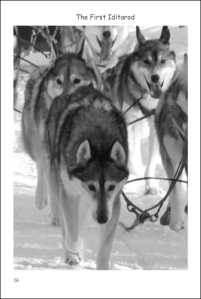
On a cold morning in March, 1973, thirty-six mushers stood at the starting line in Anchorage, Alaska, looking down the trail toward Nome, over 1,000 miles away. No one knew what to expect; nothing of this caliber and magnitude had ever been attempted. Sled dog racing in Alaska, at the time, meant driving fast teams around a sprint course, the longest and most famous of which was merely 25 miles. This race, over 1,000 miles through some of the harshest land imaginable, was something else entirely.
Olaus Murie was a naturalist, author, and awildlife biologist who did groundbreaking field research, wrote in his 1973 book, Journeys to the Far North, (American West Pub. Co; 1973):
“Why do we look back to those days as something precious? Perhaps there was something there we do not yet understand. On those long dog trails, leading through miles of scrubby spruce forest, across lowland flats, over rolling hills, every traveler I met was a friend. We would maneuver our respective dogteams past each other in the narrow trail, plant a foot on the brake, and talk….Nothing weighty, these conversations. We were complete strangers, but in a sparsely settled land each person has more value. You’re glad to see each other. When you release your brake and your dogs perk up and yank the sled loose, you wave a mittened hand to your departing acquaintance with the warm feeling of a few shared moments….”
In 2007 author Helen Hegener set about tracking down and visiting the still-living mushers from the 1973 race who would share their stories, their memories of what it was like to be one of the original pioneers setting out on what has since become known as “The Last Great Race on Earth.” Many of the first mushers had already written their own books, and many others did not reply to inquiries, but the bulk of this book is comprised of the verbatim words of eight mushers who made that first journey to Nome in 1973, captured through recorded and videotaped interviews conducted over a span of several years. They tell a captivating true story of hardship, joy, disappointment, camaraderie, harrowing escapes, and a strong proud undercurrent of knowing they were a part of Alaska’s historic first Iditarod.
“And they still don’t know what happened, because no one’s ever asked us.” ~Ford Reeves, who teamed up with Mike Schreiber to run the 1973 Iditarod
The Kindle edition of this book is formatted as a print replica Kindle book, which maintains the rich formatting and layout of the print edition, while offering many of the advantages of standard Kindle books. Features include a pop-out and linked table of contents, page numbers matching the print edition, the ability to zoom in or pan out on a page, and search, copy, and paste features. Visit theKindle store on Amazonto preview a sample of the book or to order your own copy today for only $5.99 (Kindle MatchBook $2.99)!
VISIT THE LINK ABOVE TO VISIT THE AMAZON KINDLE STORE
Share this page with your friends through social media:

 Trailing and Camping in Alaska, subtitled Ten Years Spent Exploring, Hunting and Prospecting in Alaska – 1898 to 1909, was written in 1909 by Addison M. Powell, an adventurer, prospector, hunter, and a former guide for Captain William R. Abercrombie’s 1898 Copper River Exploring Expedition, which was one of three military expeditions organized under the direction of the Secretary of War with directives for exploring the interior of the new territory of Alaska. Powell’s familiarity with the land made him a valuable addition to Abercrombie’s efforts over the next several years, and brought him into contact with many men who would help to shape the future of Alaska.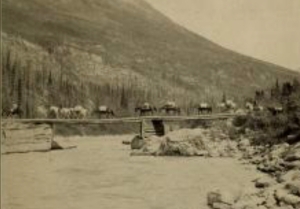



 The Seppala House Project STILL needs funds for moving and restoration, please donate generously:



 I have incorporated my new compass rose logo for Northern Light Media into the redesign (see the header above), and I hope you like this original graphic as much as I do!
 In July, 1923, President Harding, his wife, and Secretary of State Herbert Hoover stayed at the Dead Horse Roadhouse on their way to the Golden Spike-driving ceremony at Nenana. The next morning Nellie served heaping plates of sourdough pancakes in her warm kitchen, commenting, “Presidents of the United States like to be comfortable when they eat, just like anyone else!”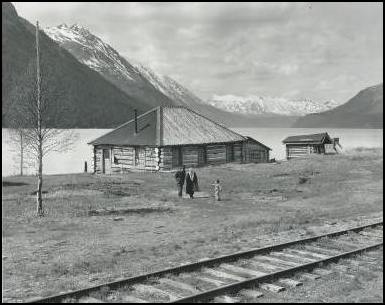
 Alaska Nellie became known far and wide, and the foreword to a 2010 reprinting of her autobiographical book, “Alaska Nellie,” by Patricia A. Heim, sums up her legendary status: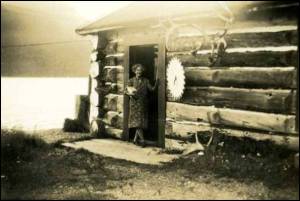
 Alaska Nellie’s grave is in the city cemetery in Seward, Alaska, a pretty place at the base of the mountains, guarded by towering Sitka spruce trees. Her gravestone bears the image of a pineapple, a symbol of hospitality which began with the sea captains of New England, who sailed among the Caribbean Islands and returned bearing cargos of fruits, spices and rum.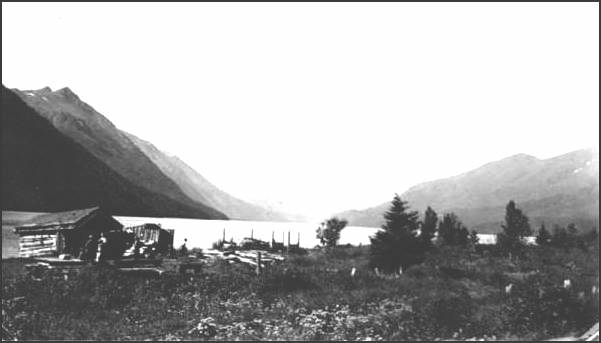

 Wonderful photographs accompany the often colorful writings of Frederick Schwatka, Hudson Stuck, Robert Service, Josiah Edward Spurr, and many others as they tell of adventures, explorations, fortunes won and lost, and the magnificent promise of our great northern lands. Read the words of those intrepid travelers who accepted the challenge of the north and left an indelible mark in their writing of it. Their first-hand observations are invaluable to understanding the history, as when world traveller Frank Carpenter noted while touring the construction of the Alaska Railroad: “I was so fortunate as to see Anchorage in the stump, tent, and shack stage, though it was growing marvelously fast. I give you my notes just as I penned them when I was on the spot, seeing how Uncle Sam’s engineers and executives were putting through their big job.”
 Selected excerpts are from the following books:
 Alaskan author Helen Hegener has compiled an engaging journey through the literary history of Alaska and the Klondike, and an introduction to some of the most compelling books ever written about the North.
 From Haly’s Roadhouse at Fort Yukon to the Grandview Roadhouse near Seward, and from the Slana Roadhouse south of Tok to the Deering Roadhouse on Kotzebue Sound, these respected establishments made travel in territorial Alaska possible. From the chapter on the Black Rapids Roadhouse:
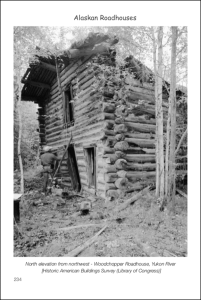 The book is divided into three parts. In Part One are the stories of those who traveled the trails and frequented the roadhouses. Part Two features in-depth histories and photographs of two dozen historic roadhouses. Part Three showcases photographs of another thirty roadhouses, including some rarely seen and hard to find. The References section shares many sources for those who wish to continue researching these historic structures.
 “These trustworthy creatures could be relied upon to do the heavy work, while remaining—as Hegener eloquently reminds us—our most treasured friends.” David Fox, for the Anchorage Press
 True stories include Alaskan mail carrier Eli Smith’s epic trip to Washington, D.C., Alaska Nellie’s daring rescue of a lost mail carrier, the Rev. Samuel Hall Young’s 1913 trip over the Iditarod Trail, and Territorial Judge James Wickersham’s 1901 dogsled trip down the frozen Yukon River from Eagle to Rampart. Fascinating stories of Alaska’s history as seen from the runners of a dogsled, told by the adventurous souls who made the journeys.
 The history of mushing is shared through stories of the sled dogs who ran in the 1933 Olympics, sled dogs who aided soldiers in the First World War and were decorated as heroes, and the dog teams which rushed hundreds of miles from Nenana to Nome with life-saving diphtheria antitoxin in 1925!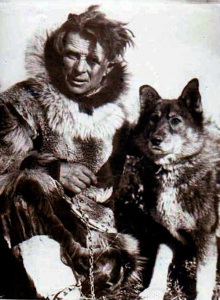

 “Musher after musher agrees that no one – racers or officials – knew what to expect.” ~Bill Sherwonit in Iditarod: The Great Race to Nome (Alaska Northwest Books, 1991)
 Olaus Murie was a naturalist, author, and awildlife biologist who did groundbreaking field research, wrote in his 1973 book, Journeys to the Far North, (American West Pub. Co; 1973):
 In 2007 author Helen Hegener set about tracking down and visiting the still-living mushers from the 1973 race who would share their stories, their memories of what it was like to be one of the original pioneers setting out on what has since become known as “The Last Great Race on Earth.” Many of the first mushers had already written their own books, and many others did not reply to inquiries, but the bulk of this book is comprised of the verbatim words of eight mushers who made that first journey to Nome in 1973, captured through recorded and videotaped interviews conducted over a span of several years. They tell a captivating true story of hardship, joy, disappointment, camaraderie, harrowing escapes, and a strong proud undercurrent of knowing they were a part of Alaska’s historic first Iditarod.