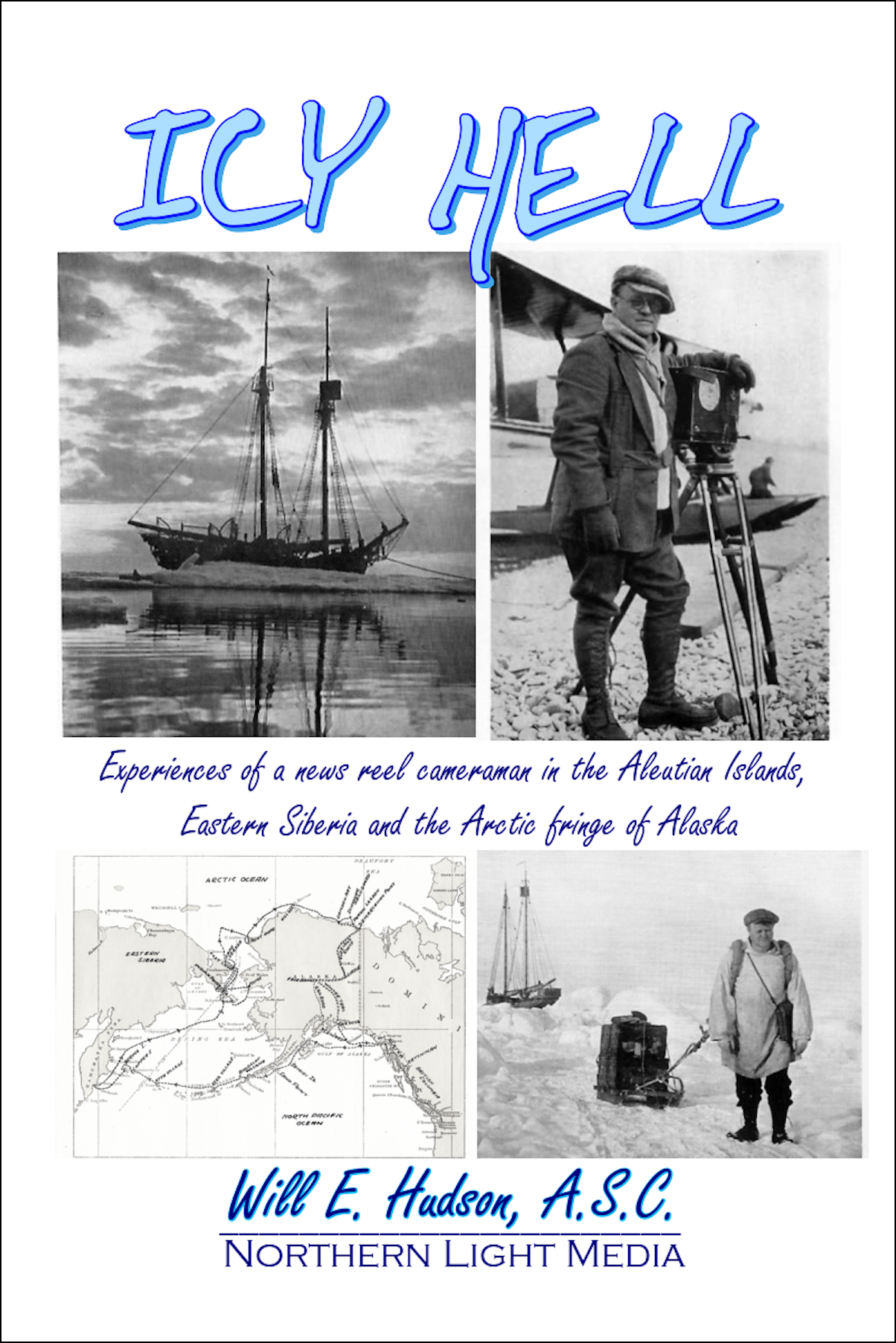
Once again Anchorage Daily News and Fairbanks Daily News-Miner book reviewer David A. James has selected one of my books to share with his readers, and his point-by-point overview of the book is a good roadmap for anyone interested in Arctic travels of the past. The book was written almost a century ago by Will Hudson, a news photographer working for the Seattle Post-Intelligencer, who happens upon the chance to join an Arctic adventure which challenges him to the core, but as James writes: “From start to finish Hudson never loses his enthusiasm nor his humor. This book is a gem.”
The book is Icy Hell: Experiences of a news reel cameraman in the Aleutian Islands, Eastern Siberia, and the Arctic fringe of Alaska, by Will Hudson, A.S.C.; published in June, 2026 by Northern Light Media, first published in 1937.
James: “Hudson’s tale begins nonchalantly enough on the streets of Seattle. In the spring of that fateful year he was working as a news photographer and happened to bump into an acquaintance of his, Captain Louis Lane, who promptly invited him along on a six month trip to Alaska and Siberia. Five days later Hudson sailed off aboard the Polar Bear, unaware of the odyssey that would soon enough follow.”
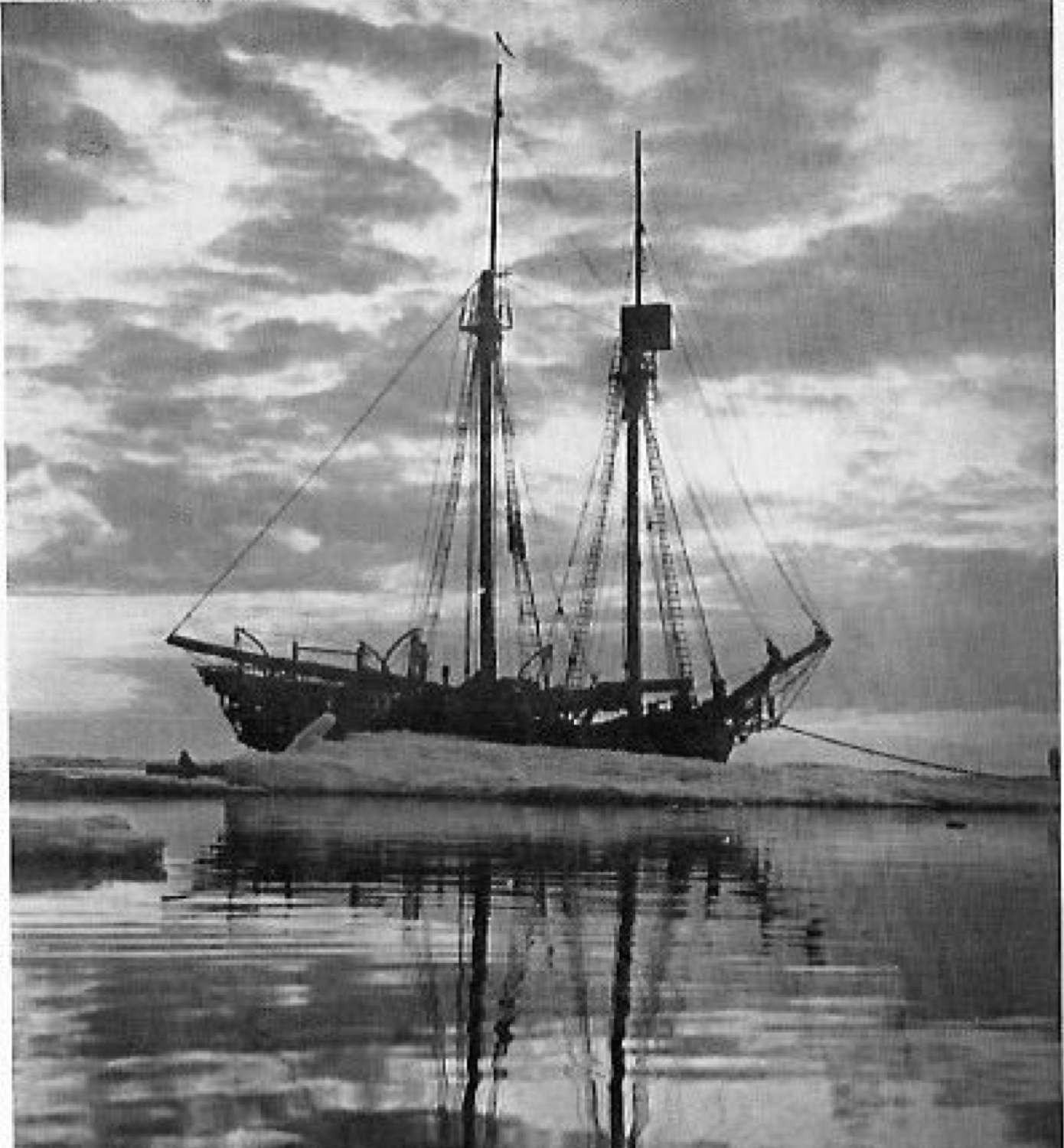
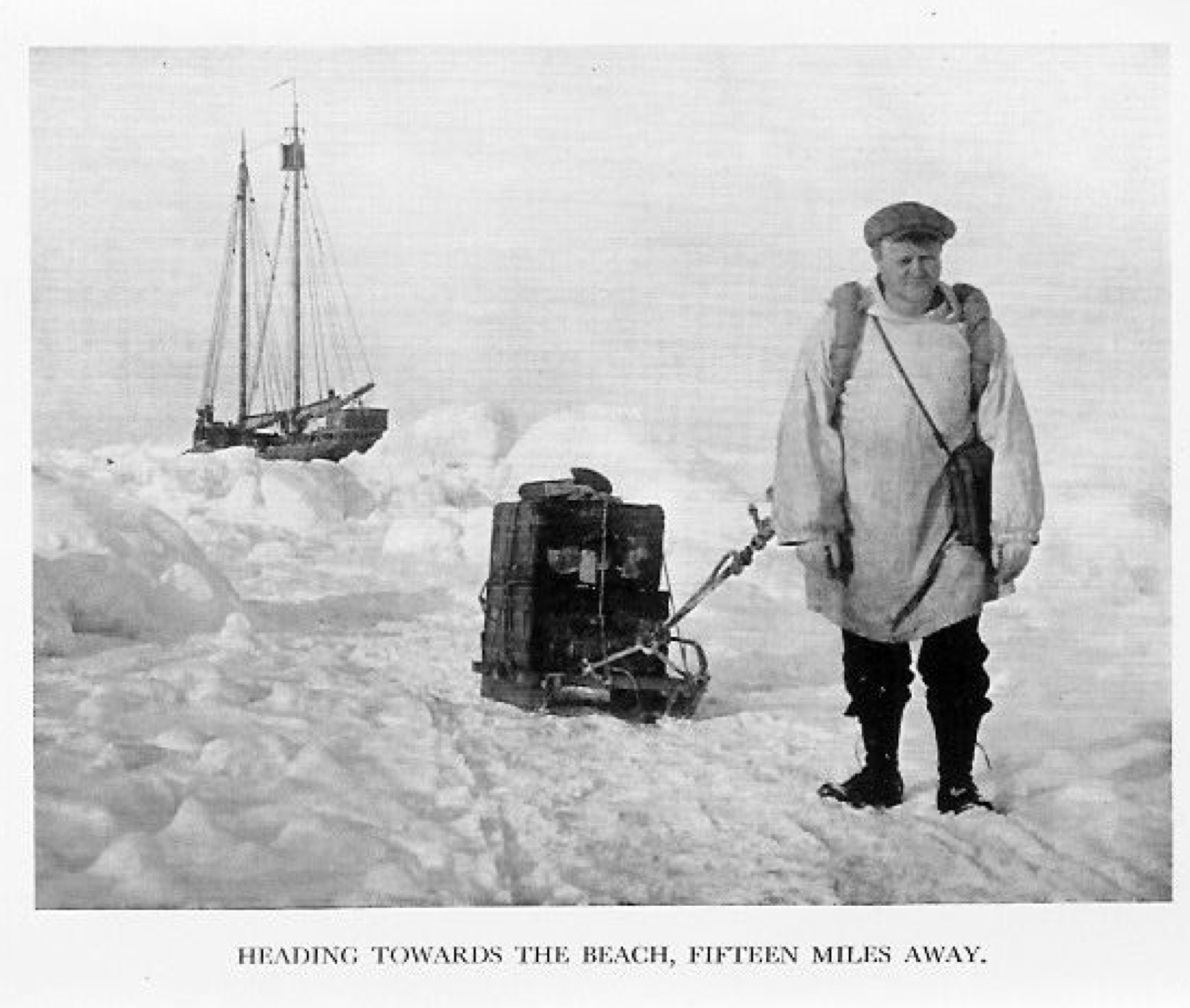
The Polar Bear, a 90’ 81-ton schooner built in 1911 by E. W. Heath Co. of Seattle, had been chartered by a group of college graduates who wanted to go to Alaska to go hunting. The cost of the trip was sponsored by Harvard University, and possibly to justify the expense, the school sent two naturalists along to collect natural history specimens and provide a kind of scientific purpose to the trip. Will Hudson had been invited to come along as the official cinematographer. When the ship was caught by pack ice and forced to overwinter on the exposed coast of northern Alaska, the captain, Hudson, and two other men left the ice-bound ship to be cared for by its capable crew and traveled south with two dog teams, crossing the uncharted Brooks Range.
David James writes: “The final section of the book tells of that adventure. Taking 10 dogs, the quartet, soon accompanied by a young Inuit man as a guide, traversed the Endicott Mountains and dropped into the Interior, fighting ice and ground conditions, inadequate gear, and temperatures as cold as 60 below. It didn’t stop them from observing the beauty however.
“’Great prismatic bands were playing across the skies like giant searchlights,’ Hudson writes of the Aurora.”
As James so rightly notes, “This book is a gem.”
Share this page with your friends through social media:
It’s time for the next issue of Alaskan History Magazine, and Volume 5, Number 5, which will be published September 1st, features a splendid lineup of articles:
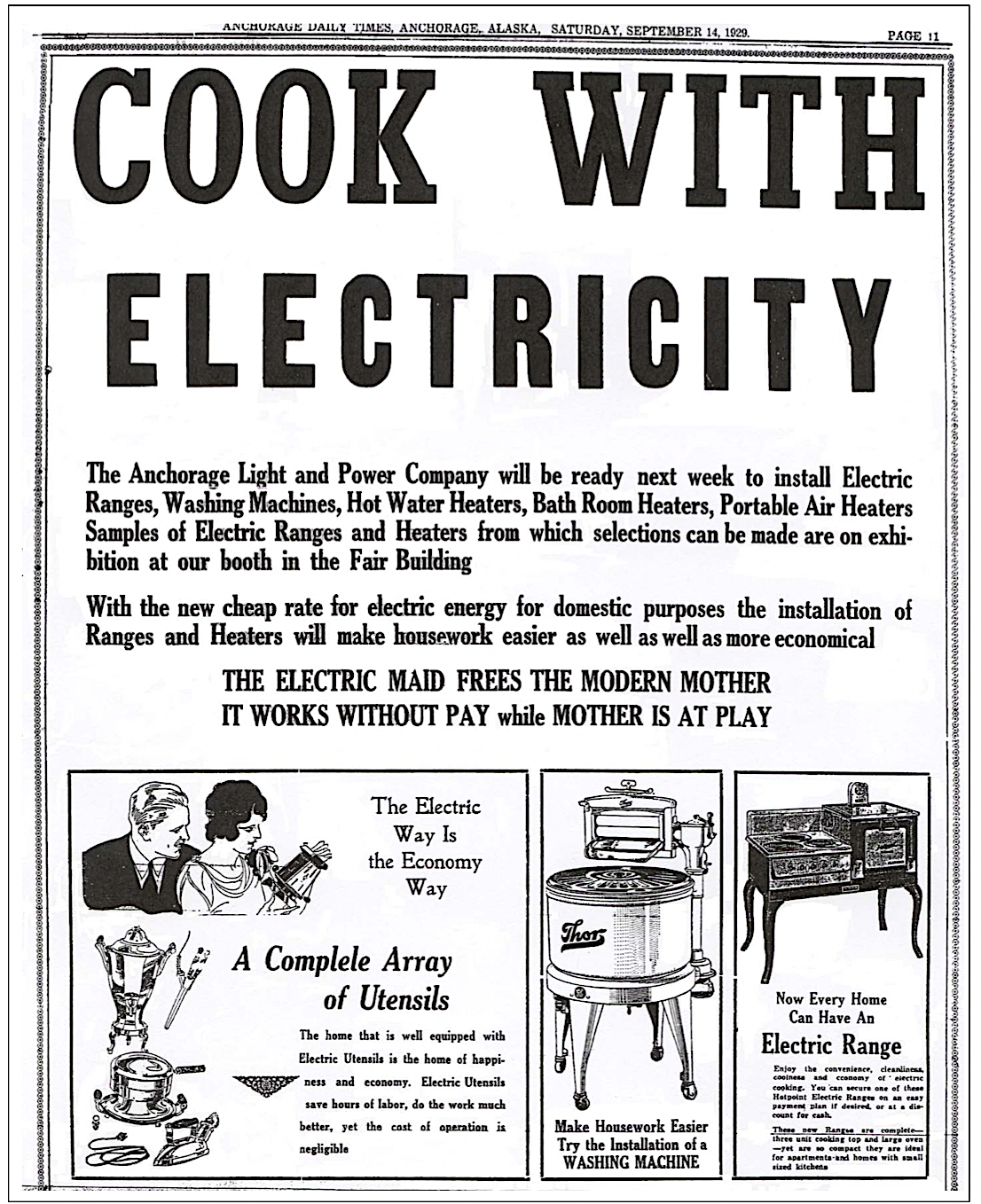
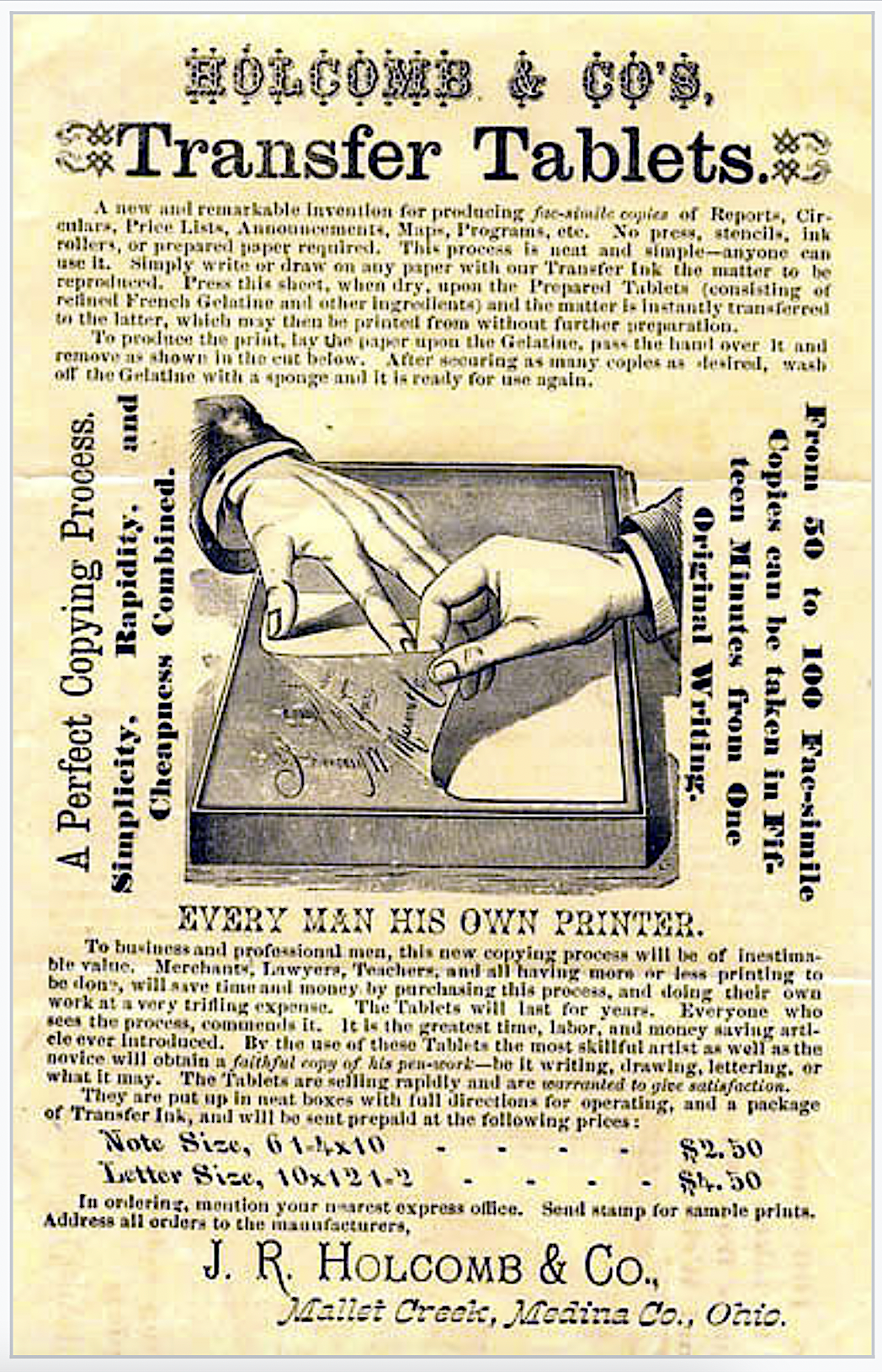
Ad from the Anchorage Daily Times, Sept. 14, 1929 to promote useage of the first Eklutna power plant.
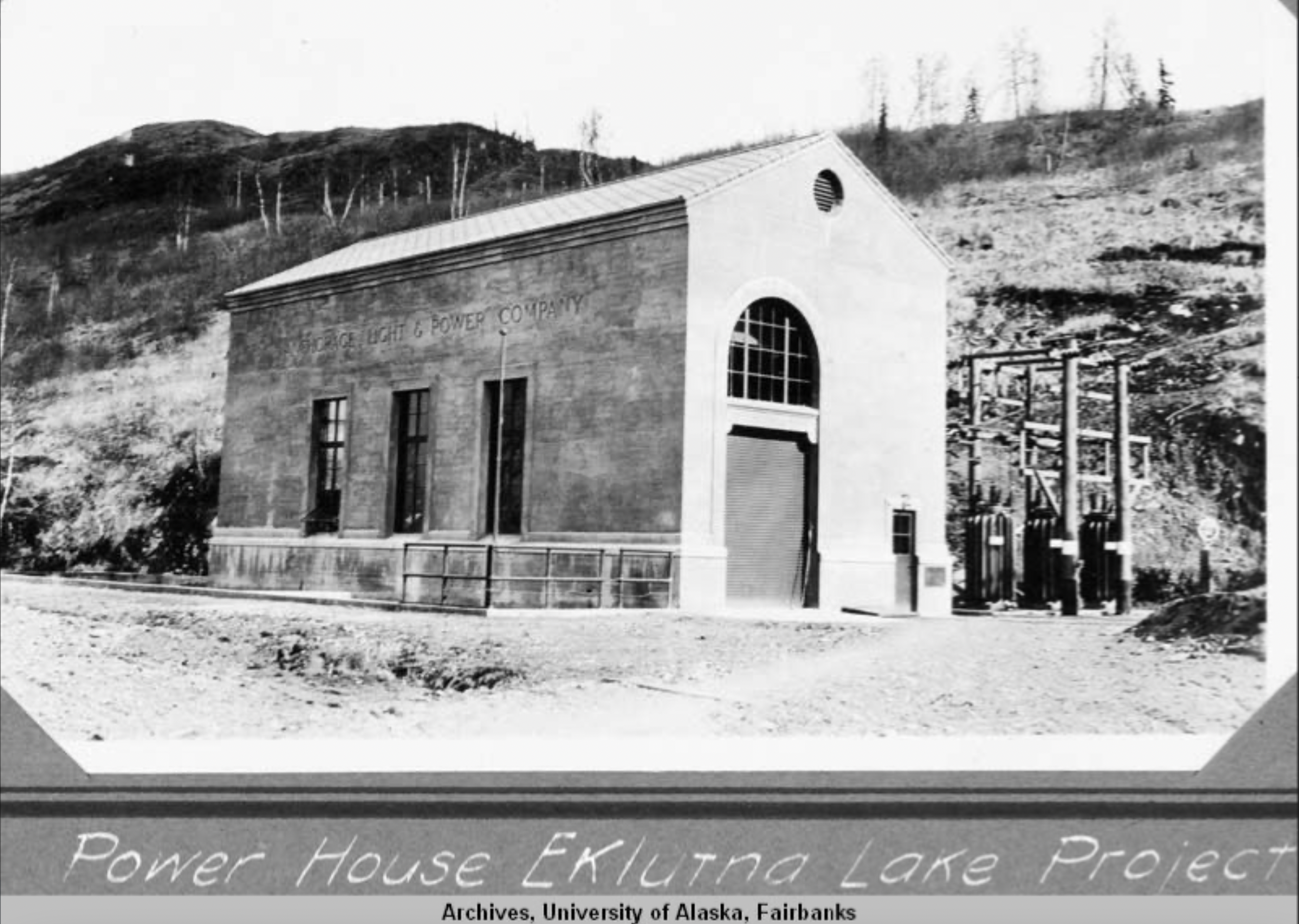
The Eklutna Hydroelectric Project has used the energy of melting glaciers to provide electricity for the Anchorage-Palmer region for almost a century, but decades before the current well-known power plant, Anchorage businessman Frank I. Reed harnessed the power of the Eklutna River by constructing a dam and power plant several miles downriver from Eklutna Lake.
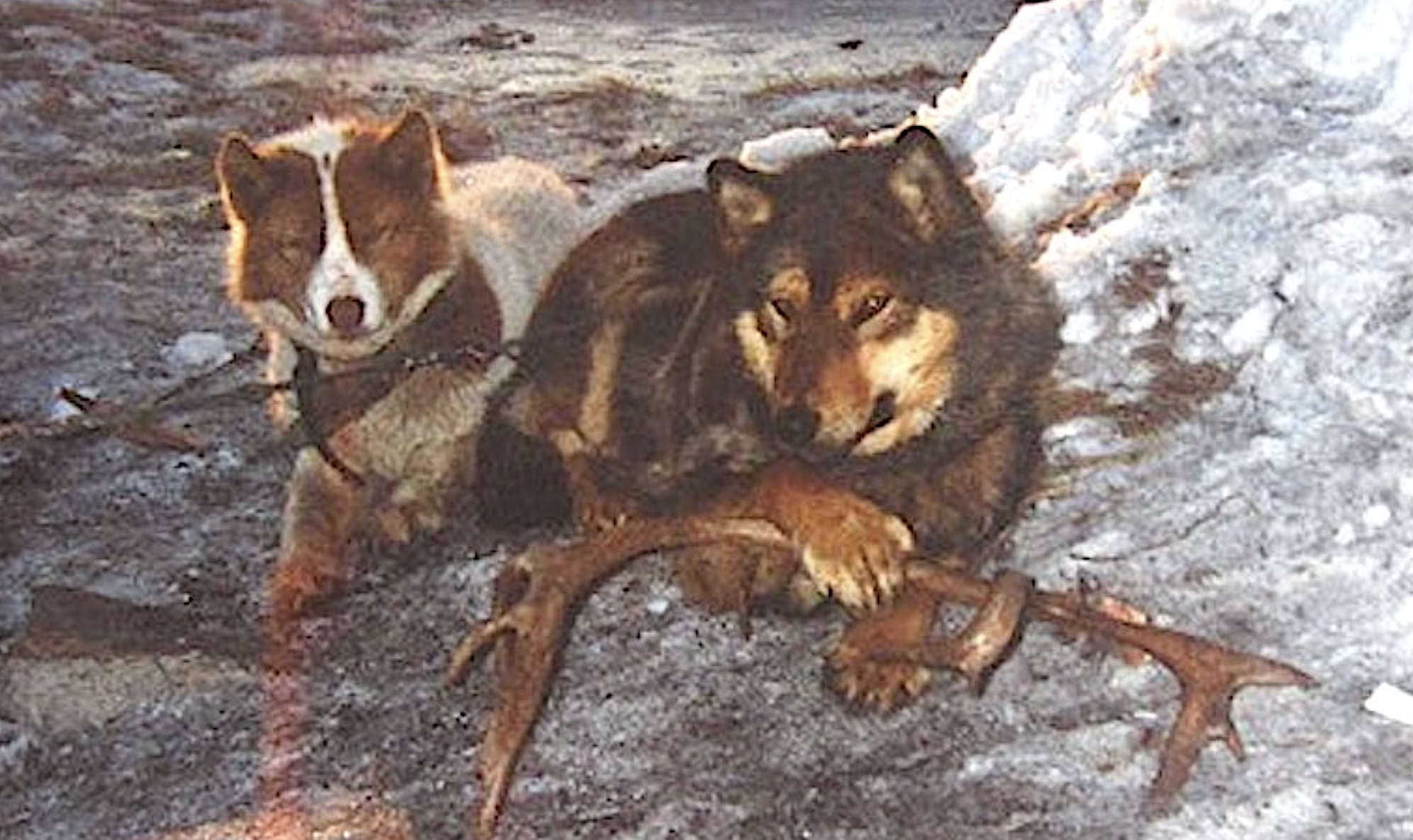
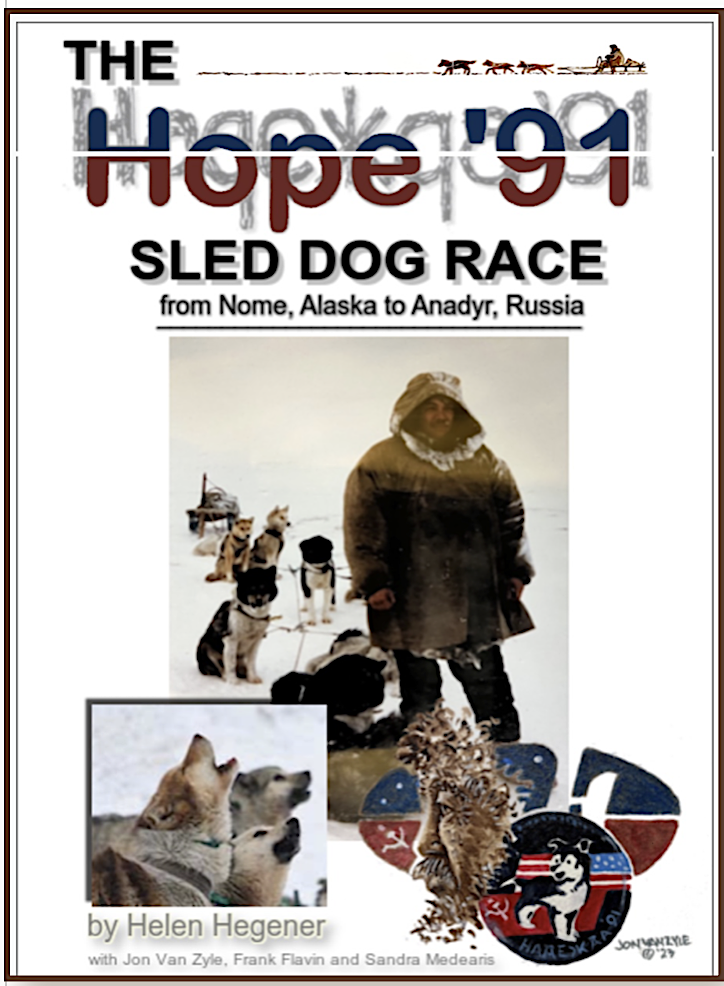
Chukotka dogs, 1991, photo by Jon Van Zyle.
A chapter from the book, The Hope ’91 Sled Dog Race: From Nome, Alaskato Anadyr, Russia, by Helen Hegener, which focuses on the unique Chukotka dogs, a stout, hardy, bright-eyed and prick-eared type of dog, used for herding, hunting, packing, and pulling sledges over long distances.
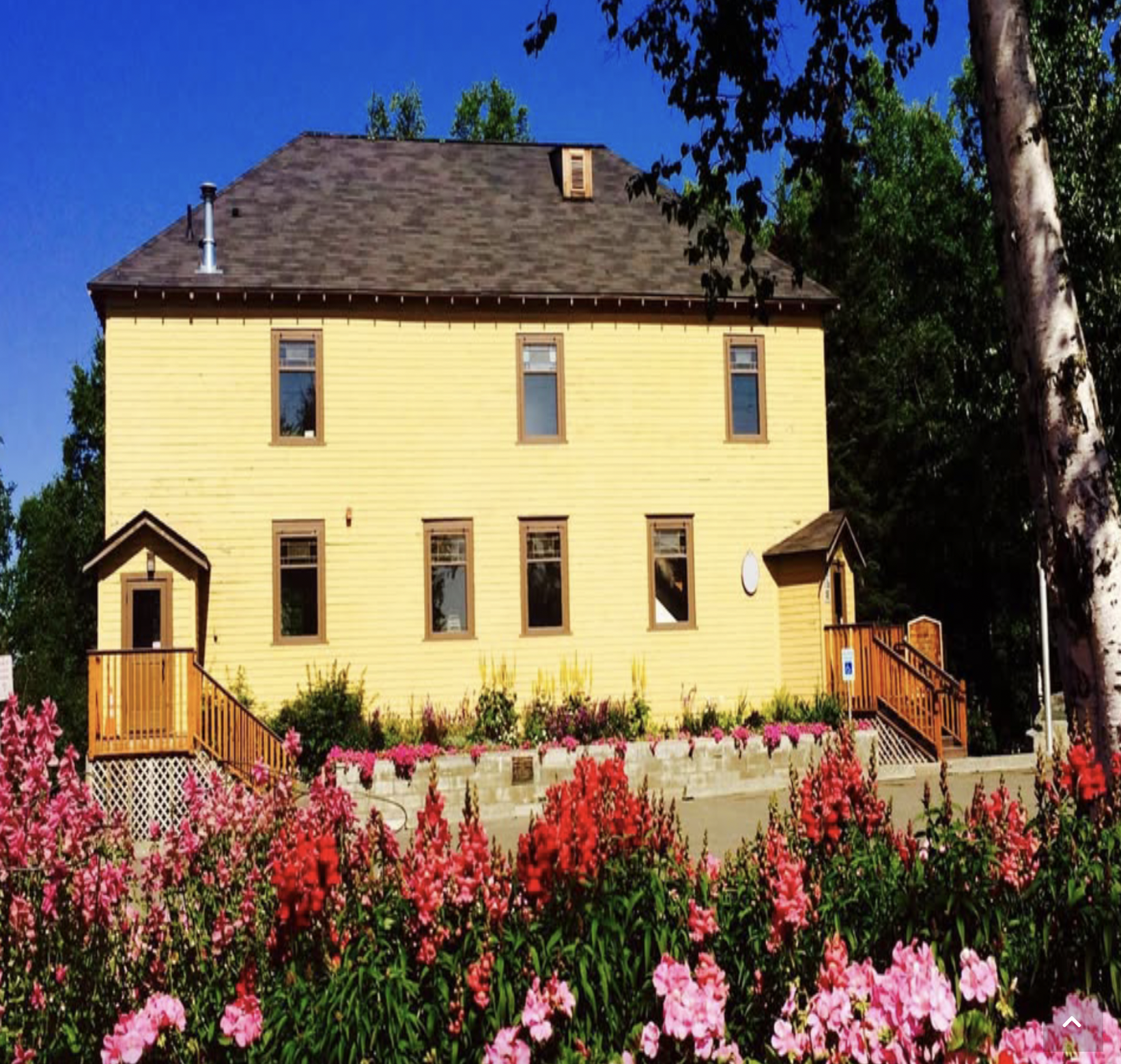
Anchorage’s Pioneer Schoolhouse, built 1915.
A 1921 Cookbook titled “A Collection of Choice Recipes” was compiled by the Anchorage Woman’s Club, which was founded in 1915 by Jane Mears, wife of the man in charge of building the Alaska Railroad. Mrs. Mears and 35 other women used the railroad’s surplus building materials to construct the first schoolhouse in Anchorage.
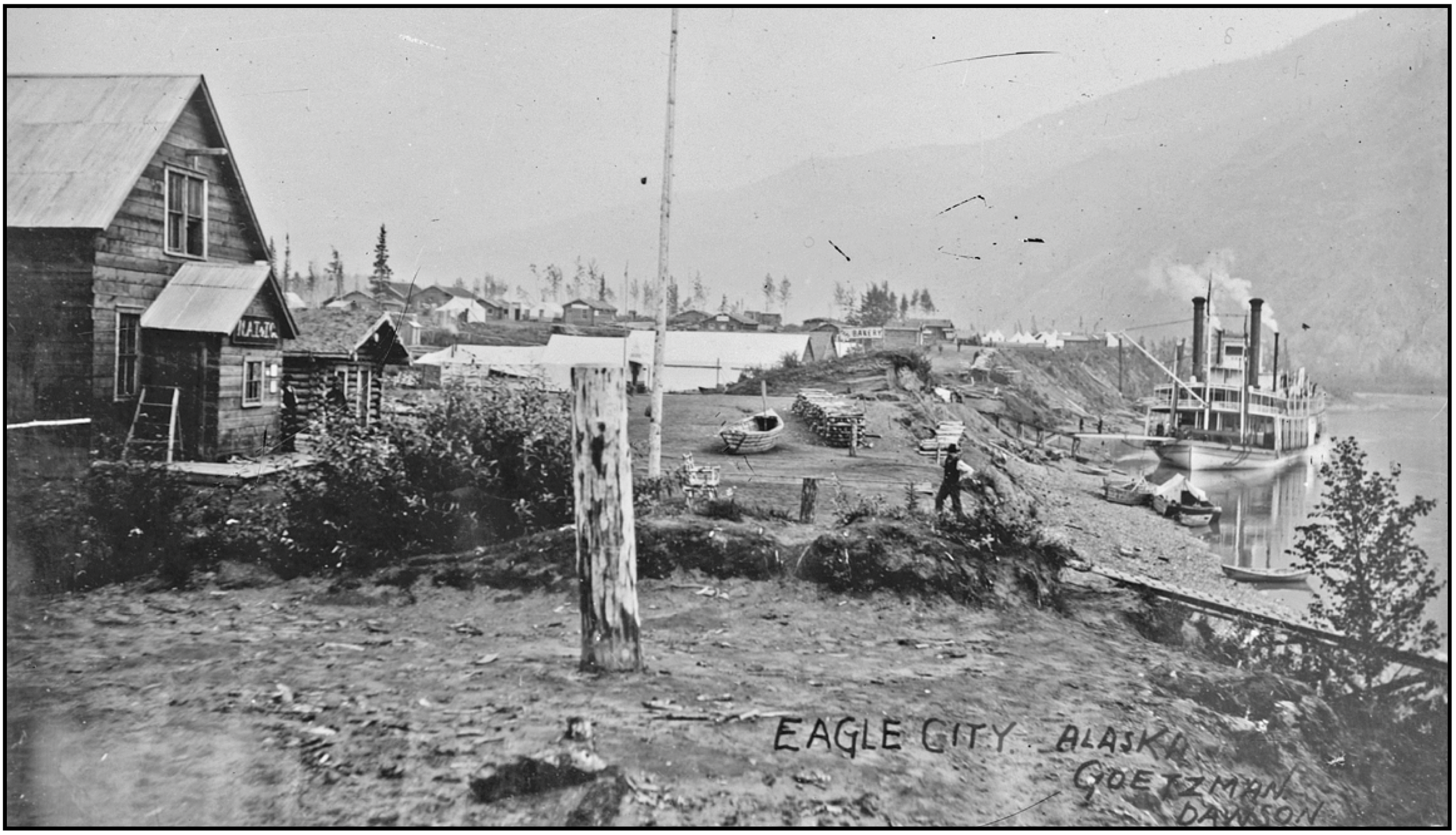
Eagle City, Alaska, 1899.
The Eagle City Tribune was a weekly newspaper published during the Klondike Gold Rush in Eagle City, Alaska, was started by surveyor Charles Carruthers in 1898. As it turns out, Carruthers was somewhat of a scoundrel and the miners held a meeting….
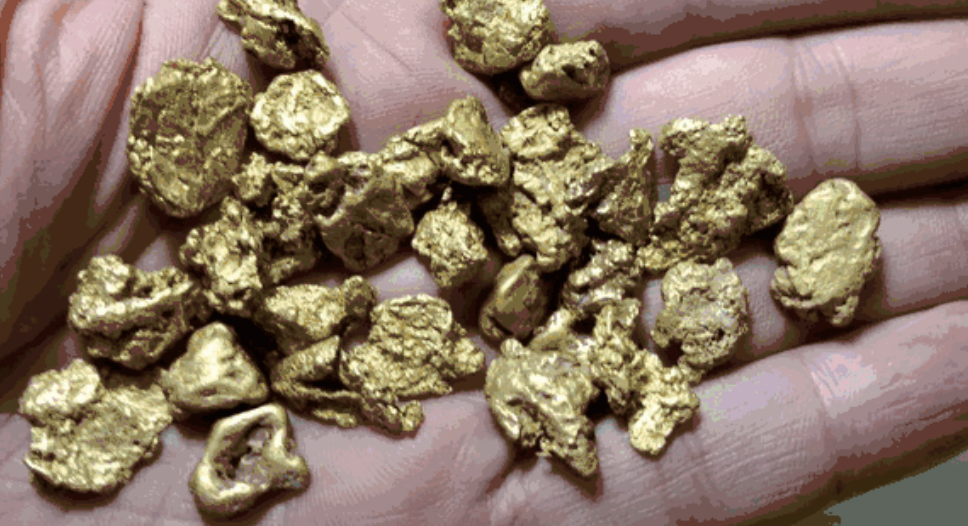
Gold nuggets.
Frank B. Camp was a soldier-poet who penned the lines of the popular ballad ‘My Hitch in Hell’ in 1917, for his book, American Soldier Ballads.In 1921 he wrote a book of Alaskan poetry, Alaska Nuggets, and four of his poems are shared in this issue.
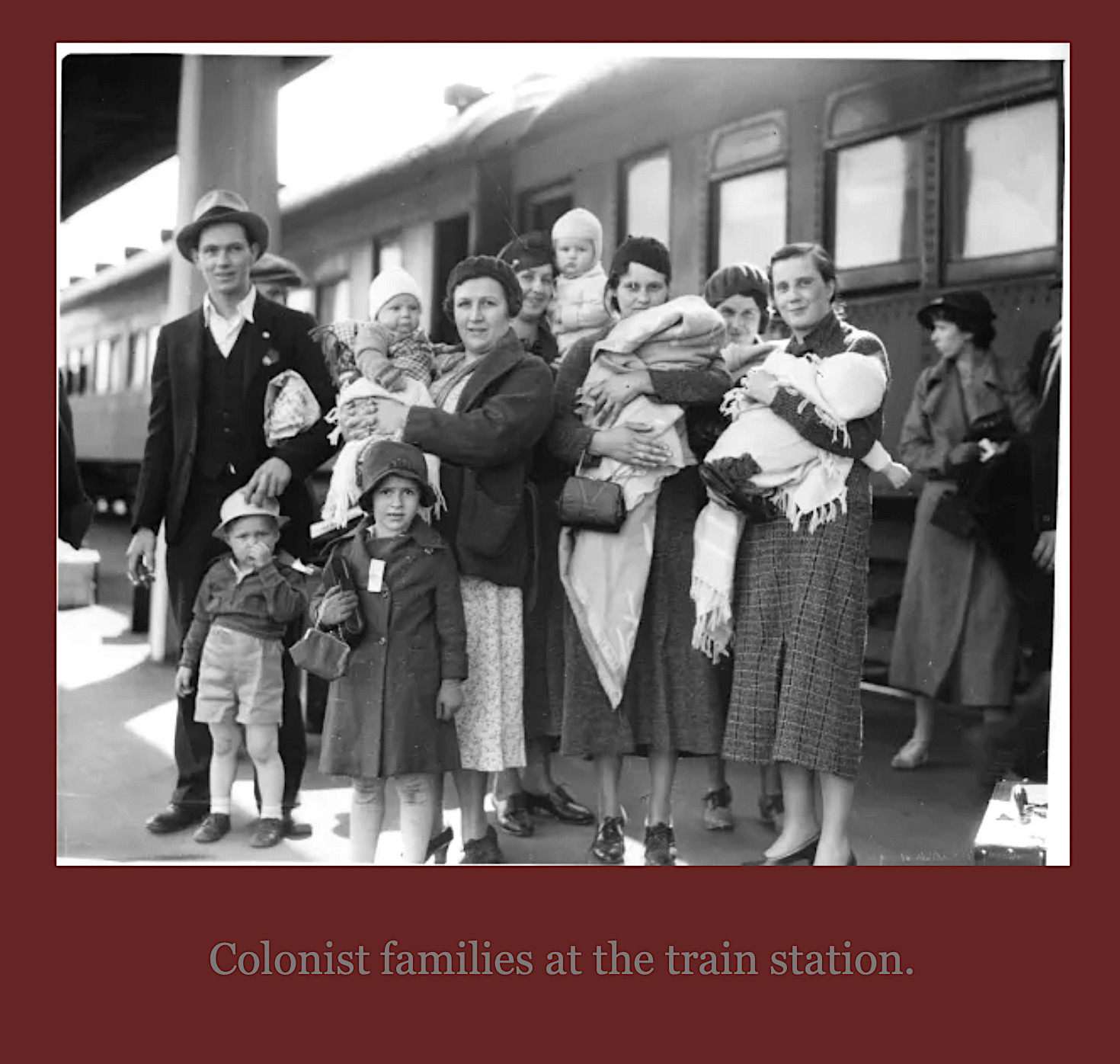
Colonists bound for Alaska, 1935.
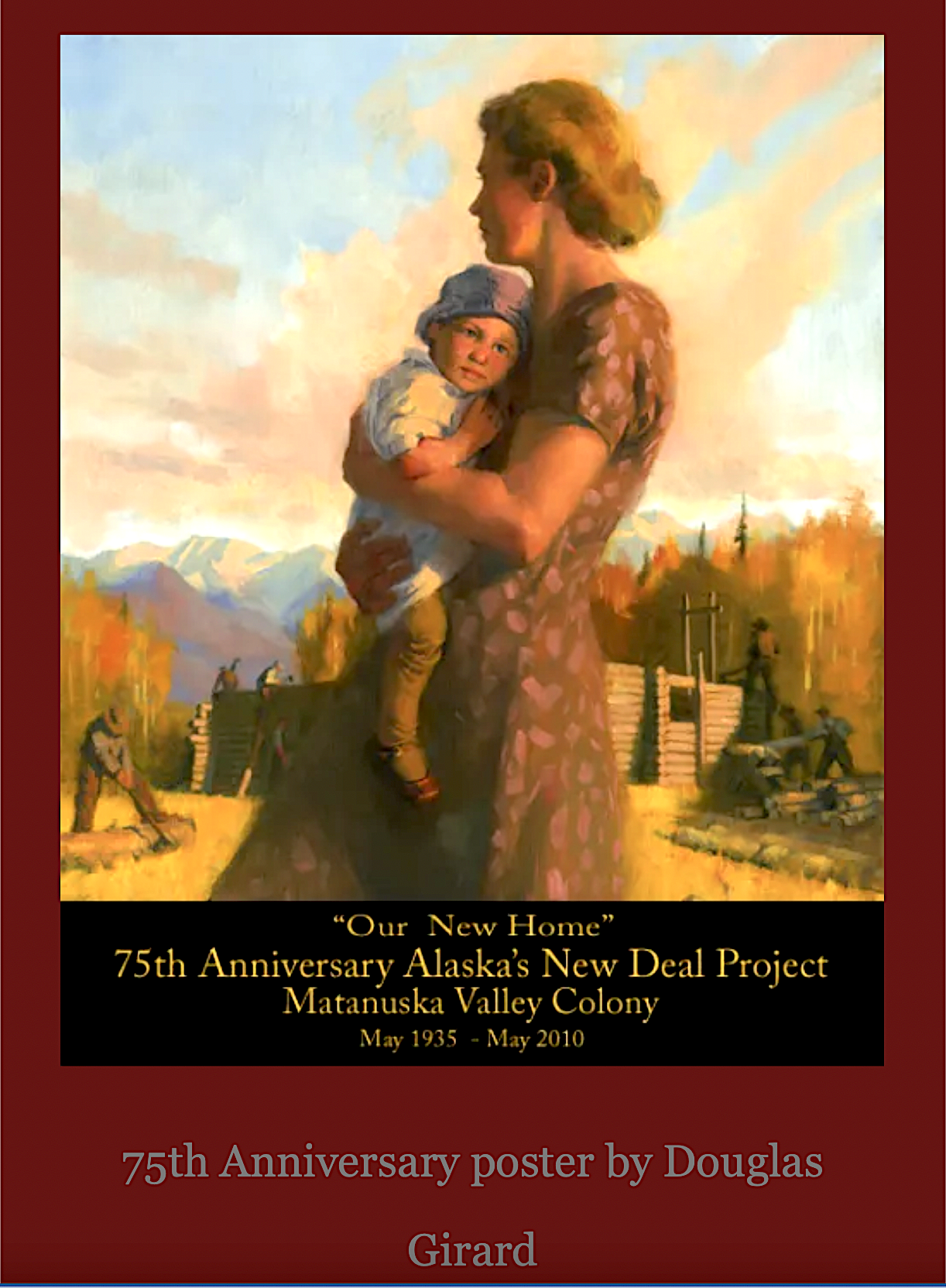
In the spring of 1935 the federal government transported 200 midwestern families to Alaska as part of F.D.R.’s New Deal social experiment, the Matanuska Colony Project. This article focuses on how and why the families were selected and transported to Alaska.
Alaskan History Magazine Volume 5, Number 5 is available here, from Northern Light Media’s site, and this issue and every back issue, plus the three collected anthologies, are available from the website for Alaskan History Magazine.
Share this page with your friends through social media:
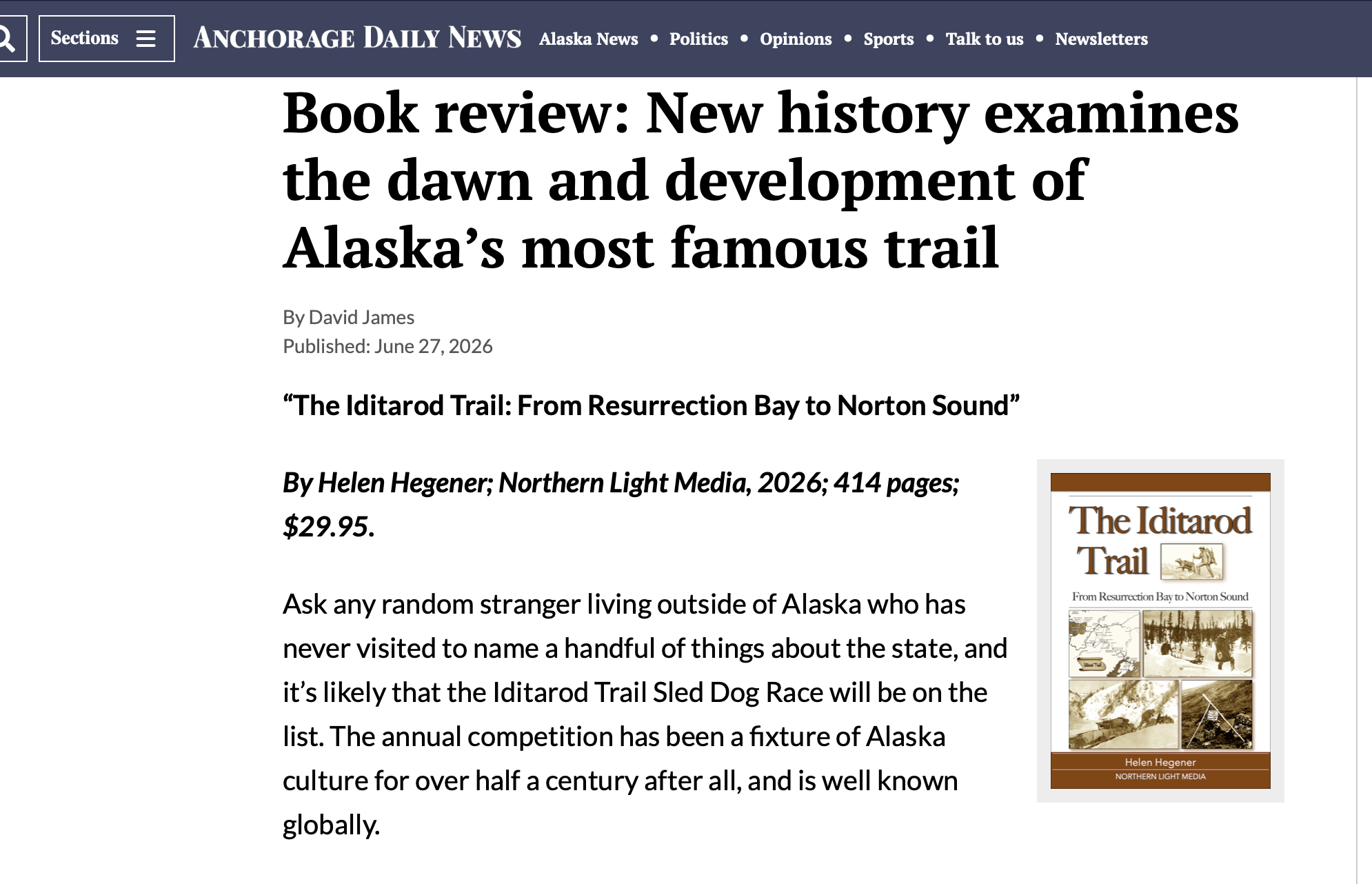
James’ review begins with the trail’s well-earned reputation thanks to the famous race which takes place each winter, but notes that not many people know more about the route and its history: “Ask them why the race exists, and they might mutter something about honoring the frantic 1925 scramble to bring serum to Nome amidst a deadly diphtheria outbreak, perhaps mention a dog named Balto, and otherwise a offer blank stare. Beyond that, even many Alaskans would struggle to cough up much more.”
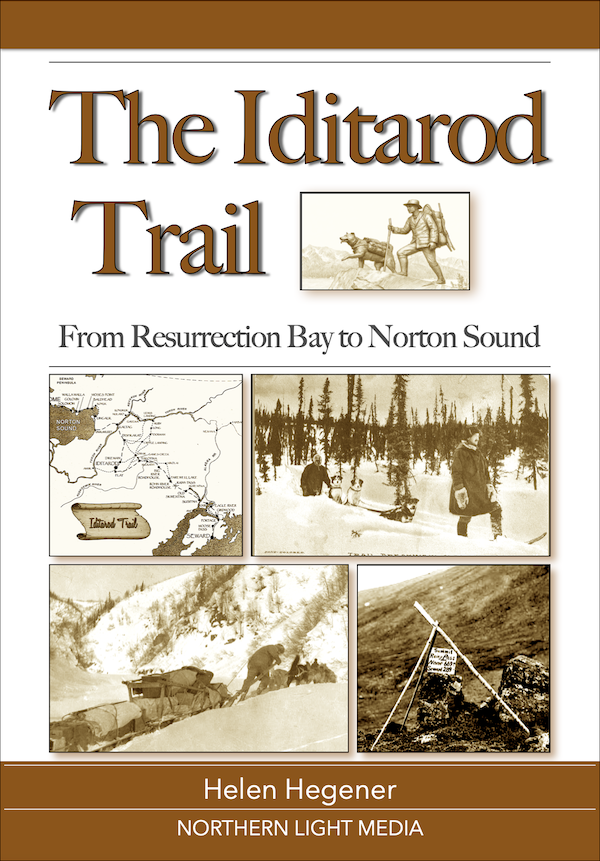
“Diving into this void of knowledge is Alaska’s most perpetually productive popular historian Helen Hegener, owner and publisher of Northern Light Media. Her latest volume, “The Iditarod Trail: From Resurrection Bay to Norton Sound,” examines how the route came to be and what’s happened along it since. Which is to say, quite a bit.”
There has indeed been a lot of history along the Iditarod Trail, and that led to the route being among the first four trails selected when the National Historic Trails were formally named under the 1968 National Trails System Act.
David James continues in his review: “As with her other books, Hegener breaks down the history she’s sharing into thematic chapters that could stand alone as magazine articles, making the book easy to pick up at one’s leisure. She packs those pages with plenty of her own writing, reprints long passages from contemporary accounts by those who lived in the periods being covered, and includes hundreds of photographs that add immeasurably to the telling.
“Though not an academic historian, Hegener’s a stickler for accuracy, and the end result is a book that serves as both a history and, because of the included historical narratives, documents, references, and photographs, a compendium of materials for those wishing to search further into the story.”
The Iditarod Trail: From Resurrection Bay to Norton Sound, by Helen Hegener, is available at bookstores and gift shops throughout Alaska. Published in March, 2026 by Northern Light Media. ISBN 9798252387352. 6” x 9” b/w format, 408 pages, over 200 photographs, indexed, bibliography, annotated references, extensive online resources. $29.95 plus shipping from any bookseller or directly from Northern Light Media.
Share this page with your friends through social media:
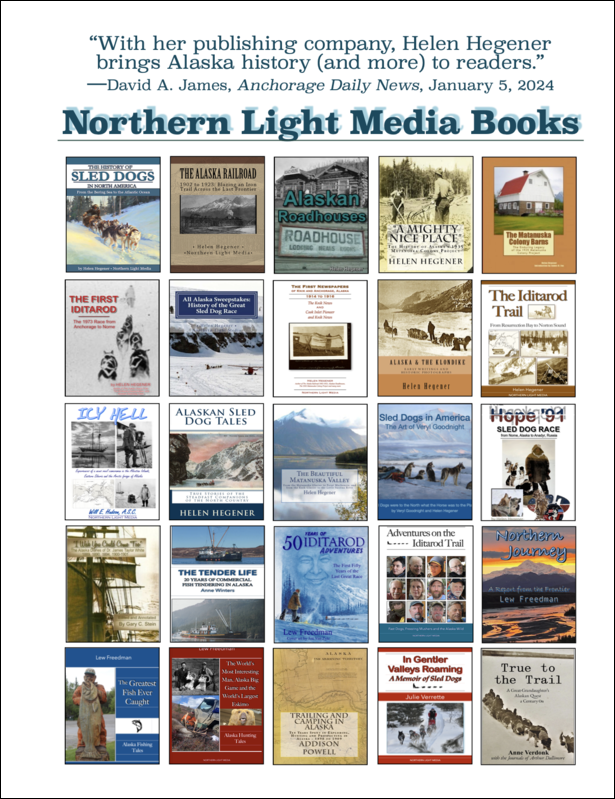
The full color, 64 page Northern Light Media books catalog is now available in a flipbook format, with a two-page spread describing each title. A wide range of titles by Alaskan author Helen Hegener has been published by Northern Light Media, from the history of the Alaska Railroad construction to the historic roadhouses of Alaska to the great sled dog races like the Iditarod, the Yukon Quest, and the All Alaska Sweepstakes, and new book on the history of the Iditarod Trail. But we’ve also published books by many other authors, and all are collected in this easy-to-read catalog.
An introduction, “A Dedication to Preserving History,” gives the backstory of Northern Light Media. Also included is page by the author and publisher, Helen Hegener, and a table of contents to help making books easier to find.
In addition to the books published by Northern Light Media over the past two decades, there’s information about the Alaskan History Magazine, published bimonthly, with issues going back to 2019.
The current issue of Alaskan History Magazine features a broad overview of many of the first missionaries to Alaska, who set in place parameters which still affect all Alaskans.
Other articles in this issue include The Espicopal Church in Iditarod by the Rev. Hudson Stuck, the first issue of The Alaska Railroad Record, pages from an early tourist book on Skagway, a look at Anchorage’s historic Federal Building, and an article from 1914 by Belmore Browne on The Dogs of the North.
Share this page with your friends through social media:
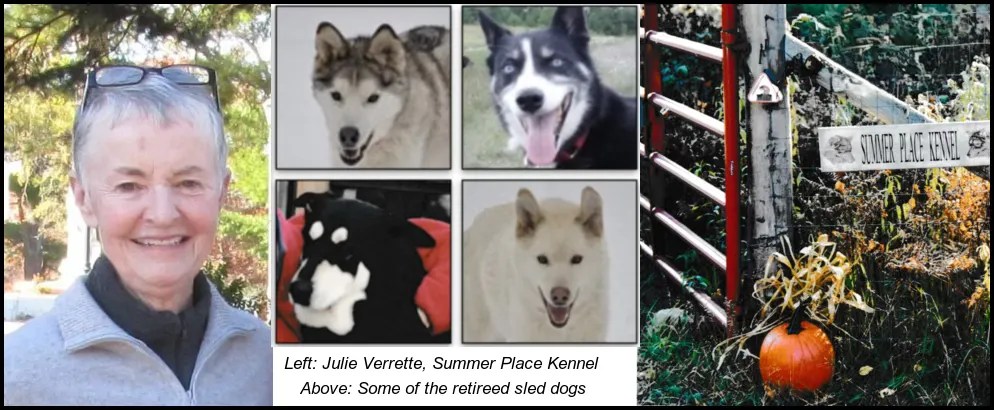
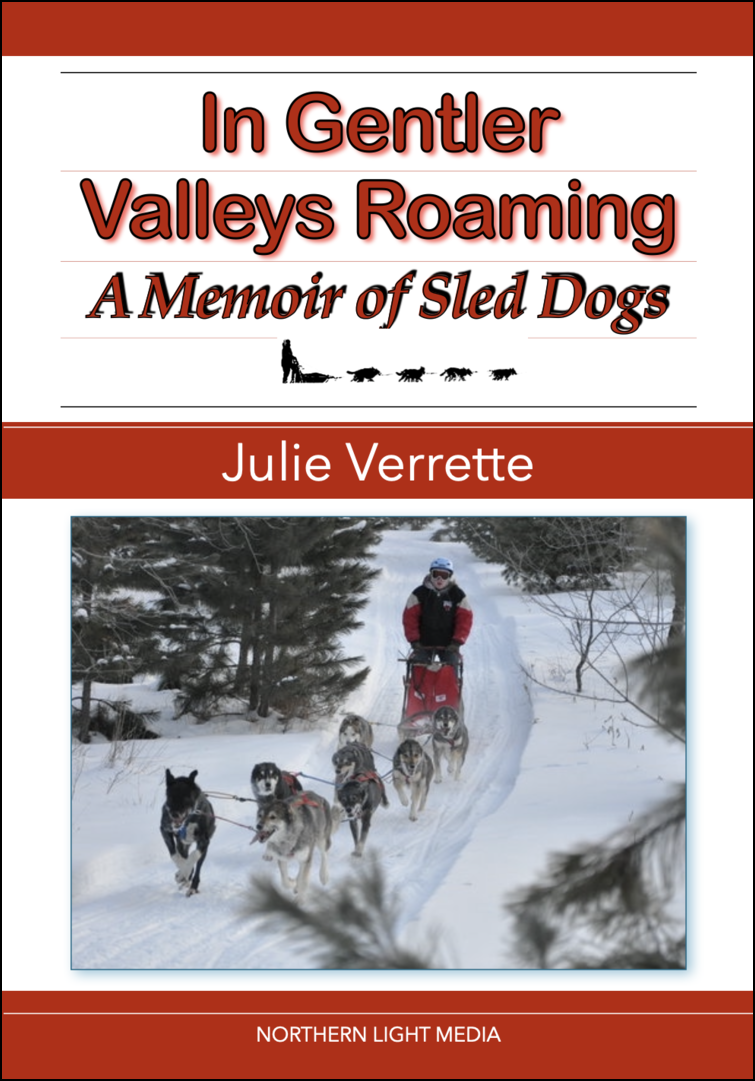
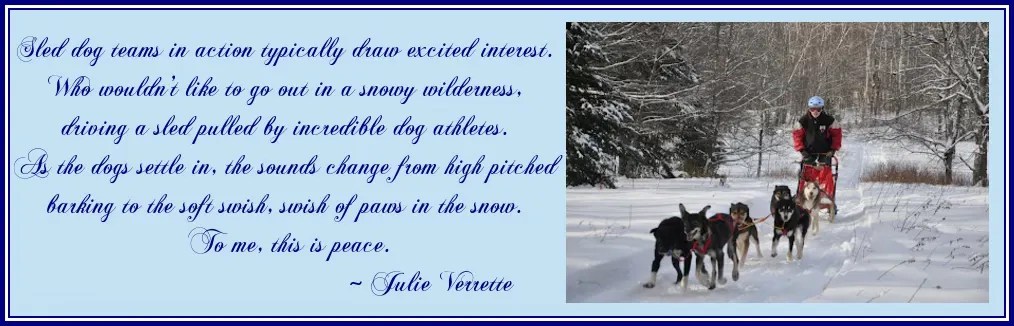
Julie Verrette, author of “In Gentler Valleys Roaming: A Memoir of Sled Dogs,” published last year by Northern Light Media, passed away on Saturday, May 23, surrounded by her family. For some time Julie had been facing Parkinson’s disease with strength, patience and grace, even as she penned the story of her life with retired racing huskies on her land near Florence, Wisconsin, where she built a sanctuary for rescued and retired sled dogs entrusted to her by some of the sport’s greatest mushers.
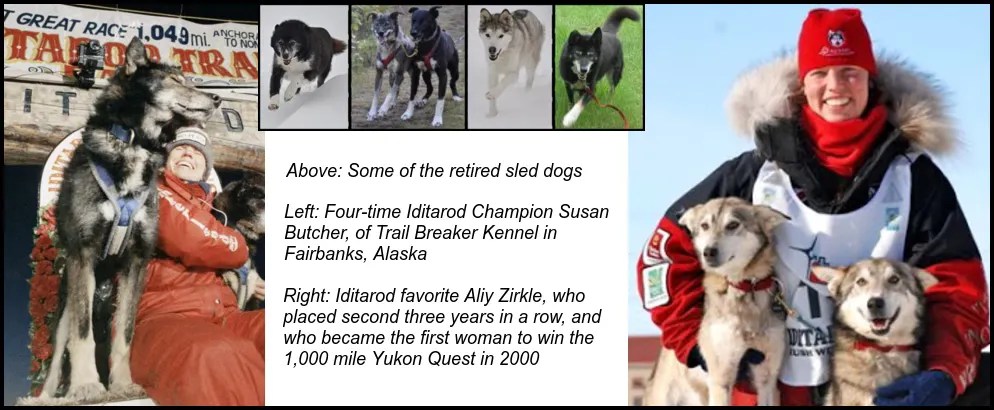
With a name inspired by the peaceful refuge in the song by the great Andy Williams, Summer Place Kennel provided a safe haven for retired sled dogs from some of the premier racers in the world, such as four-time Iditarod Champion Susan Butcher and Yukon Quest Champion Aliy Zirkle. They entrusted their beloved teammates to Julie’s care, beginning with a dog named Scuba from Susan Butcher, who landed in Wisconsin carrying a litter of puppies, born the day after Scuba arrived!
Julie’s initial goal was to simply live in the wilderness with dogs, but the retirees showed her another world, filled with fun and excitement and unexpected possibilities and limitless surprises: A life with sled dogs and all they bring to the table! There were hard times and difficulties, to be sure, but Julie had plenty of good friends and capable assistants who were willing to work and learn right along with her, and together they created a special place for the sled dogs and made Julie’s dreams come true.
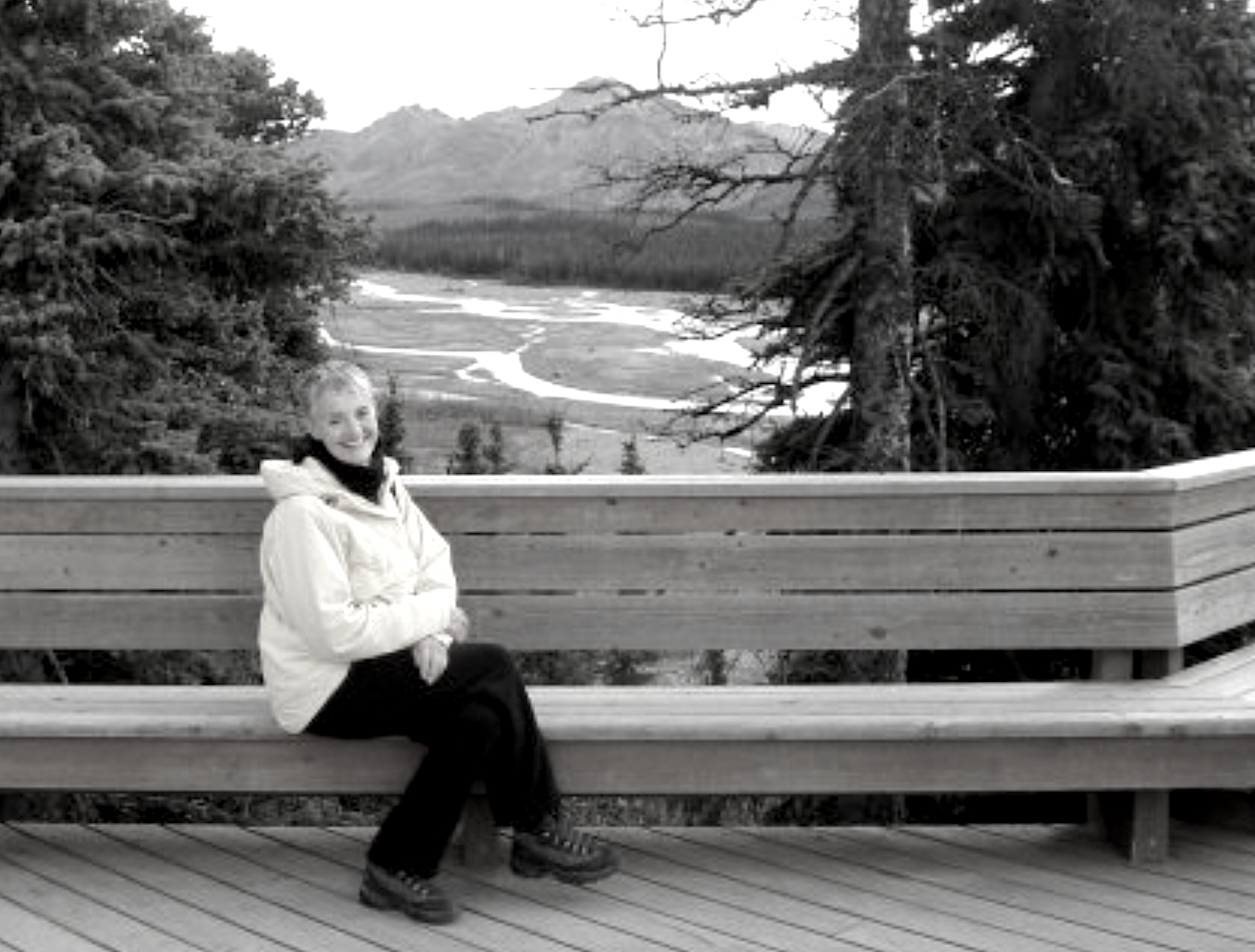
Julie at Denali National Park and Preserve
A memorial service will be held at Holy Trinity Episcopal Church, 221 W B St., Iron Mountain, Mich., at 1 p.m. on June 19, 2026, preceded by visitation at 12 noon.
Memorials may be directed to the Iditarod Trail Committee or to Parkinson’s research. Online condolences may be left at www.gundersonfh.com.
“If I can be presumptuous enough to give advice, it would be to make your own passion come true. If my story can inspire even one person to realize their vision, whatever it is, and think ‘Julie saw what she wanted to do and she did it, and so can I,’ I would be thrilled!” ~Julie Verrette
Share this page with your friends through social media:
The newest book from Northern Light Media is a reprinting of Will E. Hudson’s rare and hard to find 1937 book, Icy Hell. Experiences of a news-reel cameraman in the Aleutian Islands, Eastern Siberia and the Arctic fringes of Alaska.
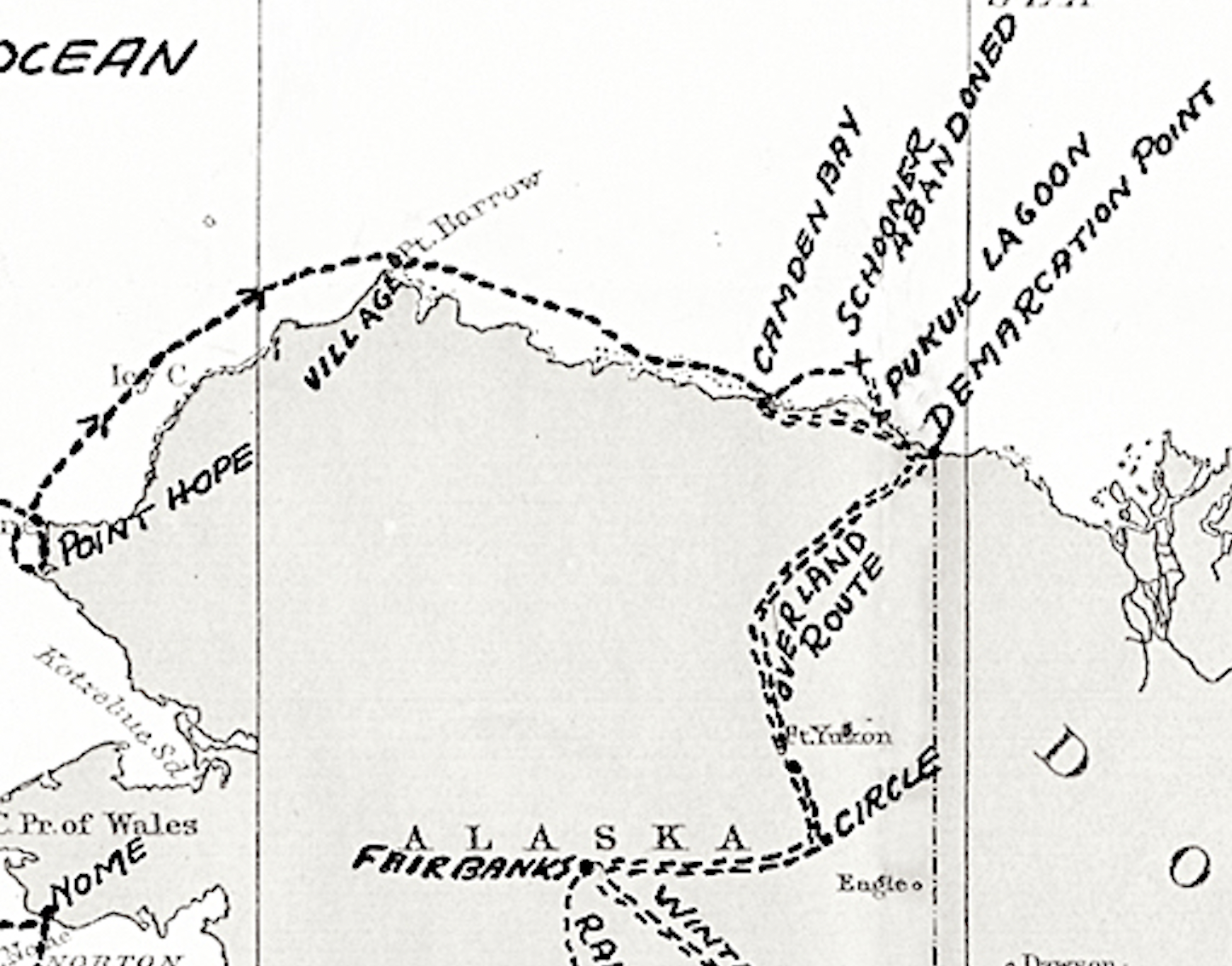
The book describes the travels of a private hunting and exploring party on a 1913 trip in the schooner Polar Bear, through the Bering Strait into the Beaufort Sea, then east to Demarcation Point, and then overland by dogsled to Ft. Yukon when the Polar Bear became trapped in the sea ice.
The Polar Bear, a 90’ 81-ton schooner built in 1911 by E. W. Heath Co. of Seattle, had been chartered by a group of college graduates who wanted to go to Alaska to go hunting. The cost of the trip was sponsored by Harvard University, and possibly to justify the expense, the school sent two naturalists along to collect natural history specimens and provide a kind of scientific purpose to the trip. Will Hudson had been invited to come along as the official cinematographer, he had worked as the first still photographer on the staff of The Seattle Post-Intelligencer since 1908.
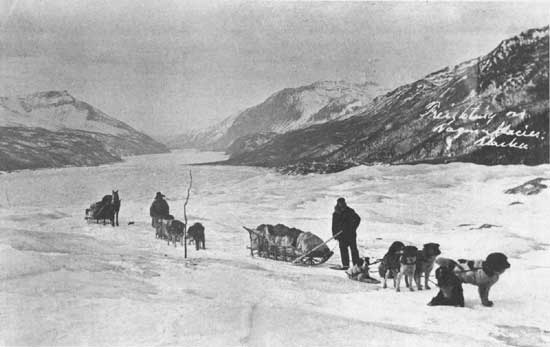
When the ship was caught by pack ice and forced to overwinter on the exposed coast of northern Alaska, the captain, Hudson, and two other men left the ice-bound ship to be cared for by its capable crew and traveled south with two dog teams, crossing the uncharted Brooks Range, stopping in Fort Yukon, and mushing up the Yukon River to Circle. From there they rode on horse-drawn sledges to Fairbanks, then continued south to Cordova and home to Seattle in time for Christmas.
Hudson noted: “No one had ever made a trip directly through the Endicotts by the course we were contemplating. We had been told by some natives earlier in the season that it could be made from where we had located our camp.”
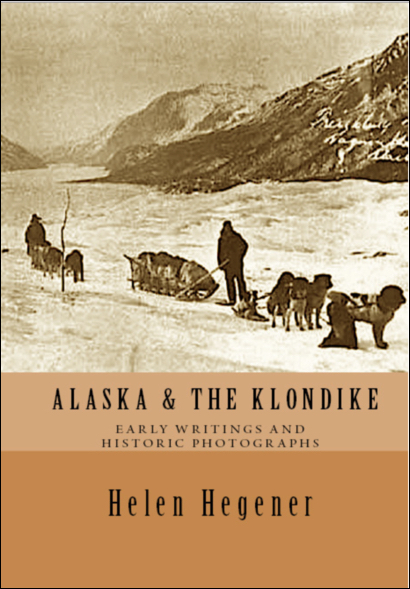
The publication of Icy Hell marks the return of my publishing company to my first love, vintage books about the history of Alaska. The first-hand experiences and photographs found in these books are true history, told by those who lived it, and I’ve shared some of that history in books such as Trailing and Camping in Alaska, by Addison Powell, subtitled Ten Years Spent Exploring, Hunting and Prospecting in Alaska – 1898 to 1909, republished in its entirety by Northern Light Media in 2018. Several more classic Alaskan titles are scheduled for publication by Northern Light Media in 2026.
Icy Hell, by Will E. Hudson:
Share this page with your friends through social media:
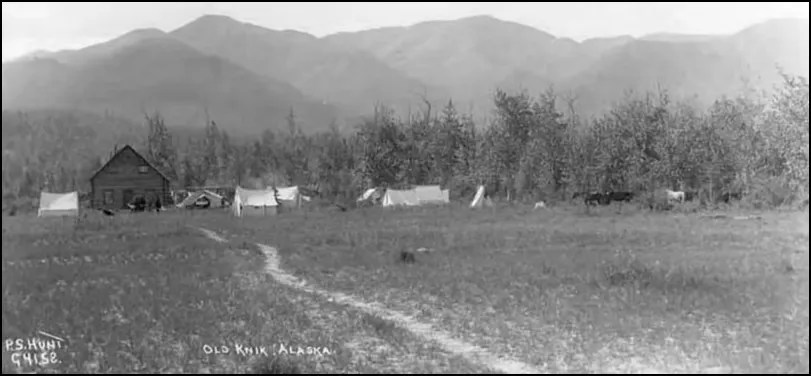
The Old Knik Roadhouse, also known as Brown’s, built in the early 1900s by Scotty Watson, roughly half a mile from Knik Arm, just north of the Eklutna Village. Surveyor K.K. Kuney’s tent camp and horses, photo for AEC by P. S. Hunt, 1914.
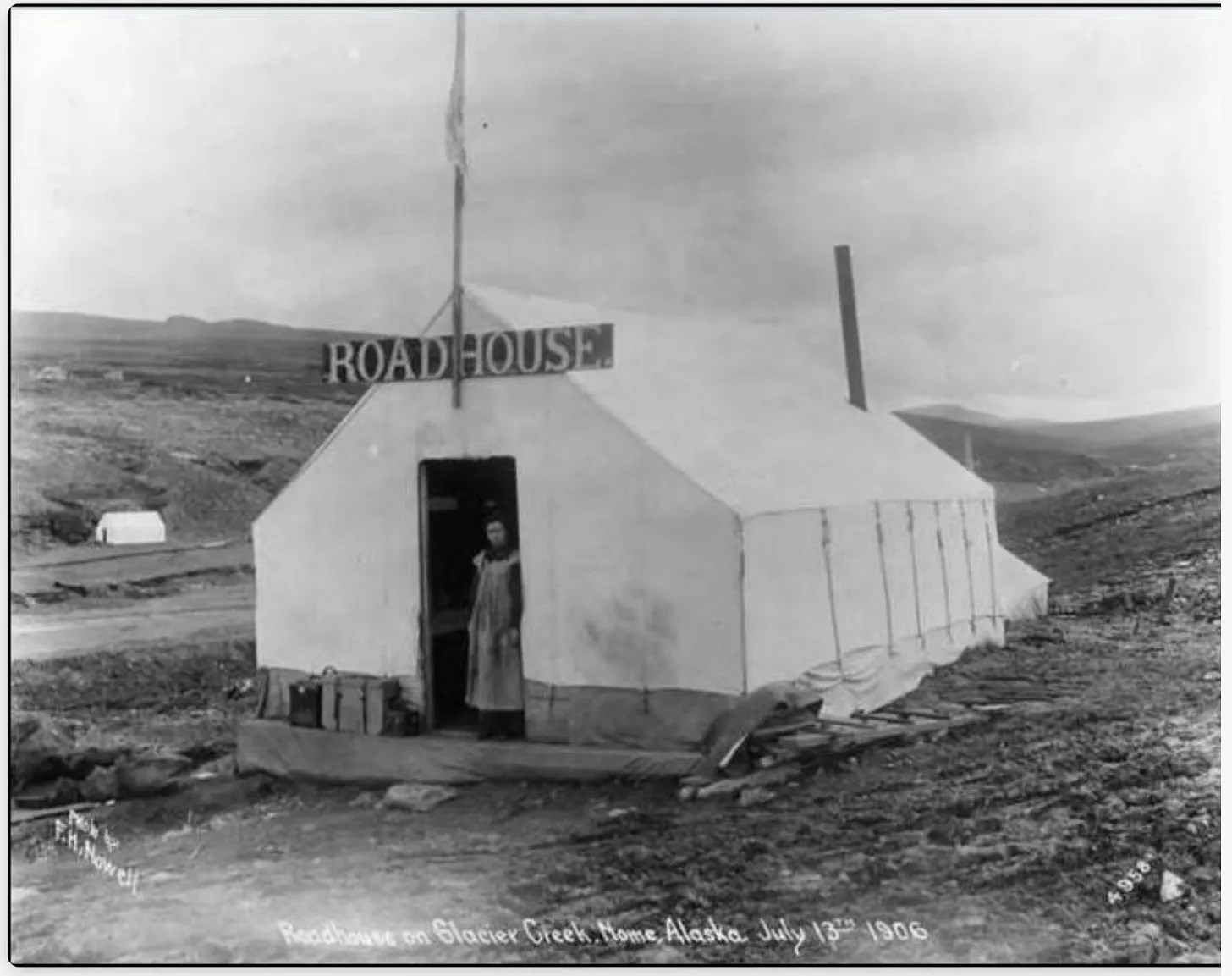
Researching my recent book on the history of the Iditarod Trail included revisiting the many roadhouses which lined the route between Seward and Nome, from mere tents in the wilderness to expansive log roadhouses which still serve travelers today. The names of many of the roadhouses were new to me, signaling a need to revise my 2016 book, Alaskan Roadhouses, which will be a research project for this summer, with revising next fall and winter, and publication in the spring or summer of 2027.The tent roadhouse on Glacier Creek near Nome was included in the first edition. Photo by F.H. Newell, July 13, 1906.
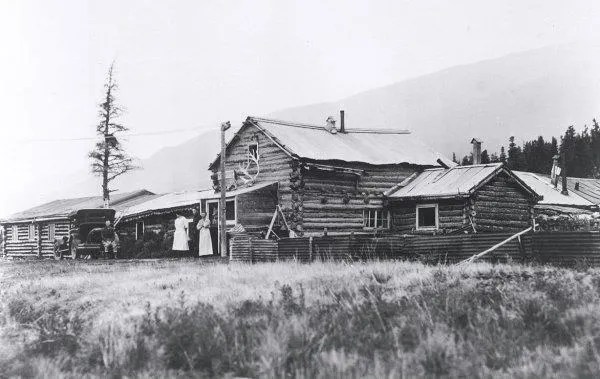
The first edition is still a terrific book, as the history is well-researched, documented, and valid, but there are so many roadhouses which should be included that the 284-page book will nearly double in size with this revision. In addition to the three dozen roadhouses on the Iditarod Trail, there were many on the Richardson Trail which were not included in the first edition, and very few from remote parts of Alaska such as the southeastern panhandle, the Aleutians, and the far North. The new edition will include all of those and more.Of the more than thirty roadhouse which operated on the Valdez Trail, later the Valdez-Fairbanks Trail, the Black Rapids Roadhouse was one of the first to open.
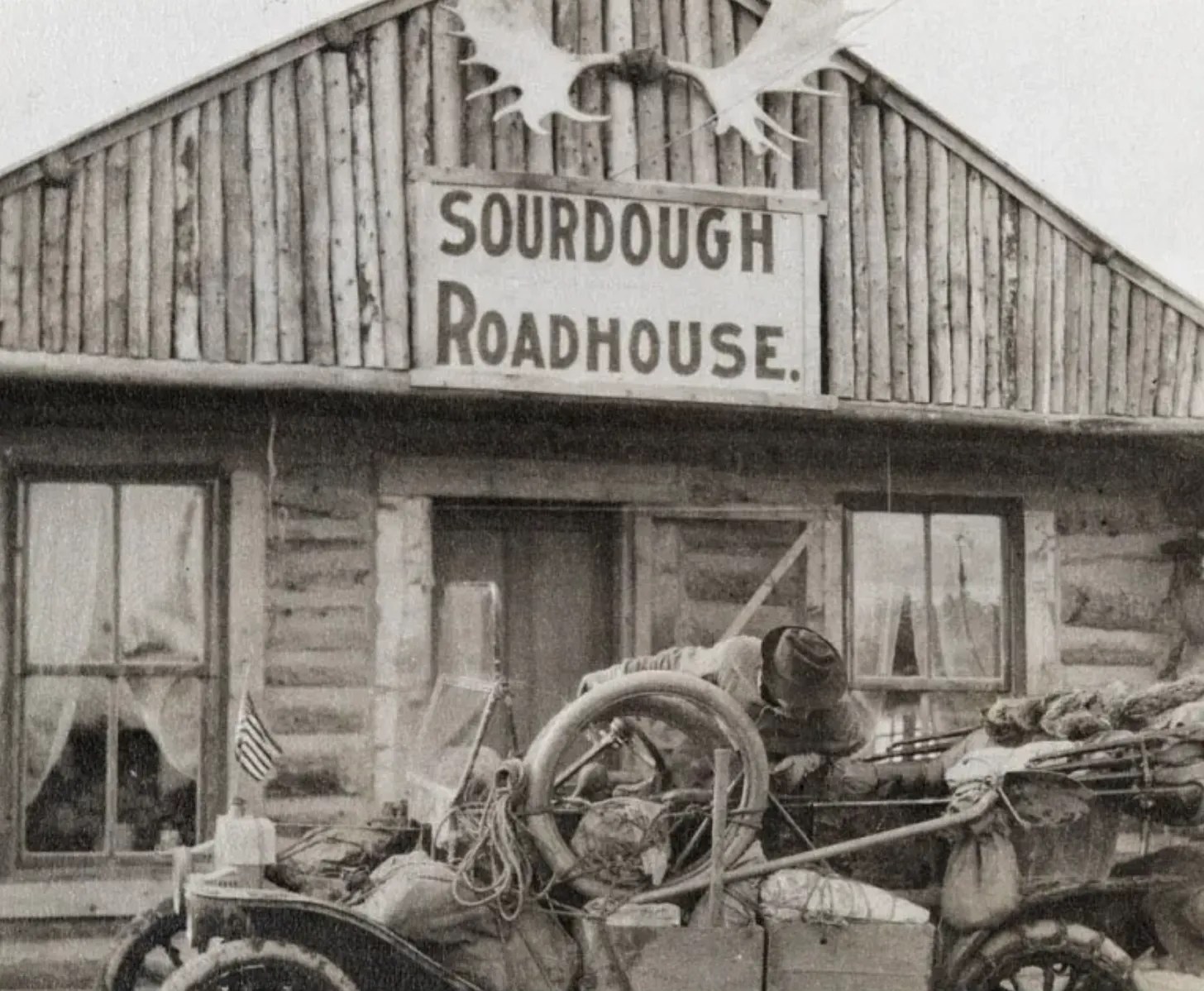
Alaskan roadhouses are a colorful reminder of the state’s past, and many are still an important part of Alaska’s transportation network. Alaskan Roadhouses: Shelter, Food and Lodging, by Helen Hegener, shares the history, photographs, and other information about these iconic Alaskan structures. It’s a great book to have on hand when traveling around Alaska this summer!The Sourdough Roadhouse, built in 1906, was at milepost 150.6 on the Valdez-Fairbanks trail (now the Richardson Highway), north of Glennallen. It was designated a National Historic Landmark, but was lost to fire in 1992.The historic Kantishna Roadhouse, built in the 1920s, still stands on its original site in Denali National Park, while a modern facility and popular tourist destination of the same name is near, close to the end of the park road.
Share this page with your friends through social media:
Missionaries • The Espicopal Church in Iditarod • The Alaska Railroad Record • Skagway • Anchorage’s Federal Building • Belmore Browne on The Dogs of the North
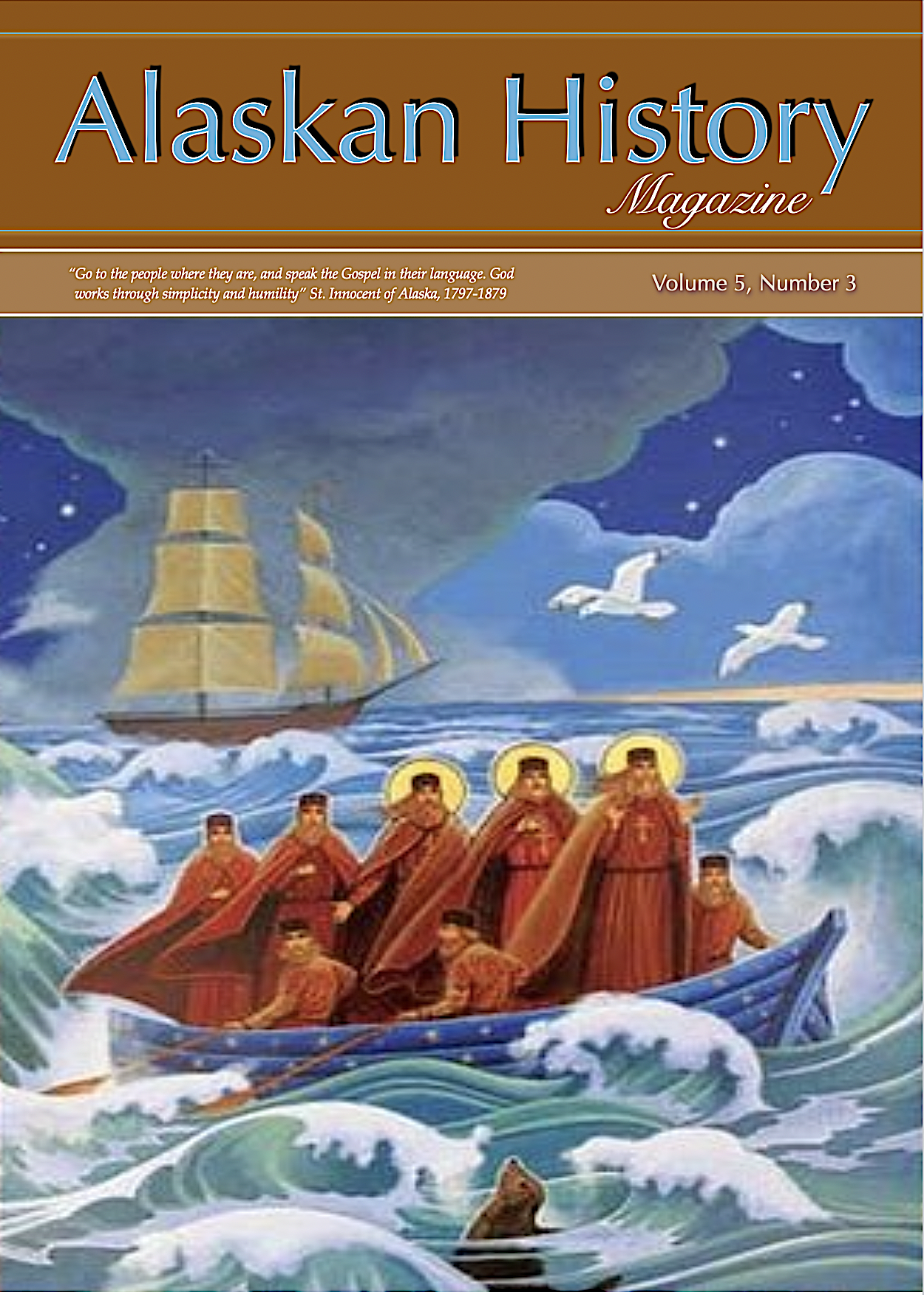
The cover of Volume 5, Number 3 features a stylized icon of the First Alaskan Mission (1794), depicting Sts. Herman, Juvenaly and Ioasaph coming ashore, bringing the Orthodox Faith to the New World, after leaving their ship.
In keeping with their primary winter means of transportation, Rev. Samuel Hall Young and Rev. Peter Trimble Rowe became known as “The Mushing Parson” and “The Mushing Bishop,” respectively.
This issue begins with a broad overview of many of the first missionaries to Alaska, who set in place parameters which still affect all Alaskans.
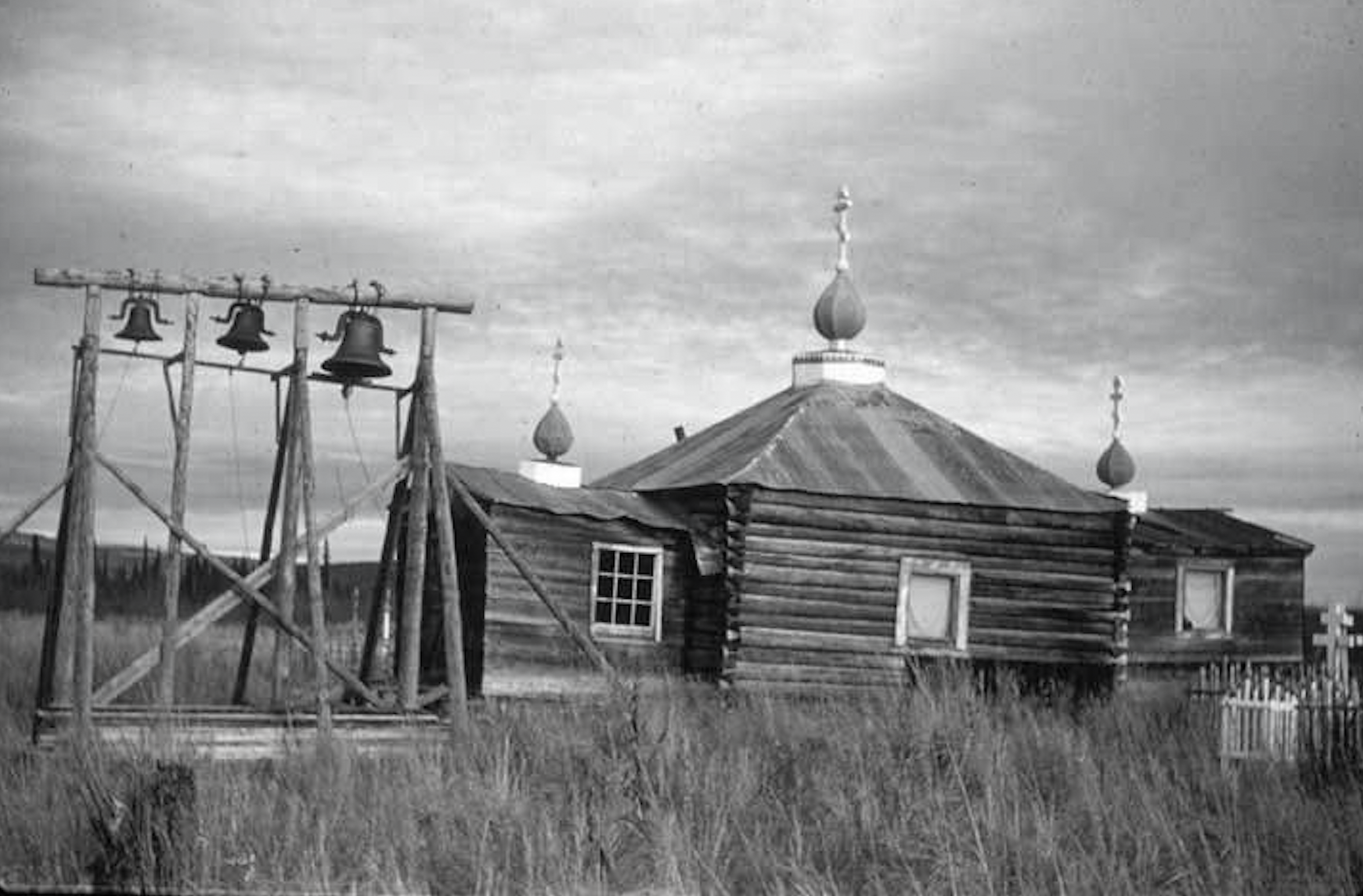
Russian church in Sleetmute
Missionaries in Russian America placed value on the local cultures and encouraged indigenous leadership to gain the loyalty of the indigenous populations, establishing the authority of Church and State..
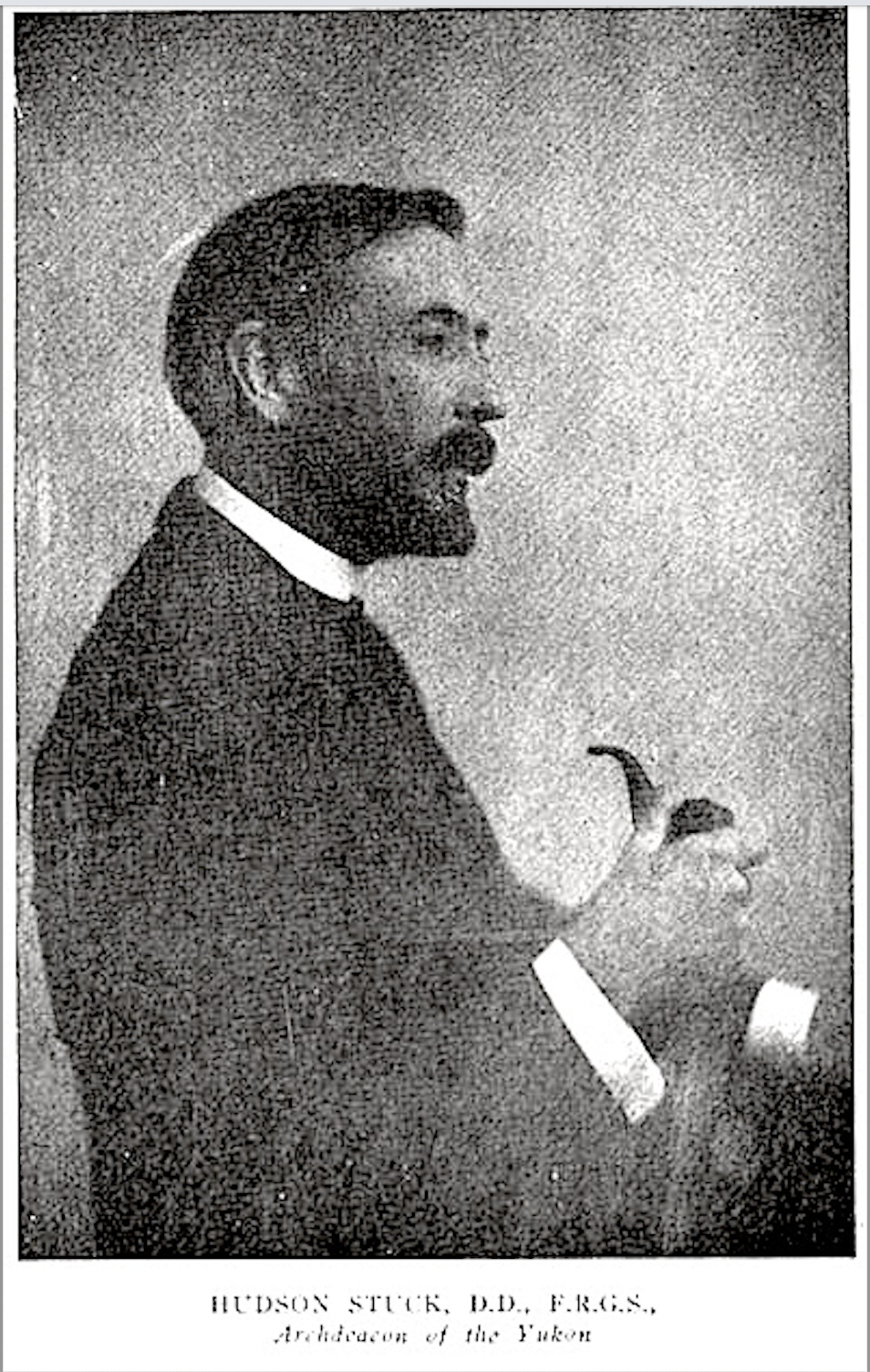
Hudson Stuck, born in England in 1863, came to the United States at the age of 22. In 1889 he began formal theological studies in Texas and was ordained deacon on Aug. 7, 1892, and an Espicopal priest on Nov. 30, 1892. He served the church in Texas until 1904, when he moved to Alaska to become Archdeacon of the Yukon in the Missionary District of Alaska. He explored the territory extensively and published many articles and several books describing his journeys, including The Alaskan Missions of the Episcopal Church in 1920. This issue includes an excerpt from Chapter IV: By Dog Sled or Launch.
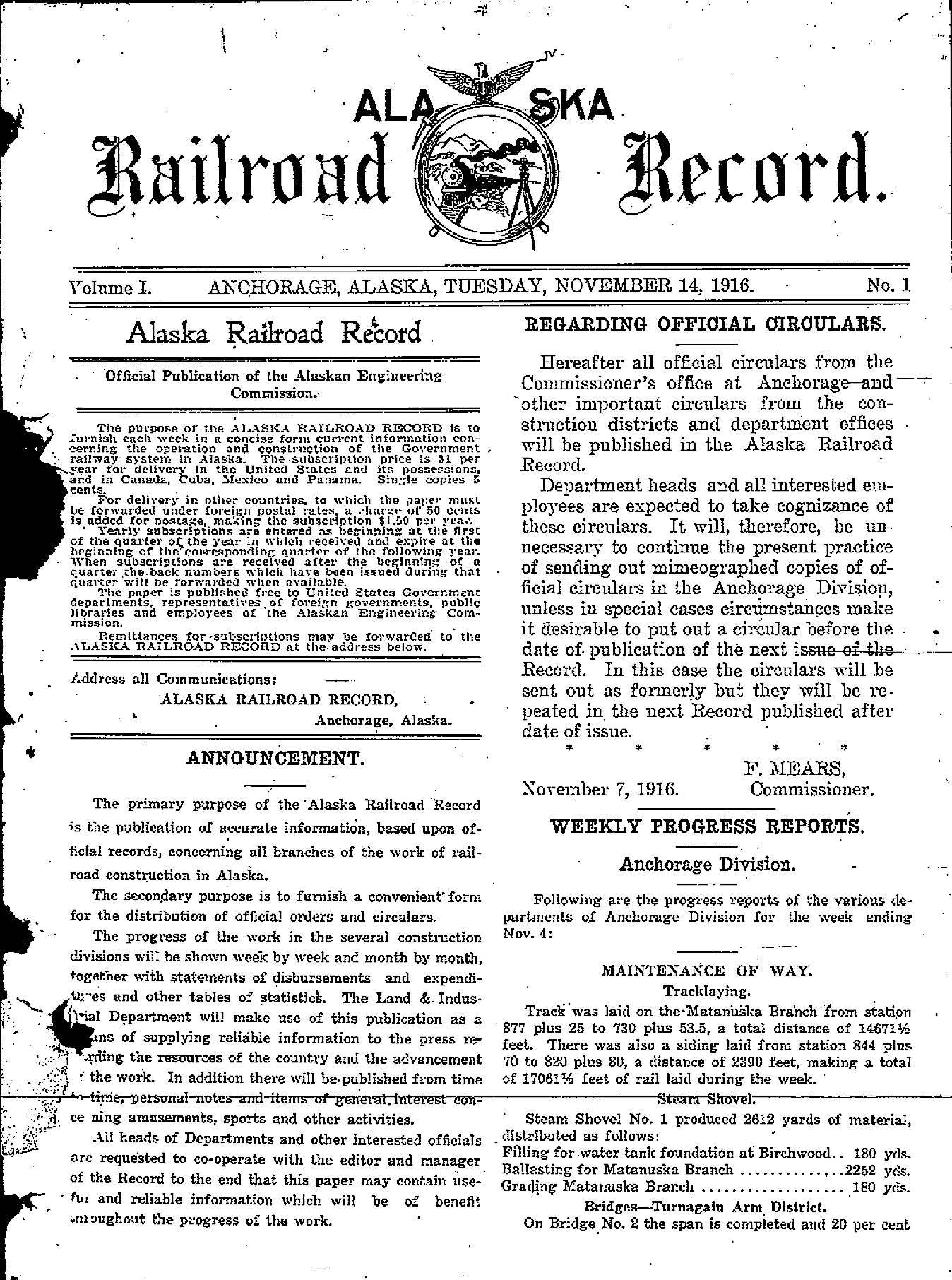
The Alaska Railroad Record was the official publication of the Alaskan Engineering Commission (AEC), providing a detailed weekly record of the construction of the Alaska Railroad, along with news, progress reports, schedules, personnel notes, and other material relevant to the federal railroad construction project between Seward and Fairbanks. It was published from November 14, 1916 to June 29, 1920. The eight-page first issue is reprinted in this issue.
On June 28, 1900, Skagway became the first incorporated first-class city in Alaska. Included in this issue are excerpts from a tourist guidebook titled Skagway, Alaska, designed to promote the city, assembled by The Skagway Commercial Club in 1910, and published by the local newspaper, The Daily Alaskan.
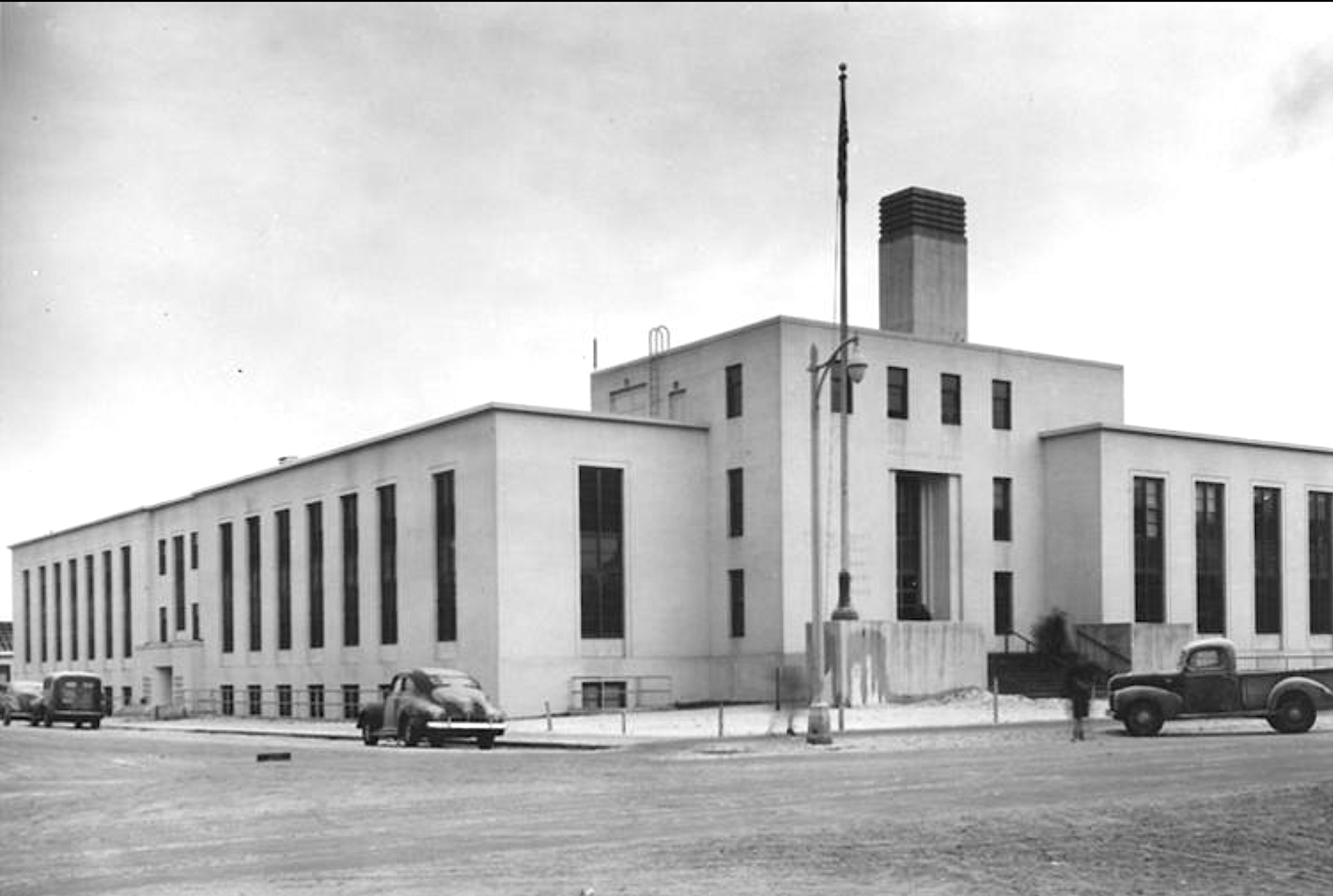
The Federal Building in Anchorage symbolized the U.S. government’s commitment to the economic growth and development of the territory. Providing residents with a post office, courthouse, and other federal services, it was the first large federal building constructed in Anchorage, and in 1978 the building was listed in the National Register of Historic Places.
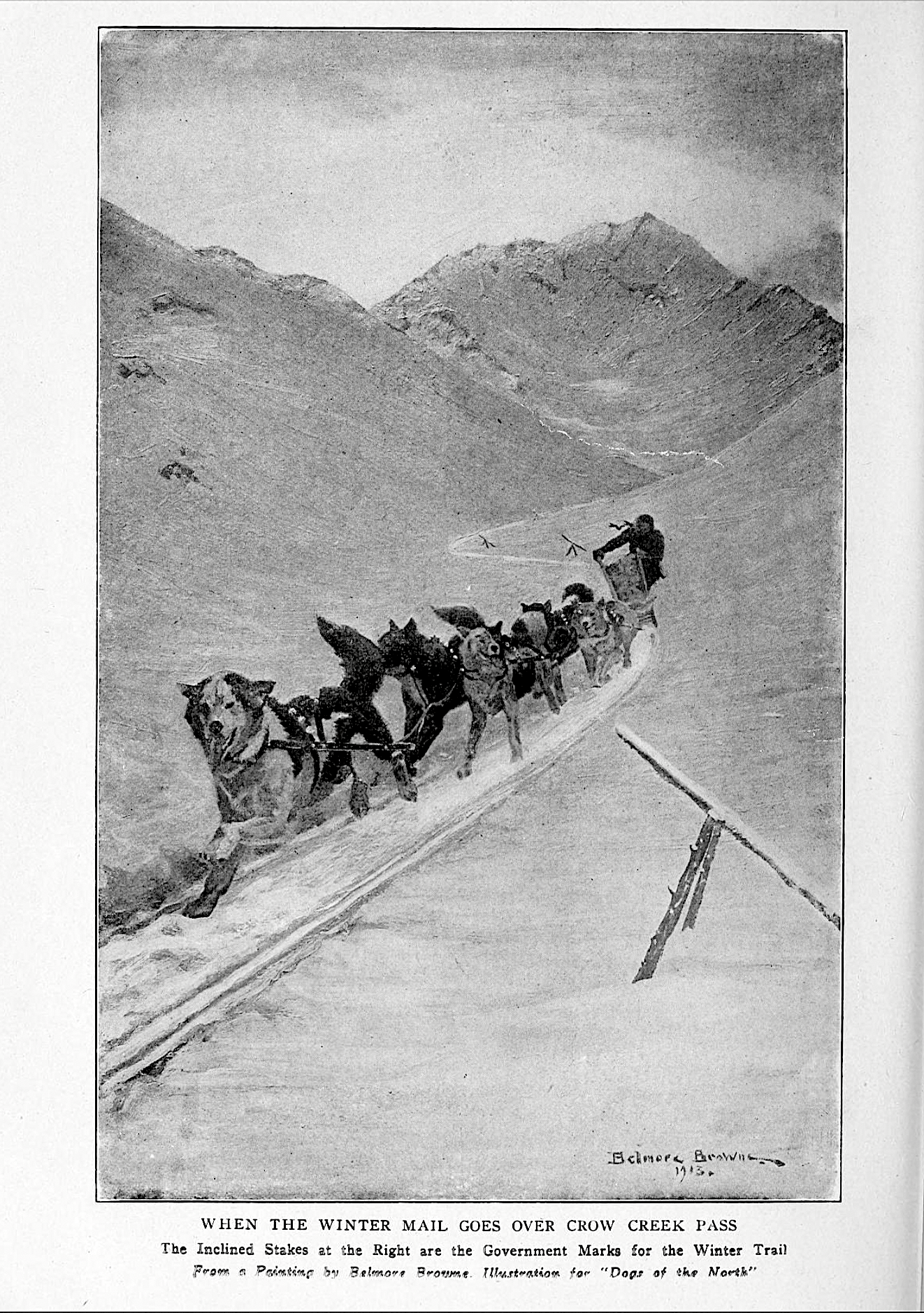
When the Winter Mail Goes Over Crow Creek Pass, a painting by Belmore Browne
An article by Belmore Browne on the Dogs of the North appeared in Outing magazine in 1914, depicting the differing breeds and their care, feeding, training, and importance to travel in Alaska and the North. The pages are reprinted in this issue, with all of the photographs, paintings, and captions which appeared in the original article.
“With her publishing company, Helen Hegener brings Alaska history (and more) to readers.” —David A. James, Anchorage Daily News, January 5, 2024
Volume 5, Number 3 will be mailed upon purchase, Be sure to check out the Alaskan History Magazine website for back issues and anthologies which collect all of the articles from past issues into convenient book format!
Share this page with your friends through social media:
Charting an unknown country, exploring a wondrous land, searching for gold, delivering freight and mail beyond where any roads would reach, these were the exciting topics of books which became northland classics, and excerpts and chapters are reprinted verbatim in this collection.
Available in Kindle format, see below
“I was so fortunate as to see Anchorage in the stump, tent, and shack stage, though it was growing marvelously fast. I give you my notes just as I penned them when I was on the spot, seeing how Uncle Sam’s engineers and executives were putting through their big job.” –Frank Carpenter, while touring the construction of the Alaska Railroad.
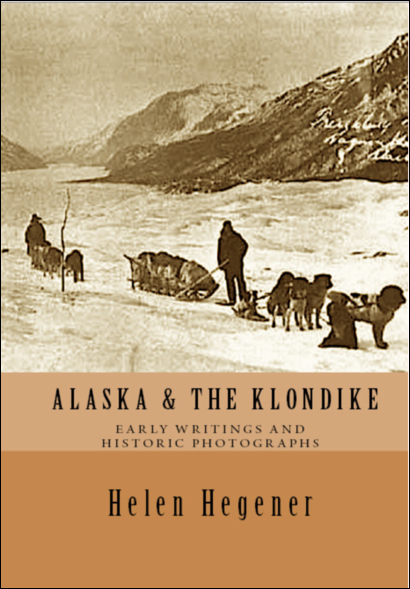
Wonderful photographs accompany the often colorful writings of Frederick Schwatka, Hudson Stuck, Robert Service, May Kellogg Sullivan, Josiah Edward Spurr, Frank Carpenter and many others as they tell of adventures, explorations, fortunes won and lost, and the magnificent promise of our great northern lands. Here is the list of books and authors included:
Golden Alaska, by Ernest Ingersoll (1897)
The Land of Tomorrow, by William B. Stephenson, Jr. (1919)
The Spell of the Yukon & Other Verses, by Robert Service (1907)
The Ascent of Denali, by Hudson Stuck (1914)
From Paris to New York by Land, by Harry DeWindt (1912)
Through the Yukon Gold Diggings, by Josiah Edward Spurr (1900)
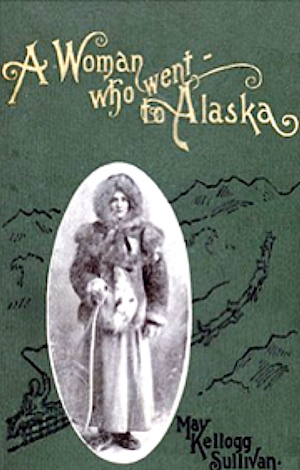
A Woman Who Went––To Alaska, by May Kellogg Sullivan (1902)
The Land of Nome, by Lanier McKee (1902)
Ten Thousand Miles with a Dog Sled, by Hudson Stuck (1916)
Along Alaska’s Great River, by Frederick Schwatka (1885)
Alaska: Our Northern Wonderland, by Frank Carpenter (1923)
A Dog-Puncher on the Yukon, by Arthur Treadwell Walden (1928)
These intrepid travelers who accepted the challenge of the north left an indelible mark in their writing about it, and their first-hand observations are invaluable to understanding the history, the people, and the land. Original maps, drawings, paintings and photographs are included as the appeared in the books.
Below is an excerpt from A Woman Who Went––to Alaska, by May Kellogg Sullivan, published in 1902 by James H. Earle & Co., of Boston, Massachusetts. The book describes two trips in which the author journeyed to the Yukon and Alaskan goldfields in 1899, a year after the height of the Klondike Gold Rush.
“Soon after landing I met upon the street an old Seattle friend of my parents, who knew me instantly and directed me to my father. This man’s kind offer to look up my baggage was accepted, and I trudged down through the town towards the Klondyke River, where my father and brother lived. I had no difficulty in finding father, and after the first surprise and our luncheon were over we proceeded to find my brother at his work. His astonishment was as great as my father’s, and I cannot truthfully state that either of them were overcome with joy at seeing me in Dawson. At any other time or place they undoubtedly would have been delighted, but they were too well acquainted with conditions to wish another member of their family there in what was probably then the largest and roughest mining camp in the world. The situation that presented itself was this. Instead of finding my relatives comfortably settled in a large and commodious log cabin of their own on the banks of the Klondyke River, as they had written they were, I found them in the act of moving all their belongings into a big covered scow or barge drawn close to the river bank and securely fastened. Cooking utensils, boxes, bags of provisions consisting of flour, beans and meal, as well as canned goods of every description, along with firewood and numerous other things, were dumped in one big heap upon the banks of the Klondyke River near the barge.”
In Alaska and the Pacific Northwest, salmon are a keystone species, playing a critical role in maintaining the structure of the ecological community, affecting many other organisms in an ecosystem and helping to determine the types and numbers of various other species in the community. Without such a keystone species, the ecosystem would be dramatically different, or cease to exist altogether.
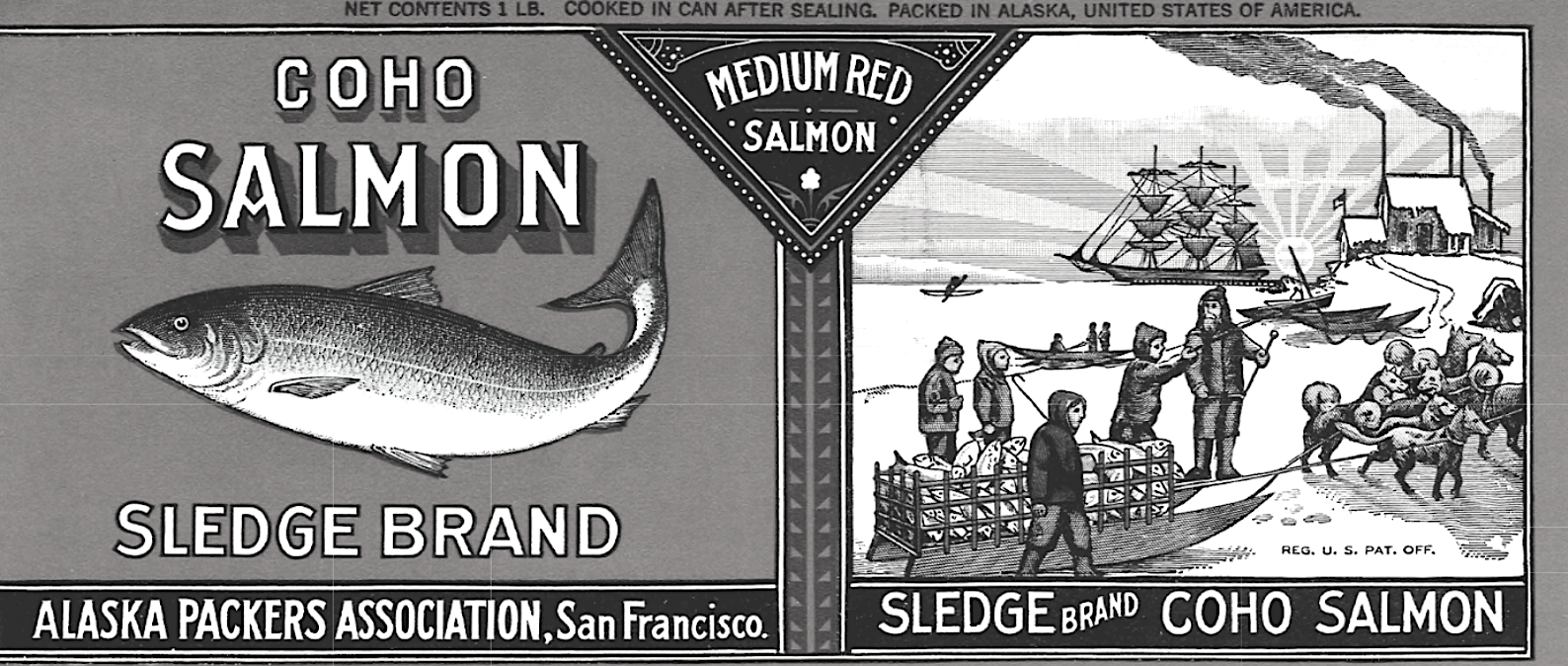
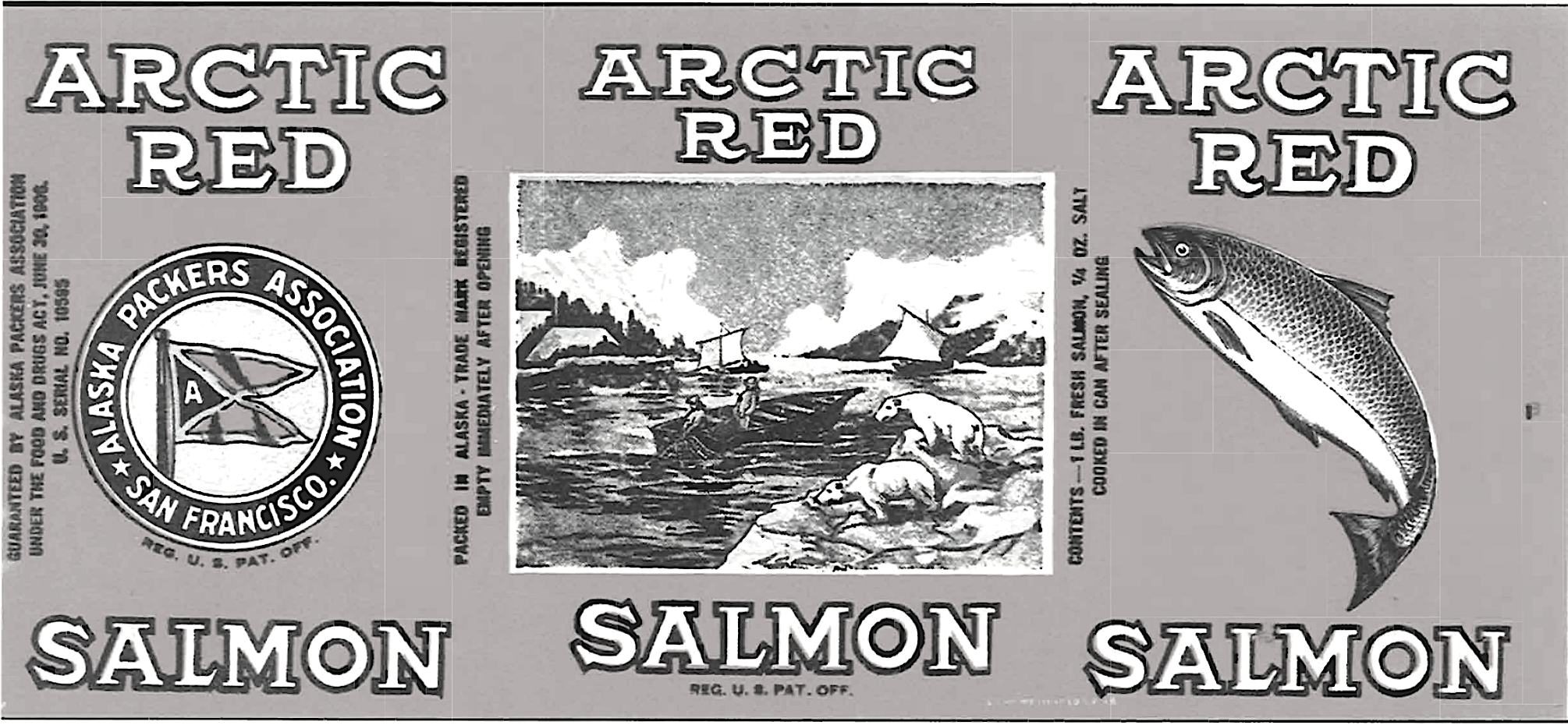
Commercial salmon canneries had their main origins in California and in the Pacific northwest, especially on the Columbia River, but by the 1920s the principal canneries had shifted their efforts to the wealth of salmon in Alaska. The Alaska Packers’ Association (APA) was a San Francisco-based manufacturer of Alaska canned salmon founded in 1891. As the largest salmon packer in Alaska, with canneries that stretched from Bristol Bay to the Southeast Alaska panhandle, the member canneries of APA were active in local affairs, and had considerable political influence.
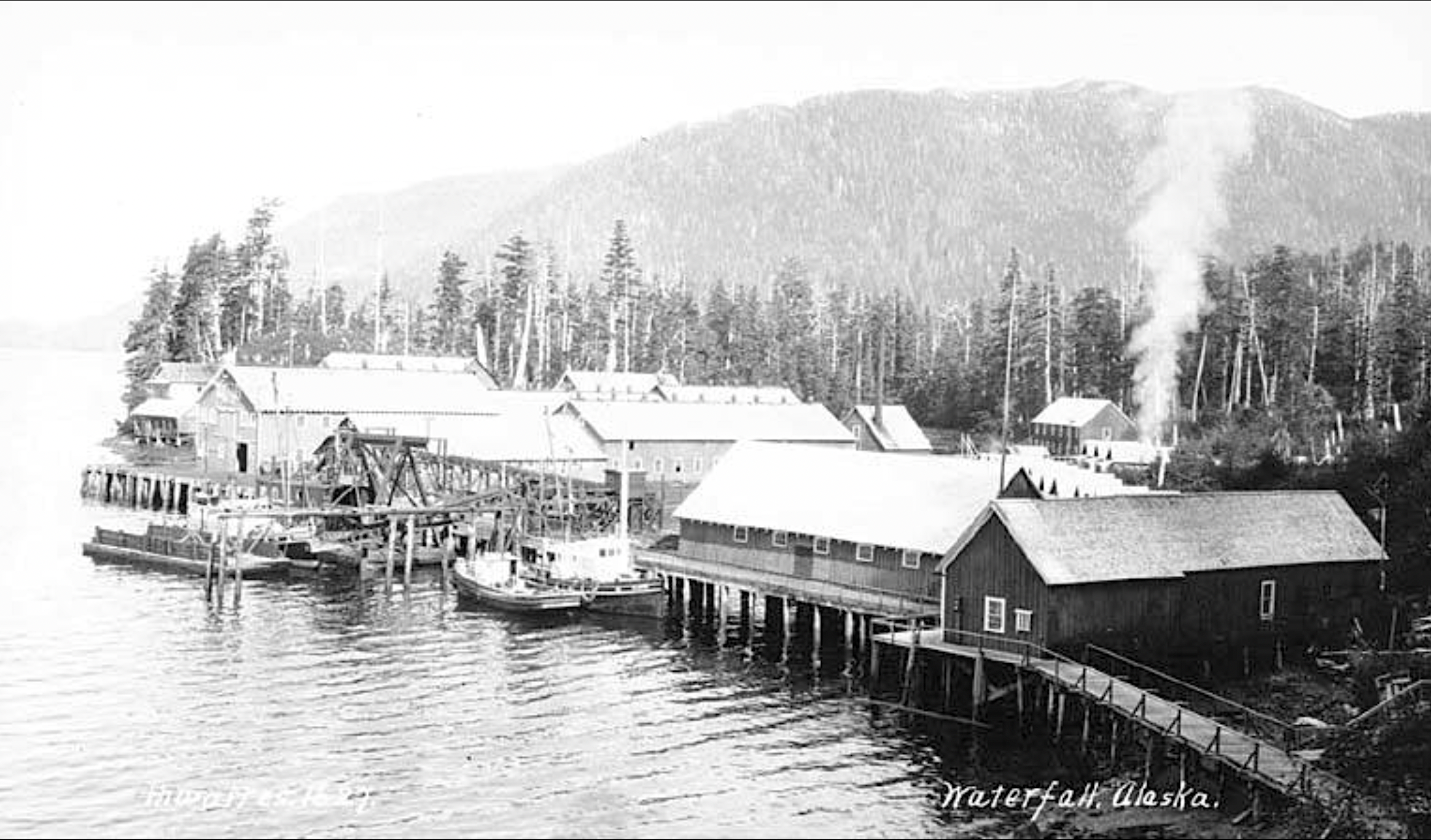
Founded in 1912 on Prince of Wales Island, Waterfall Cannery was once the largest salmon-processing facility in Southeast Alaska. The cannery closed in 1973 and was renovated into the Waterfall Resort, a sport fishing lodge.
By 1940 salmon was the largest industry in Alaska and produced over 80% of the territory’s tax revenues, even though fish numbers were already starting to significantly decline for the reasons named in the HAER survey, and due to a general downturn in salmon survival caused by a change in long-term climate cycles. Fish company lobbyists still put political pressure on the politicians in the territorial capital of Juneau and in Washington D.C., where the fishery was regulated by the Bureau of Commercial Fisheries in the U.S. Department of Commerce. The fishermen were seeking to increase the number of fish traps that were already allowed, and they wanted to locate their fish traps closer to the mouths of major salmon rivers.
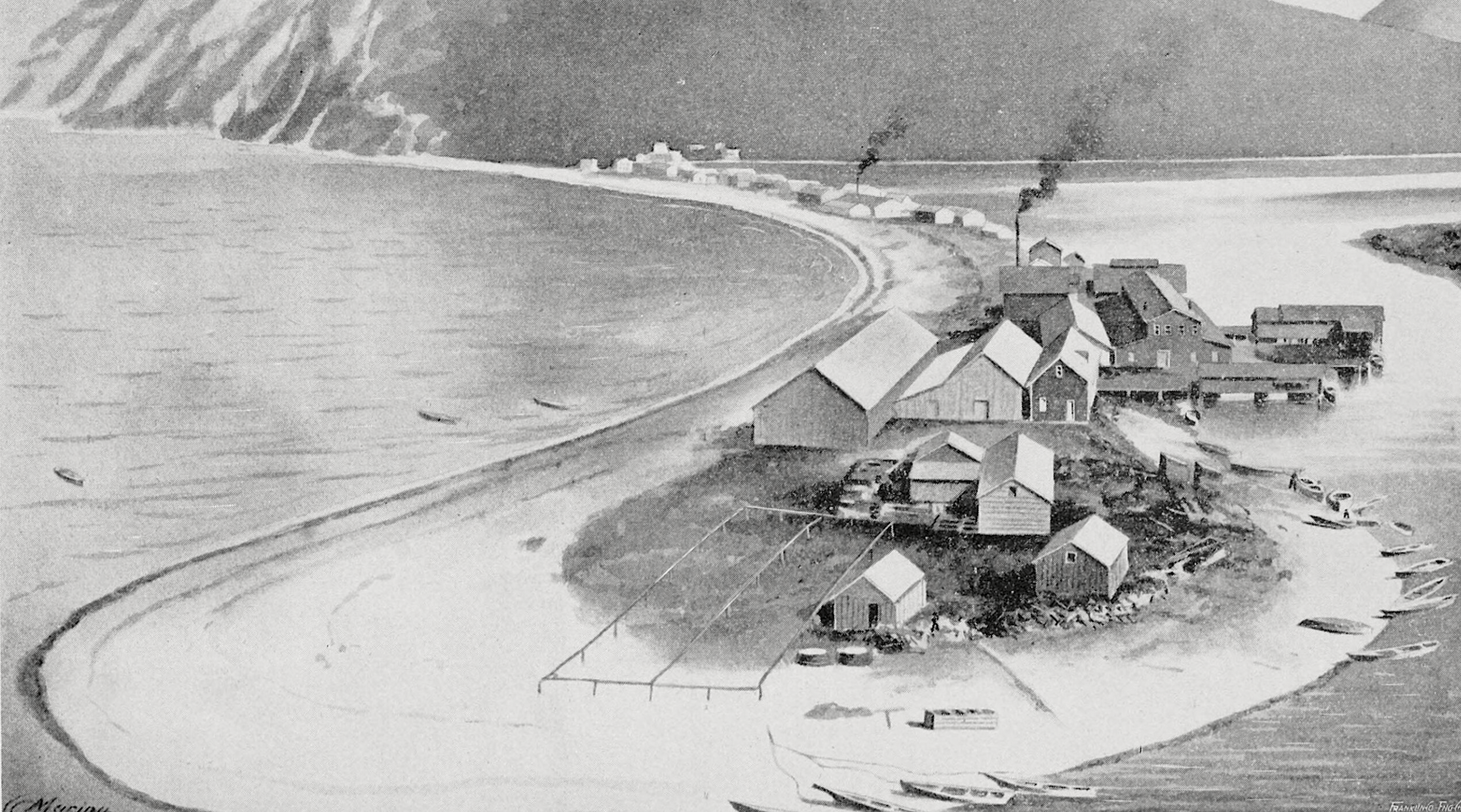
Karluk sandspit, on Kodiak Island, 1895, showing cannery and village. The Karluk River was known as the “River of Life” due to the dense salmon run.
Alaska’s cannery history was marked by frequent, destructive fires, often devastating local economies and worker housing, forcing relocations and even closures. Between 1878 and 1950, 134 canneries were constructed, and of those, 65 burned and were not rebuilt; five burned and were rebuilt, but by the end of 1950, only 37 canneries were still in operation.
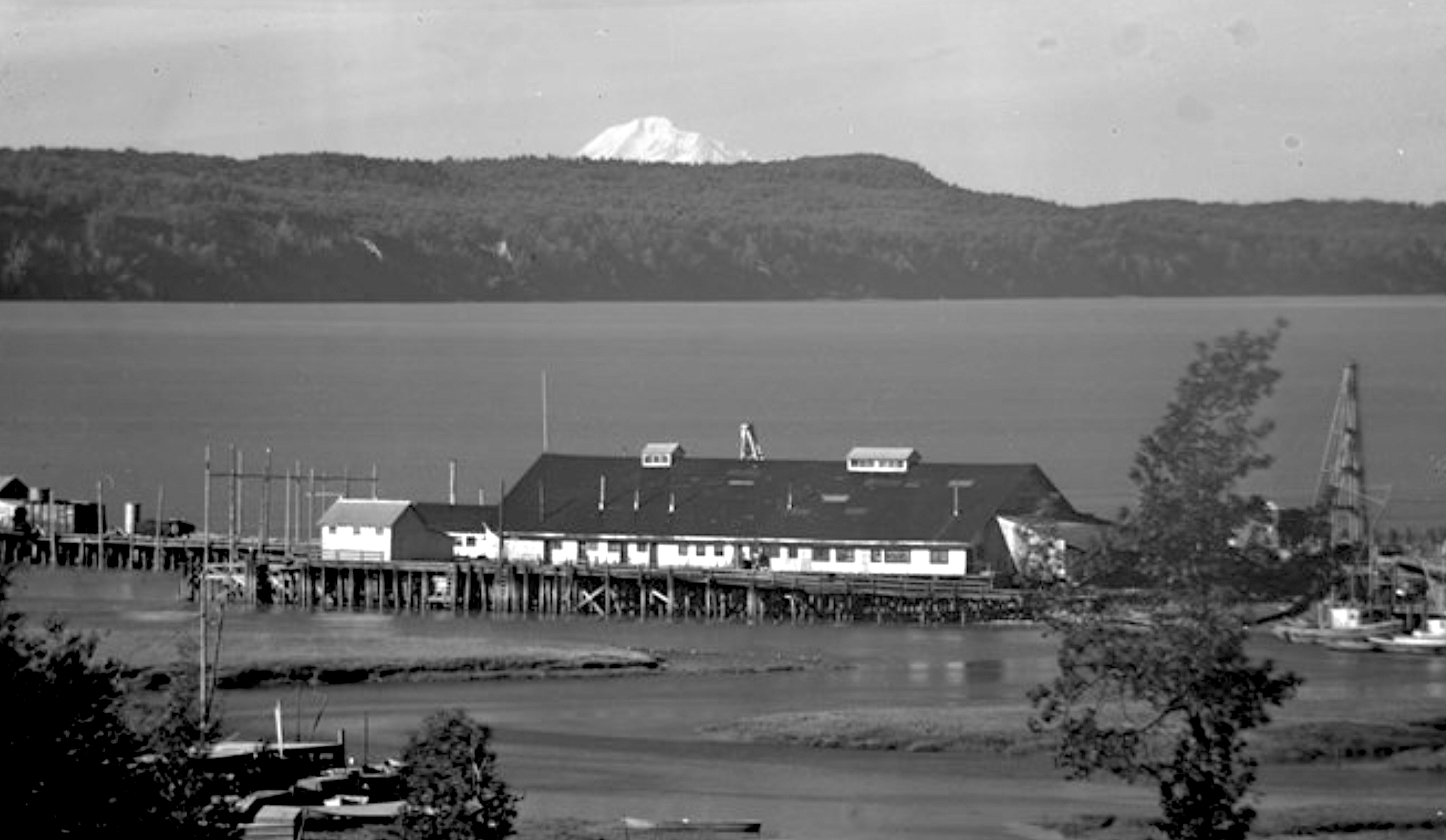
Emard Cannery at Ship Creek, with Denali on the horizon, 1940.
The seemingly endless abundance of previous years was not, however, sustainable, and while the early 20th century saw massive catches peaking around 1936, followed by significant declines, studies were undertaken, rules and laws were put in place, and recovery of the fisheries began through scientific management by the state. Modern management practices by the Alaska Department of Fish and Game has resulted in Alaska becoming the world’s largest producer of sustainable wild salmon. ~•~
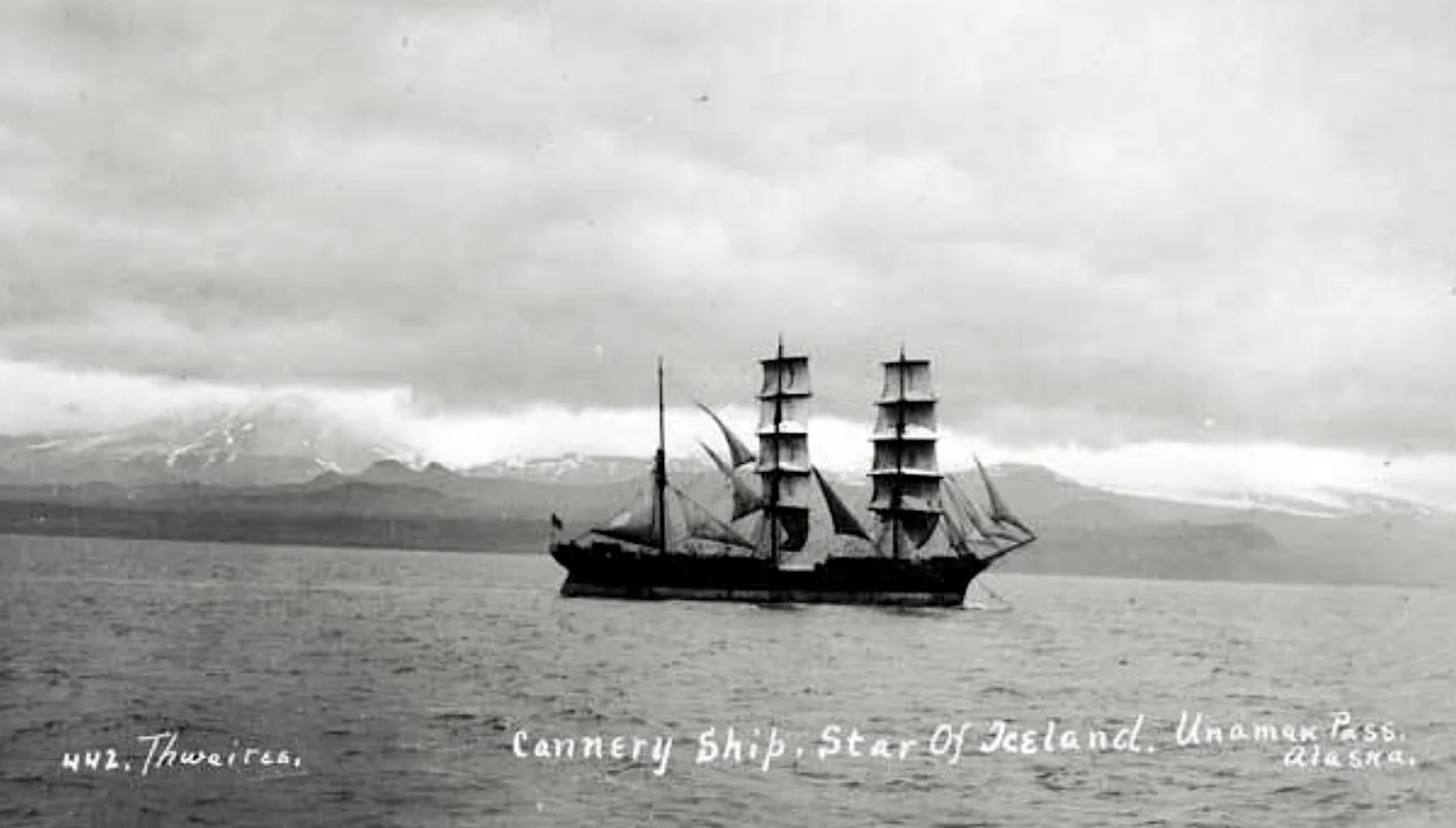
The Alaska Packers’ Association is best known for operating the “Star Fleet,” the last fleet of commercial sailing vessels on the West Coast of North America. Their tall ships reigned until around 1930, when most of the sailing ships were replaced with steam or diesel powered ships, but the company maintained the “Star of” naming protocol.
Cannery ship, “Star of Iceland,” at Unamak Pass in the Aleutian Islands, circa 1920
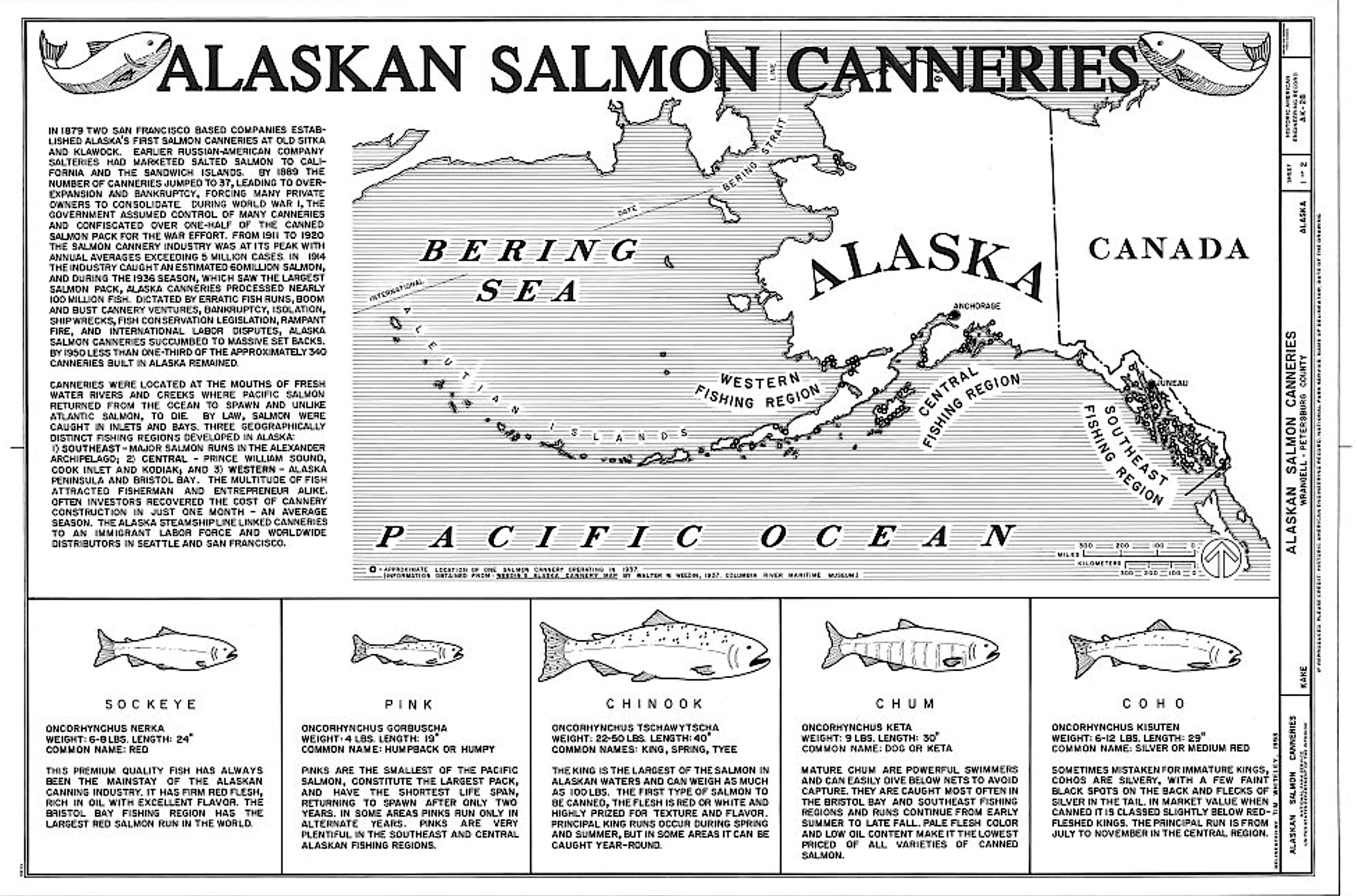
The text below is from the sidebar in the graphic above, which is part of the Historic American Engineering Record at the Library of Congress (HAER AK-28):
In 1879 two San Francisco based companies established Alaska’s first salmon canneries at Old Sitka and Klawock. Earlier Russian-American Company salteries had marketed salted salmon to California and the Sandwich Islands. By 1889 the number of canneries jumped to 37, leading to over-expansion and bankruptcy, forcing many private owners to consolidate.
During World War I, the government assumed control of many canneries and confiscated over one-half of the canned salmon pack for the war effort. From 1911 to 1920 the salmon cannery industry was at its peak with annual averages exceeding 5 million cases.
In 1914 the industry caught an estimated 60 million salmon, and during the 1936 season, which saw the largest salmon pack, Alaska canneries processed nearly 100 million fish. Dictated by erratic fish runs, boom and bust cannery ventures, bankruptcy, isolation, shipwrecks, fish conservation legislation, rampant fire,and international labor disputes, Alaska salmon canneries succumbed to massive set backs. By 1950 less than one-third of the approximately 340 canneries built in Alaska remained.
Canneries were located at the mouths of fresh water rivers and creeks where Pacific salmon returned from the ocean to spawn and unlike Atlantic salmon, to die. By law, salmon were caught in inlets and bays. Three geographically distinct fishing regions developed in Alaska: 1) Southeast – Major salmon runs in the Alexander Archipelago; 2) Central – Prince William Sound, Cook Inlet and Kodiak; and 3) Western – Alaska Peninsula and Bristol Bay. The multitude of fish attracted fisherman and entrepreneur alike. Often investors recovered the cost of cannery construction in just one month – an average season. The Alaska Steamship Line linked canneries to an immigrant labor force and worldwide distributors in Seattle and San Francisco. ~•~