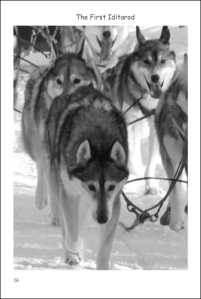
“Musher after musher agrees that no one – racers or officials – knew what to expect.” ~Bill Sherwonit in Iditarod: The Great Race to Nome (Alaska Northwest Books, 1991)
Mushers’ Tales From the 1973 Race
On a cold morning in March, 1973, thirty-six mushers stood at the starting line in Anchorage, Alaska, looking down the trail toward Nome, over 1,000 miles away. No one knew what to expect; nothing of this caliber and magnitude had ever been attempted. Sled dog racing in Alaska, at the time, meant driving fast teams around a sprint course, the longest and most famous of which was merely 25 miles. This race, over 1,000 miles through some of the harshest land imaginable, was something else entirely.
 Olaus Murie was a naturalist, author, and awildlife biologist who did groundbreaking field research, wrote in his 1973 book, Journeys to the Far North, (American West Pub. Co; 1973):
“Why do we look back to those days as something precious? Perhaps there was something there we do not yet understand. On those long dog trails, leading through miles of scrubby spruce forest, across lowland flats, over rolling hills, every traveler I met was a friend. We would maneuver our respective dogteams past each other in the narrow trail, plant a foot on the brake, and talk….Nothing weighty, these conversations. We were complete strangers, but in a sparsely settled land each person has more value. You’re glad to see each other. When you release your brake and your dogs perk up and yank the sled loose, you wave a mittened hand to your departing acquaintance with the warm feeling of a few shared moments….”
 In 2007 author Helen Hegener set about tracking down and visiting the still-living mushers from the 1973 race who would share their stories, their memories of what it was like to be one of the original pioneers setting out on what has since become known as “The Last Great Race on Earth.” Many of the first mushers had already written their own books, and many others did not reply to inquiries, but the bulk of this book is comprised of the verbatim words of eight mushers who made that first journey to Nome in 1973, captured through recorded and videotaped interviews conducted over a span of several years. They tell a captivating true story of hardship, joy, disappointment, camaraderie, harrowing escapes, and a strong proud undercurrent of knowing they were a part of Alaska’s historic first Iditarod.
“And they still don’t know what happened, because no one’s ever asked us.” ~Ford Reeves, who teamed up with Mike Schreiber to run the 1973 Iditarod
The Kindle edition of this book is formatted as a print replica Kindle book, which maintains the rich formatting and layout of the print edition, while offering many of the advantages of standard Kindle books. Features include a pop-out and linked table of contents, page numbers matching the print edition, the ability to zoom in or pan out on a page, and search, copy, and paste features. Visit the Kindle store on Amazon to preview a sample of the book or to order your own copy today for only $5.99 (Kindle MatchBook $2.99)!

VISIT THE LINK ABOVE TO VISIT THE AMAZON KINDLE STORE
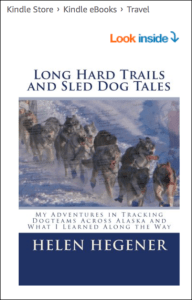 Now available in a print replica Kindle edition,
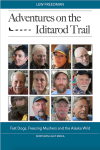
 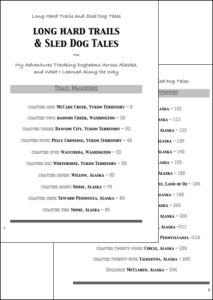 In this book Helen shares the life-changing adventures of her first few years spent paralleling the sled dog trails as a columnist for Alaska Dispatch, and a frequent contributor to several other publications, including Alaska Magazine, Last Frontier Magazine, Mushing Magazine and others.
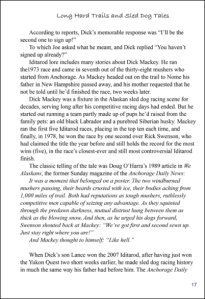 But going beyond the championship sled dog races, she also gives readers the backstory of her life as founder and co-publisher of an award-winning and widely-respected publication in alternative education, and the riveting nationally-watched lawsuit which set legal precedent, but cost her that business and much more; the ‘long hard’ part of the trail…
 “The valley looks great. It looks fine, fine. You got a mighty nice place here.” ~American humorist and commentator Will Rogers, Palmer, Alaska, August, 1935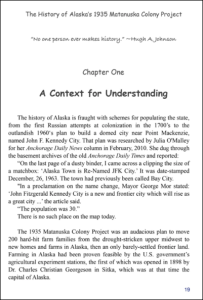
 The April 13, 1935 issue of the Ironwood Daily News, Ironwood, Michigan, noted: “Two hundred families–including 1,000 persons–have been selected from farms in northern Minnesota, Michigan and Wisconsin to form the colony. Each family will be lent $3,000 and will be furnished a 40-acre homestead. Thirty years will be allowed for repayment of the money. The 480 relief workers who help launch the project will return to the states in the fall, leaving the farmers to carry on.”
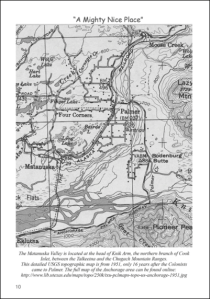 The remarkable photos of Willis T. Geisman, A.R.R.C. official photographer for the Matanuska Colony Project, documented every aspect of the venture, from the kitchen help aboard the North Star to the colonists’ children playing in the tent city, from officials posing stiffly for portraits to farmers working together to build homes before winter. His photographs portray proud farm wives showing their neat tent kitchens, and a small girl sitting in an Alaskan berry patch grinning at the cameraman. Geisman’s compelling images tell the true stories, moments in time captured and preserved, of children laughing, women working, men building futures for their families, brought together here with the detailed history of the Matanuska Colony Project.
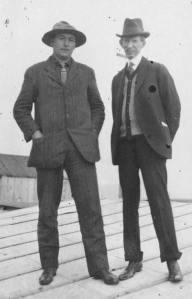
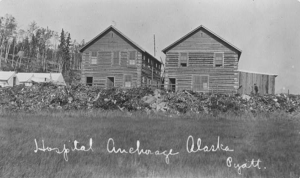
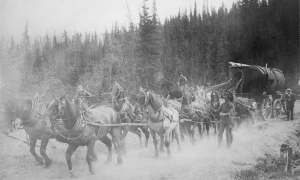
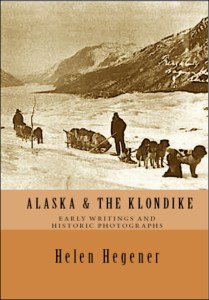
 Alaska & the Klondike, Early Writings and Historic Photographs, by Helen Hegener, published May, 2018, by Northern Light Media. An engaging journey through the literary history of Alaska and the Klondike, and an introduction to some of the most compelling books ever written about the North. $24.95 (plus shipping), 320 pages, over 100 b/w photos, ISBN-13: 978-1717401991.


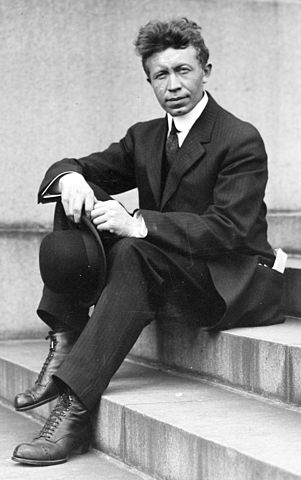

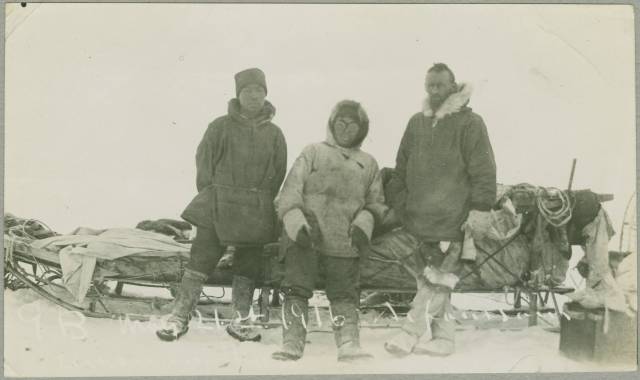
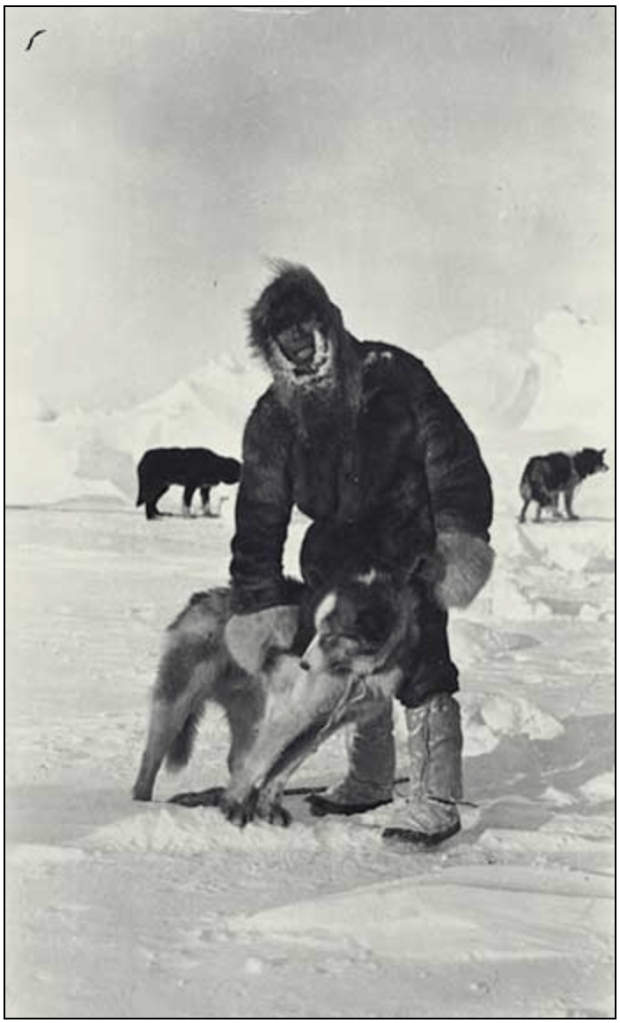

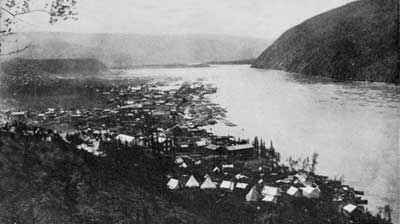
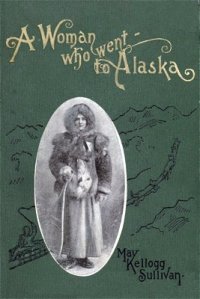 A Woman Who Went––to Alaska, by May Kellogg Sullivan, was published in 1902 by James H. Earle & Co., of Boston, Massachusetts. The book describes two trips in which the author journeyed to the Yukon and Alaskan goldfields in 1899, a year after the height of the Klondike Gold Rush. Her father and brother were working claims near Dawson City, and they were surprised to see her, and perhaps even more surprised when she continued her travels, eventually reaching Nome and Dutch Harbor. Regarding the reason for her adventurous trip, the author wrote: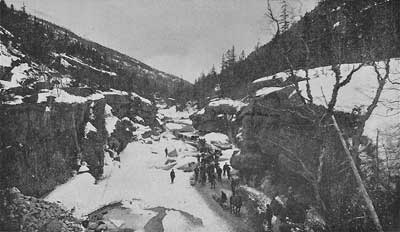
 Excerpts from May Kellogg Sullivan’s A Woman Who Went––to Alaska are included in the most recent book by Helen Hegener:


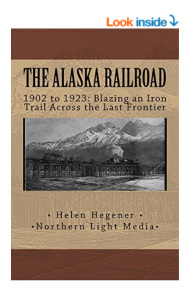
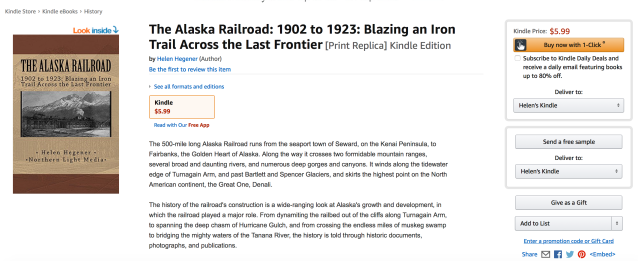
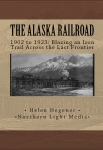 The Alaska Railroad: 1902-1923, Blazing an Iron Trail Across The Last Frontier, by Helen Hegener, published in May, 2017 by Northern Light Media. 400 pages, over 100 b/w historic photos, maps, bibliography, indexed. The book can be ordered via PayPal for $24.00 plus $5.00 postage, by














 Northern Light Media