Scheduled for publication in the fall of 2022 by Northern Light Media, The History of Sled Dogs in North America, by Helen Hegener and several contributing writers, will highlight the working sled dogs which helped shape the future of the continent.
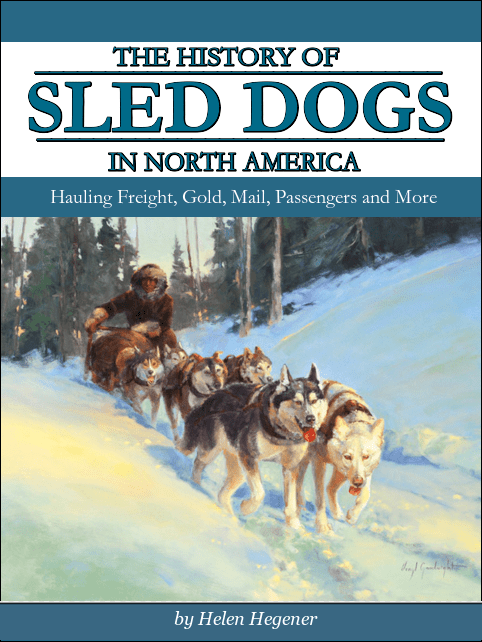
This full-color, elegantly illustrated book will feature historic photographs, illustrations, and beautiful art, such as the splendid “Northwoods Journey” on the cover, by Colorado artist Veryl Goodnight. This book will become a landmark reference on the interdependence of man and dog.
Click here to receive email updates on the book. Your email address will not be used for any other purpose.
Share this page with your friends through social media:
It’s been my good fortune to live in the Matanuska Valley for more than 40 years, and the Matanuska Colony barns have always been a part of my life in Alaska. Driving the roads around Palmer and Wasilla one sees the old structures often, glimpsed down a tree-lined dirt lane or silhouetted against a mountain backdrop, and they rarely fail to bring a smile. Like trusted and comforting old friends, the barns are always there.
In 1935 the U.S. Government transported 200 families from the Great Depression-stricken midwest to a valley of unparalleled beauty in Alaska, where they were given the chance to begin new lives as part of the Matanuska Colony Project. As part of each family’s farmstead, a magnificent barn was raised, a sturdy square structure 32′ by 32′ and soaring 32′ high. Today these Colony barns are an iconic reminder of what has been called the last great pioneering adventure in America.
I have been living with, admiring, and photographing these picturesque barns for decades, and in 2012 I turned my longtime interest into a book, a video, and a website.
The video is free to watch on this website. The book is available here or at Amazon. The website is filled with photographs, the history of the barns and the Matanuska Colony Project, and more. Check them out!
Share this page with your friends through social media:
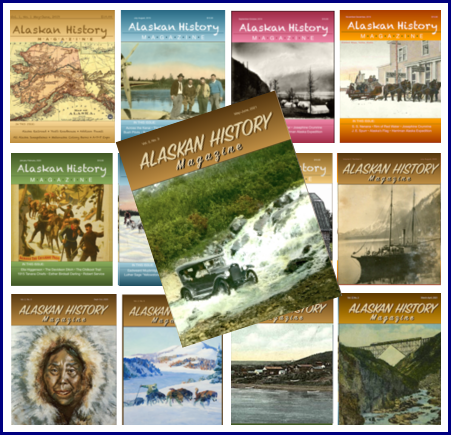
Alaskan History Magazine was a full color bimonthly magazine featuring stories and photos of the people, places and events which shaped the history of Alaska from prehistory to statehood. The magazine was published by Northern Light Media. Production stopped in June, 2021, but the fourteen issues in print will remain available through Amazon and Issuu.
Anthologies which collect issues into book format are also available from Northern Light Media.
The History of Sled Dogs in North America, by Helen Hegener and several contributing writers, tells the many and varied stories of the teams of working sled dogs which helped shape the future of the continent, whether hauling the mail, gold, freight, passengers, or racing each other for winning purses for their owners.
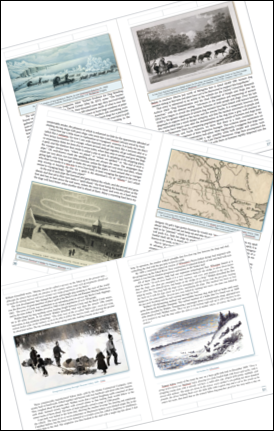
This full-color, elegantly illustrated book features the outstanding art of award-winning artist Veryl Goodnight and dozens of splendid historic photographs and illustrations. Drawing from many vintage books and historic writings on the earliest accounts of travel by dogteam, the book is a landmark reference on the interdependence of man and dog.
“They were new dogs, utterly transformed by the harness. All passiveness and unconcern had dropped from them. They were alert and active, anxious that the work should go well, and fiercely irritable with whatever, by delay or confusion, retarded that work. The toil of the traces seemed the supreme expression of their being, and all that they lived for and the only thing in which they took delight.”
—Jack London, The Call of the WIld, 1903
This wide-ranging book includes the use of sled and pack dogs by native Americans, traced back to prehistory; the coureurs des bois (runners of the woods), who were the first European mushers in North America; historic explorations which relied on dog teams; the dog teams of the Hudson Bay and Northwest Companies; the intrepid dogs of the Royal Canadian Mounted Police; famous mushers such as Harry Karstens, Arthur Treadwell Walden, Scotty Allan, Leonhard Seppala, Emile St. Goddard, Harry Wheeler, Jujiro Wada, Robert Kennicott, Dick Moulton, Norman Vaughan, Joe Redington Sr., Albert Campbell, Tud Kent, and many others; The Sirius Dog Sled Patrol in Greenland, the history of sled dogs at Denali National Park; the demonstration races at the 1932 Olympic games; the many gold rushes in which dog teams played key roles; the 1925 Serum Run to Nome; the breeding and development of northern breeds such as the Alaskan Malemute, the Chinook, the Siberian Husky, the Alaskan Husky and others; the great sprint and long-distance races; the long-distance travels of mushers such as Slim Williams, Mary Joyce, Eli Smith and others; and the dog teams of the scientists, doctors, mailmen, missionaries, businessmen, and dozens more whose teams made winter travel easier–and sometimes they were all that made it possible.
The History of Sled Dogs in North America
Softcover paperback printed in full color on premium stock paper, 416 pages, 8.5″ x 11″ format, dozens of b/w and color photographs, images, and artwork, extensively annotated, resources, bibliography, indexed. Published by Northern Light Media. $69.95 plus $6.50 shipping and handling. The important role of sled dogs across the North American continent, from their earliest partnerships with Native peoples to their significance in the opening of the North during gold rush and pioneer times, to their work delivering mail and supplies across Canada and the northern U.S.
$76.45
“This, in my opinion, is the Gold Standard on sled dogs.” -Amazon reviewer
“I am absolutely blown away! I have hundreds of books–make that thousands–and very few come close to being as extraordinary in scope!” -Veryl Goodnight, Mancos, Colorado
“You should be very proud of what you’ve created. It will be a long time, if ever, before something comparable is produced.” -Thomas Swan, Two Rivers, Alaska
“I have never seen a book about sled dog history this comprehensive and complete!” -Lila Franceau, Duluth, Minnesota
“This coffee table handsome book of 400 pages is filled with information, history, photography, art and stories. The full and mostly untold history between humans and dogs in the arctic is traced, beginning with the first inhabitants of North America. The great depth and breadth of this book truly makes it the Sled Dog Bible.” -Roger Brooks, Amazon Review
“I also know far more about not just the history of my home state of Alaska through the history shared by Hegener, but how sled dogs have impacted the nation as a whole. Bottom line, whether a dog fan, history buff, or someone just curious about past lives in the north, this book is a must. Having the info in one place is wonderful, but to have it in one place with such an array of illustrations and historical writings is amazing.” -June Price, Sunhusky Reviews, on Amazon
Share this page with your friends through social media:
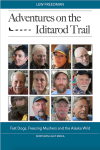
Author Lew Freedman details fifty years of race history, with synopses of each annual race, records of all of the award winners, and biographies of many individuals and families who have contributed to make the race what it is today, a worldwide phenomenon and The Last Great Race on Earth.
The cover art is by famed Alaskan artist Jon Van Zyle, a two-time Iditarod finisher (1976, 1979), a member of the Iditarod Hall of Fame, and the Official Artist of the Iditarod Trail Sled Dog Race.
“50 Years of Iditarod Adventures, The First Fifty Years of the Last Great Race,” by Lew Freedman. Published in February, 2022 by Northern Light Media. 310 pages, over 80 b/w photos, $24.95 plus $5.00 shipping. Available from Amazon, Paypal, or via any bookstore with ISBN no. 9798409923990
Reviewed in the United States on February 26, 2022
Having moderated a couple Iditarod related online groups in the past, I can attest to the fact that author Lew Freedman has managed to answer most of the FAQs that pop up, well, frequently. It will be a handy, easy to read resource for fans. Lots of list of who ran/won/placed/won awards and more. Freedman has also taken a look at some of the memorable characters of the sled dog race, including families who have become a part of race lore, the Mackey and Seavey families. Lots of photos, too, including I should probably admit, one of my own, and maps. If you’re a race fan, you need this book. Kudos to Freedman for putting together his love and extensive knowledge of the sport together in such a readable, usable fashion.
Share this page with your friends through social media:
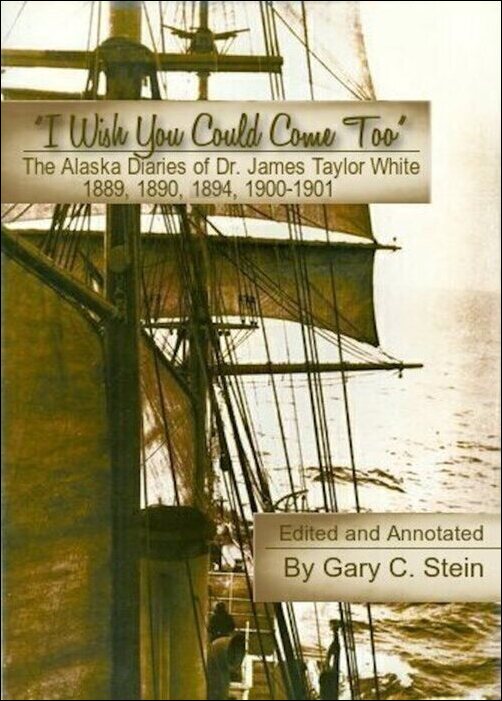
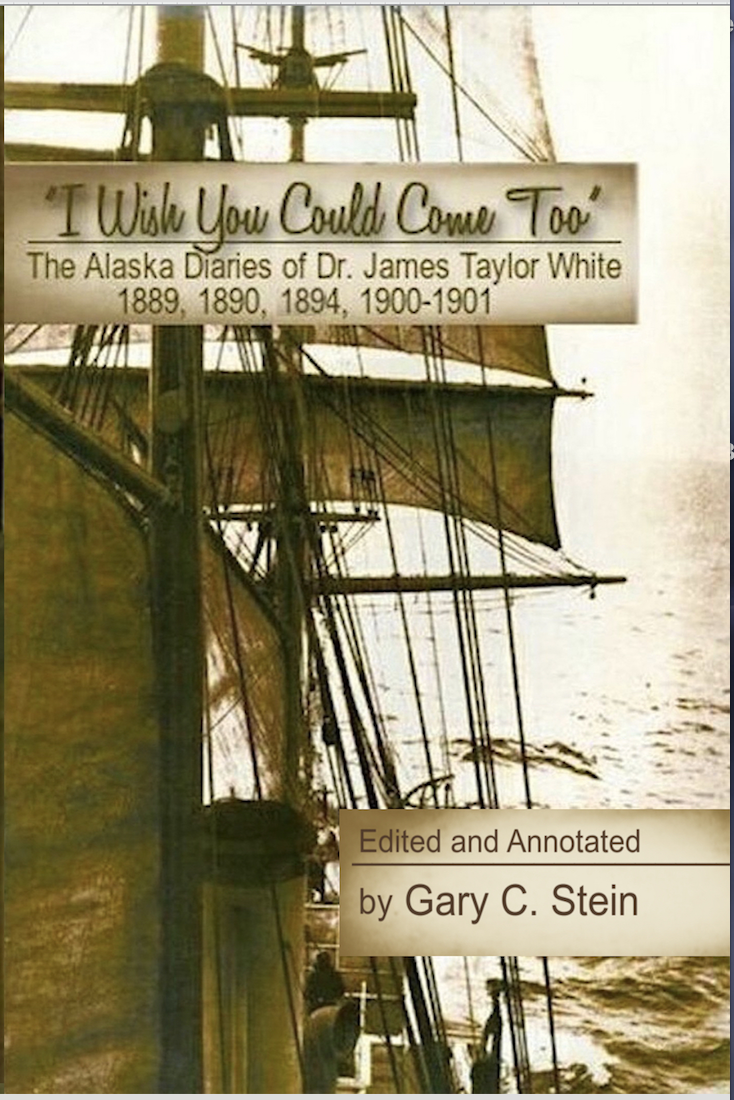
“I Wish You Could Come Too,” The Alaska Diaries of Dr. James Taylor White, by Gary C. Stein, is a first-hand look at life aboard a revenue cutter during Alaska’s formative early years.
The ships of the U.S. Treasury Department’s Revenue-Cutter Service patrolled the waters of the Bering Sea, the coast of Alaska, and the Yukon River, and for several of those voyages a bright and engaging young physician, Dr. James Taylor White, served aboard and recorded his adventurous work in personal correspondence and journals.
$29.95 plus $6.00 shipping. 412 pages, over 45 photographs, images, and maps. 6″ x 9″ b/w format, extensively annotated, bibliography, indexed.
Available from Northern Light Media (below) or your favorite bookstore!
The Alaska Diaries of Dr. James Taylor White
“I Wish You Could Come Too,” The Alaska Diaries of Dr. James Taylor White, by Gary C. Stein. $29.95 plus $6.00 shipping from Northern Light Media. 412 pages, over 45 photographs, images, and maps. 6″ x 9″ b/w format, extensively annotated, bibliography, indexed.
$35.95
Share this page with your friends through social media:
In the last half of the nineteenth century the ships of the U.S. Treasury Department’s Revenue-Cutter Service patrolled the waters of the Bering Sea, the coast of Alaska, and the Yukon River. For several of those voyages a bright and engaging young physician, Dr. James Taylor White, served aboard and recorded his adventurous work in personal correspondence and journals. Now a new book, “I Wish You Could Come Too,” The Alaska Diaries of Dr. James Taylor White, by Gary Stein, Ph.D. provides a first-hand look at life aboard a revenue cutter during Alaska’s early years.
The revenue cutters on which Dr. White served played a crucial role in the history of the north, beginning with the legendary USRC Bear, under the command of Capt. Michael A. “Hell Roaring Mike” Healy. On board the Bear Dr. White took part in patrolling for seal poachers, smugglers, and illegal traders; assisted in the capture and ferrying of Siberian reindeer to Alaska; and witnessed the Bear‘s duties as a floating hospital, courthouse, and rescuer of shipwrecked sailors. His later tours of duty aboard the USRC Rush and the USRC Nunivak included customs duties and enforcement of revenue and conservation laws, search and rescue missions, and bearing witness to the ravages of the 1900 influenza and measles epidemics in Native villages along the Yukon River.
Dr. White had many interests aside from his medical profession; he was also a naturalist, a photographer, a bit of an artist, an astute observer, and an amateur ethnographer particularly fascinated by Native cultures and traditions. Dr. White served as a contracted physician with the Revenue-Cutter Service during two decades of significant events, people, and trends in Alaska’s history. His diary entries are jumping-off points from which to see how Alaska’s history played out around him, while the author’s prologues and epilogues to each diary, along with extensive annotations, add contextual details about Alaskan history.
More than simply a dry text about historic events, Gary Stein’s book is the result of four decades of research, during which he developed an affinity for the good doctor, writing, “I met James T. White in 1980 while I was researching in the Alaska and Polar Regions Collections & Archives at the University of Alaska Fairbanks. We instantly became fast friends. He had been dead for sixty-eight years, but he let me pry into his life through his diaries, correspondence, scrapbooks, photographs, and natural history and ethnological collections located in various archives, museums and cemeteries in Alaska, Washington State, California, and Washington, D.C. We are friends still—I’ve even smoked a pipe with him at his grave—and there is a great deal of his life to share.”
Author Gary C. Stein received his Ph.D. from the University of New Mexico in 1975 with fields in Western American History and U.S. History to 1860, specializing in Native American History. He has worked as a research historian for the University of Alaska Fairbanks, the Alaska Department of Natural Resources in Anchorage, and the Bureau of Indian Affairs in Washington D.C. His personal research interests gravitated toward the history of the Revenue Cutter Service in Alaska. He is now retired and lives in St. Ann, Missouri, where he continues to write.
The Alaska Diaries of Dr. James Taylor White, by Gary C. Stein
$29.95 plus $6.00 shipping. 412 pages, over 45 photographs, images, and maps. 6″ x 9″ b/w format, extensively annotated, bibliography, indexed.
$35.95
Share this page with your friends through social media:
True Stories and Historic Photographs of the North
Available now are the first two volumes of what will be an ongoing series of engaging stories of the people who wrote the history of the Great Land, and the great events which shaped and defined that history.
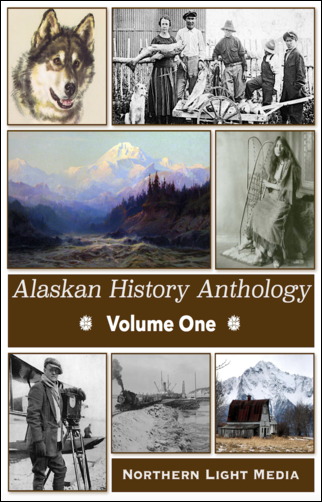
Volume One is a revised edition of the original anthology which featured the stories and photographs which ran in Alaskan History Magazine from the inaugural issue in May-June, 2019 through the Nov-Dec, 2019 issue. Compiled and edited by Helen Hegener, contributions by Tim Jones, Patricia De Nardo Schmidt. 225 pages, b/w 6″x9″ format, over 150 photographs.
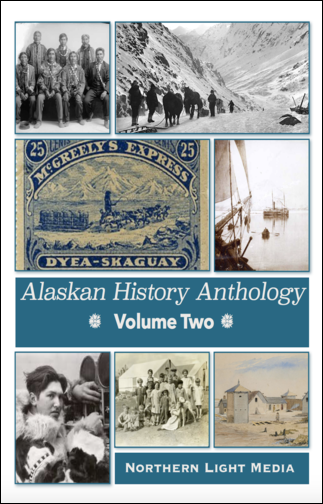
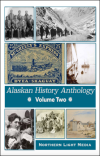
Alaskan History Anthology: Volume Two captures the second year of Alaskan History Magazine with “True Stories and Historic Photographs of the North.” The full texts of every article are highlighted by historic photos from the magazine. Compiled and edited by Helen Hegener, contributions by Gary Stein, Thomas Eley, Thom ‘Swanny’ Swan. 347 pages, b/w 6″x9″ format, over 200 photographs.
A third anthology, based on the articles from the 2021 magazine issues, will be released early next year. After that the books will take their content from my weekly newsletter and posts at my websites.
Alaskan History Anthology Volume 1
Volume 1 features articles from the first four issues: Alaska Railroad, Bush Pilots, Matanuska Colony Barns, Aleutian Islands, SS Nenana, J. S. Spurr, Harriman Expedition, All Alaska Sweepstakes, Orr Stage Company, Elizabeth Peratrovich, Glenn & Mendenhall in 1898 and much more! 225 pages, b/w 6″x9″ format, over 150 photographs. $24.95 plus $5.00 First Class shipping.
$29.95
Alaskan History Anthology Volume 2
Volume 2: Jan-Feb, 2020 through Nov-Dec, 2020: Chilkoot Pass, Tanana Chiefs, Robert Service, Governors of Alaska, Dr. James Taylor White, Mary Joyce, Matanuska Colony, Yellowstone Kelly, Stephen Birch, Hudson Stuck, 1918 Epidemic, SS Dora, C. C. Georgeson, Wells Fargo Co., Ray Mala, Leffingwell, Ft. Yukon, Nellie Cashman, Robert Kennicott and much more! 347 pages, b/w 6″x9″ format, over 200 photographs. $29.95 plus $5.00 First Class shipping.
$34.95
Share this page with your friends through social media:
Please note: Alaskan History Magazine ceased publication with the July-August, 2021 issue. All issues will remain in print, and are available in digital editions at issuu.com (2021 issues will be added soon.) In this issue:
• The Clay Street Cemetery
• Alaska Nellie, Peerless Alaska Railroad Hostess
• Ivan Petroff’s 1880 Report on Alaska
• Jujiro Wada, The Samurai Musher
• USGS Topographer-in-Charge, R. Harvey Sargent
• 1926-1929 U.S. Navy Aerial Alaskan Survey
• Dispatching the Army to Alaska
Sign up for the free email newsletter!
The May-June, 2021 issue of Alaskan History Magazine will include the following articles:
• Knik – At one time the largest community on Cook Inlet, and being on the Iditarod Trail, it was the chief outfitting point for much of western Alaska.
• Alaska Villlages, Eskimo, Indian, Aleut, 1937 – An unusual look at the villages of Alaska, from the perspectives of students boarding at the Eklutna Vocational School.
• An Alaskan “Mush” to Presbytery – The Reverend Samuel Hall Young was known as “The Mushing Parson,” and here he details one trip over the Iditarod Trail.
• Historic Alaskan Hot Springs – From the Panhandle to the Seward Peninsula, and from the Arctic Slopes to the Aleutian Islands, thermal hot springs are found all across Alaska.
• Hotel Holman / Blix’s Roadhouse – From a roadhouse in a tent beside the Copper River to one of the most respected establishments on the Valdez-to-Fairbanks Trail.
• Trading Cards: Captain Cook’s Third Voyage – Small colorful and informative, commercial trading cards from the Arbuckle Coffee Company told of Captain Cook’s final voyage.
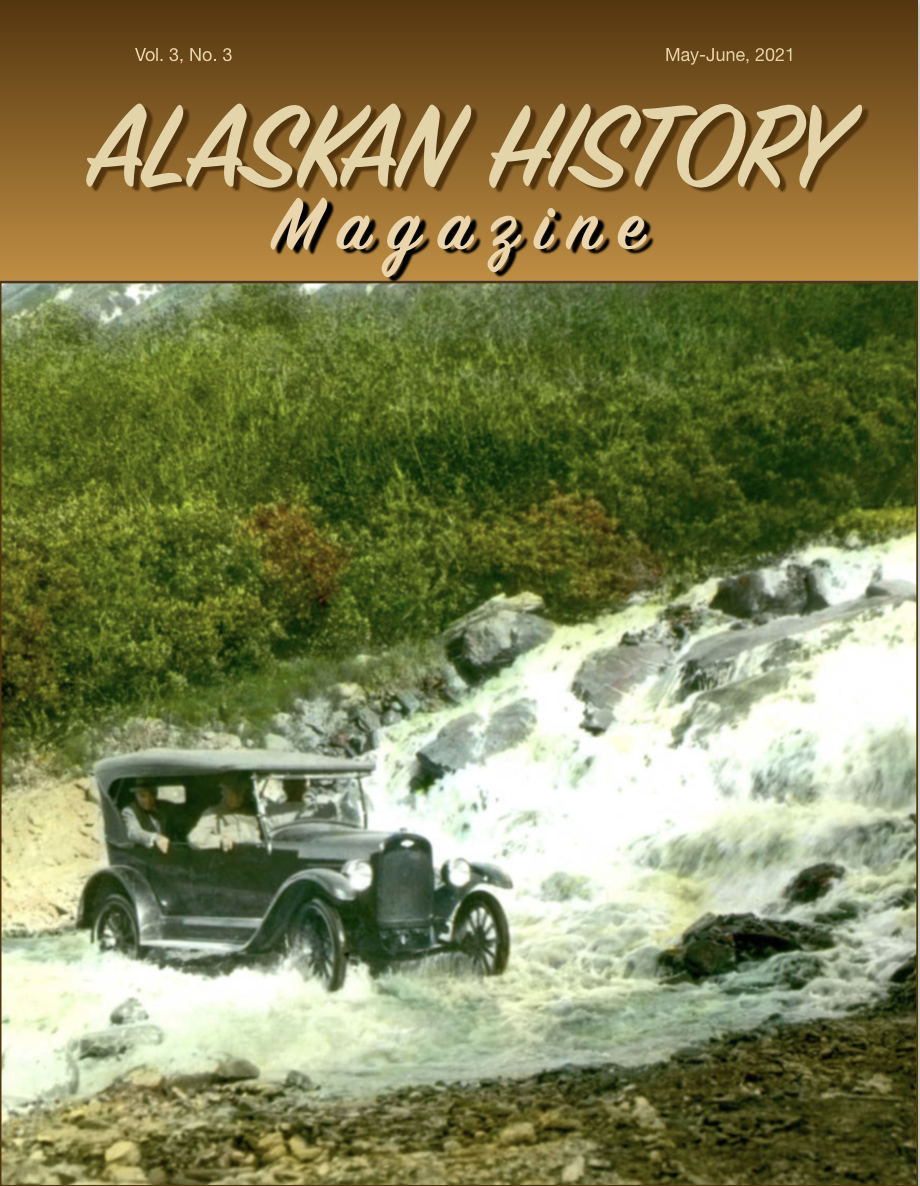
• 1923 Alaska Railroad Tour Lantern Slides – Presented as a promotional program for the then-new Alaska Railroad, these colorful slides share scenes of Alaska’s Great Circle Tour. The cover is a tinted slide from the tour, showing a Chevrolet crossing a glacier stream near the Worthington Glacier on the Richardson Highway. Click below to pre-order the May-June issue, mailed April 15th.
$12.00
Share this page with your friends through social media:






















 Northern Light Media