John August Springer

The Wes Grover farm is part of the original Springer homestead. Photo by Albert Marquez/Planet Earth Adventures LLC

The Venne barn, one of three on Wes Grover’s RG Farm. The Wes Grover farm is part of the original Springer homestead. Photo: Albert Marquez/Planet Earth Adventures LLC.

John August Springer

In October of 1914, an Alaskan pioneer of Swedish descent named John August Springer filed for homestead rights to 320 acres of benchland located on the north bank of a sweeping bend in the Matanuska River, with a commanding view of Pioneer Peak and the Knik River Valley to the south and east, and the Chugach Range behind what would become the location of Palmer to the northeast. Palmer wouldn’t be there for another fifteen years, of course, but George Palmer’s trading station had been established sometime between 1894 and 1898, near where the present-day bridges cross the Matanuska River just east of town.

According to a post on Facebook from the Palmer Historical Society, “Homesteader John August Springer put his model T Ford up on blocks with only 800 miles on it. He decided that the Valley roads were not good enough to drive on – thus he proceeded to walk everywhere for the remainder of his life.”

Springer built a log cabin and a few other buildings, and cleared and proved up on his land, receiving the patent in 1920. Fifteen years later, in 1935, he sold a portion of his homestead to the United States government for $7.50 an acre for the Matanuska Colony Project, which would bring 203 new families from the depression-era Midwest to build their own homes in the Valley. The Colonists who drew tracts in the area which had belonged to John Springer were very fortunate, for it was an excellent location with supreme topsoil.

The Grover farm and Springer's original homestead can be seen closest to the viewer. Springer System, June 7, 1941. Photo by U.S. Army Air Corps.

The Grover farm and Springer’s original homestead can be seen closest to the viewer. Springer System, June 7, 1941. Photo by U.S. Army Air Corps.

William Ising Family

One of the tracts of land previously belonging to John Springer was drawn by William Ising, who had joined the Colony Project from Saginaw, Minnesota with his wife, Marie, and their two children. William drew tract number 81, one of the few parcels which was 80 acres instead of the more usual 40-acre size. In 1948 the Isings sold their farm to Clifton and Vera Grover, who had recently arrived in Alaska from Utah. In 1968 their son Wes Grover and his wife, Bonnie, purchased the farm, which was by then a dairy operation. Two additional Colony barns were added to the property, the Joseph Dragseth barn from tract no. 84 was moved into place adjacent to the Ising barn, creating one large building; and the George Venne barn was moved onto the farm from tract number 82 and was set in a pasture just north of the other two barns. The picturesque RG Farm, located at the end of Grover Lane off the Outer Springer Loop, has been the location for many weddings, television commercials, and other events, and has been featured on the cover of the MTA phone directory.

Only a few notched logs remain to mark the location  of John Springer’s cabin overlooking the Matanuska River.

Only a few notched logs remain to mark the location of John Springer’s cabin overlooking the Matanuska River.

Inner and Outer Springer

The area south of Palmer which became known as the Springer System, with its looping roads named Inner Springer and Outer Springer, is the site of some of the richest and levelest farmland in the Matanuska Valley. Of the more than 200 farms which became the Matanuska Colony Project, for which the federal government offered financing and support, over one-quarter of them were located in the Springer Loop area. Today the Springer System is a network of picturesque farms which might pass for almost anywhere in the midwest if not for the towering peaks of the nearby Chugach Range. While an ever-increasing number of farms are being subdivided for tract housing, there are still enough hayfields, pastures, croplands and massive Colony barns to give the area a friendly rural feel. In fact, the Springer Loop Road area has the largest concentration of existing Colony barns, with most of them in their original locations.

Detail of logs, John Springer cabin.

Detail of logs, John Springer cabin.

In the southeast corner of the Outer Springer Loop Road, at the end of E. DePriest Avenue, a barely visible trail leaves the end of a cul-de-sac and strikes out toward the Matanuska River. A weathered sign on a nearby tree marks the trail, and after a short walk through the woods, a few of the logs of John Springer’s cabin can still be seen on a bluff overlooking the Matanuska River. John A. Springer chose an outstanding place for his homestead, and today’s residents of the area can only wonder what forces aligned for him and how he came to chose the splendid riverside location.

Posted in Alaska History, Matanuska Colony | Tagged | Leave a comment

The Great Alone

MV5BMTUxMzk0MjY4M15BMl5BanBnXkFtZTgwMjMyNjQxNDE@._V1_SX214_AL_During the 2013 Iditarod Trail Sled Dog Race the independent filmmaker Greg Kohs followed four-time Iditarod and Yukon Quest champion Lance Mackey along the trail. Combining that hard-won film footage with family photos, interviews and other media, Kohs produced a film which told an incredible story of one man’s dedication, endurance, and faith, not only in his own abilities, but in his dogs, and in his family, friends, fans and sponsors who helped him achieve the seemingly near-impossible.

In March the film was screened for audiences in Anchorage and Fairbanks, and in an article for Alaska Dispatch Suzanna Caldwell quoted Kohs, “What was appealing to me about Lance was his openness and honesty, he was just very authentic.” Caldwell wrote [the film] “…traces back to his early life, with family interviews, including dad and 1978 Iditarod champion Dick Mackey, along with his hard-scrabble rise over the years to becoming a legendary dog musher.”

Best_of_SIFF_238x238The film was enthusiastically received by sold-out crowds in both Anchorage and Fairbanks, and this past weekend Kohs’ film, The Great Alone, won the Grand Jury Award for Best Documentary at the Seattle International Film Festival. Recognized as one of the top film festivals in North America, the Seattle International Film Festival (SIFF), held annually since 1976, is the largest, most highly-attended film festival in the United States, with over 155,000 attendees annually. This year’s SIFF showcased over 450 films, with 70 documentaries competing for top honors.

For those in the Seattle area, there will be an encore presentation of The Great Alone at “The Best of SIFF 2015” on Sunday, June 14th @ 2:15 p.m. at SIFF Cinema at the Uptown Seattle, Washington.

Posted in DVD & Video | Tagged , , , , , , , , , , , | Leave a comment

Knik Arm

Knik Arm, looking northeast from Point Mackenzie

Knik Arm, looking northeast from Point Mackenzie

Only a River . . .

Knik Arm is the northernmost branch of Cook Inlet, a great body of water which stretches 180 miles from the Gulf of Alaska and splits at Anchorage into Knik Arm and the more southern Turnagain Arm.

BlighWilliam Bligh, who served as Captain Cook’s Sailing Master on his third and final voyage, thought that both Knik Arm and Turnagain Arm were the mouths of rivers and not the opening to the Northwest Passage.

Under Cook’s orders Bligh organized a party to travel up Knik Arm, and they quickly returned to report that Knik Arm indeed led only to a river.

Early Knik

Early Knik

Early Navigation

Boats of any kind are a rare sight on Knik Arm today, but in times long past the Arm was traversed by rowboats, freighters, and sailing ships.

George Palmer, a merchant who owned stores in Knik and near the later site of Palmer, frequently crossed the Knik Arm, as cited by Valley historian Colleen Mielke: “Palmer’s first schooner, the two masted ‘C. T. Hill,’ arrived at Knik Harbor June 7, 1913. Leaving his store in the hands of a clerk, Palmer and crew sailed the schooner from Goose Bay to San Francisco, two or three times a summer and brought back merchandise for his store.” And: “In the spring of 1915, Palmer traveled to Seward, by dog sled, where he boarded a steamer to San Francisco to purchase a newer schooner named ‘The Lucy.’ Palmer and ‘The Lucy’ arrived at Goose Bay on May 3, 1915.”

26473520

April 1907, Palmer’s launch via Knik to Seldovia

Colleen Mielke later reports: “A fearless boatman, Palmer made routine trips from Knik to Tyonek, Sunrise, Hope and Seldovia, bucking the relentless Turnagain Arm wind and tide, in a small open gas boat.”

Today’s navigators generally avoid the silty, churning, tide-wrenched waters of Knik Arm. There are far easier ways to get from point A to point B.

Excerpted from The Beautiful Matanuska Valley, by Helen Hegener (Northern Light Media, 2013).

The Beautiful Matanuska Valley

Matanuska ValleyThis book is a must-have volume for anyone who lives in, travels through, or loves Alaska’s beautiful Matanuska Valley! 140 pages, full color, 8.5″ x 10″ paperback, maps, resources, index and photo index.

• $29.95 plus $5.00 postage and handling.

Valley Buy Now• To place a secure order via credit card or Paypal, simply click this image link:

• To order via check or money order, mail your order to Northern Light Media, PO Box 298023, Wasilla, Alaska 99629

• Also available via IndieBound and on Amazon

Posted in Books | Tagged , , , , , , , , , , , | Leave a comment

Sheep Camp Dog Team

Hegg, Eric A., 1898: Sheep Camp on the Chilkoot trail during the Klondike Gold Rush. Advertisement on log cabin reads: "The Mascot. Hot drinks and meals, lunches and beds." Caption on image: "The favorite dog team of Sheep Camp"


Sheep Camp on the Chilkoot trail during the Klondike Gold Rush. Advertisement on log cabin reads: “The Mascot. Hot drinks and meals, lunches and beds.” Caption on image: “The favorite dog team of Sheep Camp” Photo by Eric A. Hegg, 1898

Posted in Uncategorized | Leave a comment

Alaskan Roadhouses

"An Alaskan Road House"; stable, cabins, and tents at the mouth of a mountain valley, a snowy peak framed in the valley. Location not specified. From 'Alaska the Great Country,' copyright 1908, MacMillan Co., by Ella Higginson, photographer E.A. Hegg, Juneau

“An Alaskan Road House”; stable, cabins, and tents at the mouth of a mountain valley, a snowy peak framed in the valley. Location not specified. From ‘Alaska the Great Country,’ copyright 1908, MacMillan Co., by Ella Higginson, photographer E.A. Hegg, Juneau

“Under no circumstance should the Alaskan roadhouse be confused with the establishments scattered along the highways on the outside that call themselves ‘roadhouses.’ The Alaskan roadhouse is a trail or roadside hotel. It deserves and has earned the high regard that all Alaskan and northern travelers have for the ‘roadhouse.’ Many tales of heroism and bravery could be told of the daring rescue and relief parties that have been headed by the intrepid roadhouse keepers. Story has it that no stranded man or dog has ever been denied food or shelter by these landlords of the lonely northern trails.” ~William E. Gordon, in Icy Hell (Wm. Brendan & Son, 1937)

Blix Roadhouse ~ Copper Center

Cape Nome Roadhouse ~ Seward Peninsula

Deering Roadhouse ~ Seward Peninsula

Grandview Roadhouse ~ Kenai Peninsula

Haly’s Roadhouse ~ Fort Yukon

Kantishna Roadhouse ~ Denali Park

Pioneer Roadhouse ~ Knik

Rika’s Landing Roadhouse ~ Delta Junction

Slana Roadhouse ~ Slana

Talkeetna Roadhouse ~ Talkeetna

Posted in Uncategorized | Tagged | Leave a comment

Matanuska Colony History

On Wednesday, May 20, I gave an hour-long talk and slideshow on the history of the 1935 Matanuska Colony Project for the Palmer Historical Society. It’s always interesting to given presentations of that history in Palmer, for many of those in the audience are friends and descendants of the original Colonist families, and they often know a lot more about the history than I do. But I talk about what I’ve learned in my research and we have a good time sharing and enjoying the old photos. And there are many wonderful photos! Here is a quick sampling of those I shared during my talk, most of them are by Willis T. Geisman, the official A.R.R.C. photographer for the project:

I explained how my interest in the Colony began with my research on the Colony barns. This is the Rebarchek barn, gone now. [Library of Congress photo]

I explained how my interest in the Colony began with my research on the Colony barns. This is the Rebarchek barn, gone now. [Library of Congress photo]

The old Rebarchek farm is now part of the Alaska State Fairgrounds. [Northern Light Media photo]

The old Rebarchek farm is now part of the Alaska State Fairgrounds. [Northern Light Media photo]

The iconic Palmer water tower behind Palmer's second post office, 1935. [Willis T. Geisman, 1935]

The iconic Palmer water tower behind Palmer’s second post office, 1935. [Willis T. Geisman, 1935]

The town of Matanuska, seen from the tracks of the Alaska Railroad, August, 1916

The town of Matanuska, seen from the tracks of the Alaska Railroad, August, 1916

Constructing the mess tent for the workers at Palmer [Willis T. Geisman, 1935]

Constructing the mess tent for the workers at Palmer [Willis T. Geisman, 1935]

Newly arriving colonist families seek their tent homes [Willis T. Geisman, 1935]

Newly arriving colonist families seek their tent homes [Willis T. Geisman, 1935]

Driving pins into log walls [Willis T. Geisman, 1935]

Driving pins into log walls [Willis T. Geisman, 1935]

Near the warehouse in Palmer [Willis T. Geisman, 1935]

Near the warehouse in Palmer [Willis T. Geisman, 1935]

A group of colonist children [Willis T. Geisman, 1935]

A group of colonist children [Willis T. Geisman, 1935]

Mrs. Anna Emma Havemeister and her family [Willis T. Geisman, 1935]

Mrs. Anna Emma Havemeister and her family [Willis T. Geisman, 1935]

Posted in Alaska History | Tagged , , , , | Leave a comment

PHS History Night

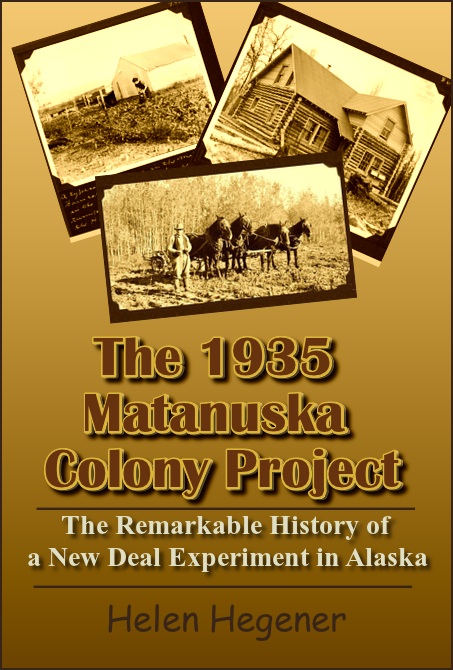
Mat Colony ProjectI’ll be giving a slideshow and presentation about four of my books for the Palmer Historical Society’s History Night on Wednesday, May 20th, at the Palmer Public Library. Through photos, stories, and a look at the history behind the Colony Project, I’ll share what led me to write the books which focus on the Colony and the Matanuska Valley, including how my research was done, and what I learned about this important chapter of Alaska’s history, when 200 families traveled north on a government troopship to carve their homes and farms from the Alaskan wilderness.

Matanuska ValleyThe four books featured will be The Matanuska Colony Barns, The Beautiful Matanuska Valley, and my two books on the history of the Matanuska Colony Project. All can be purchased at Fireside Books and the Colony House Museum in Palmer, from this website or Amazon, or from any bookstore, anywhere, just give them the title and author.

I hope you’ll join us on May 20th, at 7:00 pm, in the conference room of the Palmer Public Library, for this fun FREE event! The Palmer Historical Society’s History Nights are always an interesting and engaging exploration of our Valley’s fascinating past!

Posted in Alaska History, Books | Tagged , , , , , | Leave a comment

Road Trippin’ Roadhouses

Screen Shot 2015-05-07 at 8.21.59 PMOver the past couple of weeks I’ve been watching with interest as reporters from KTUU Channel 2 in Anchorage have been visiting old roadhouses around the state for their program Road Trippin’ Alaska. They’ve already visited several of the classic roadhouses I’d earmarked for inclusion in my upcoming book about the roadhouses, such as the Talkeetna Roadhouse, the Chatanika Roadhouse, the Black Rapids Roadhouse, and the Gakona Roadhouse. These great roadhouses have also been featured by artist and author Ray Bonnell in Alaska Sketchbook and his column for the Fairbanks Daily News-Miner.

Screen Shot 2015-05-07 at 8.23.38 PMThe short video visits are fun and informative, and many of the roadhouses have been filmed more than once. For example, at the Talkeetna Roadhouse there’s an overview of the history of Talkeetna and the roadhouse, and in other videos the reporters join roadhouse owner Trisha Costello to learn pie-making, visit the local radio station and check out the recycling center.

Screen Shot 2015-05-07 at 8.19.33 PMAn Instagram feed and additional photos showcase more history and details about the roadhouses, and there’s a Road Trippin’ ‘I Spy‘ game to play in conjunction with the program. Check out KTUU’s Morning Edition for the next roadhouse on their statewide tour!

Posted in Roadhouses | Tagged , , , , , , , , | Leave a comment

S. Hall Young, Mushing Parson

400px-Cover_-_Alaska_days_with_John_Muir“In the summer of 1879 I was stationed at Fort Wrangell in southeastern Alaska, whence I had come the year before, a green young student fresh from college and seminary–very green and very fresh–to do what I could towards establishing the white man’s civilization among the Thlinget Indians. I had very many things to learn and many more to unlearn.” These are the opening words of Reverend Samuel Hall Young’s classic 1915 book, Alaska Days with John Muir (Fleming H. Revell Co., New York 1915). Young paints a vivid picture of the iconic naturalist, arriving on a steamboat with a group of people Young had come down to the dock to meet: “Standing a little apart from them as the steamboat drew to the dock, his peering blue eyes already eagerly scanning the islands and mountains, was a lean, sinewy man of forty, with waving, reddish-brown hair and beard, and shoulders slightly stooped. He wore a Scotch cap and a long, gray tweed ulster, which I have always since associated with him, and which seemed the same garment, unsoiled and unchanged, that he wore later on his northern trips. He was introduced as Professor Muir, the Naturalist.”

S. Hall Young, circa 1879

S. Hall Young, circa 1879

Reverend Young and Mr. Muir were destined to become great friends, and Young details their first mountain-climbing jaunt with great relish: “I had been with mountain climbers before, but never one like him. A deer-lope over the smoother slopes, a sure instinct for the easiest way into a rocky fortress, an instant and unerring attack, a serpent-glide up the steep; eye, hand and foot all connected dynamically; with no appearance of weight to his body—as though he had Stockton’s negative gravity machine strapped on his back.” The book is online to read or download free. The first two chapters are a breathless recitation of the thrilling climb across a glacier and up a sheer mountainside to see the sunset from the peak, and when near-tragedy befalls Reverend Young the story relates Muir’s almost unbelievably heroic rescue of his friend.

mapReverend Young, the first missionary in Alaska, recounts a six-week voyage through southeastern waters he undertook in a great cedar canoe with Muir and a half-dozen Thlinget Indians as scouts and crew. Visiting villages along the route, Young noted: “I took the census of each village, getting the heads of the families to count their relatives with the aid of beans,—the large brown beans representing men, the large white ones, women, and the small Boston beans, children. In this manner the first census of southeastern Alaska was taken.”

John Muir circa 1875

John Muir circa 1875

One night John Muir stumbled into their Glacier Bay camp with two Indians who’d guided the great explorer off the glacier which would bear his name. Muir had been long overdue when Reverend Young sent them to build a beacon fire, which Muir admitted turned his back in the right direction, but then he excitedly added, “Man, man; you ought to have been with me. You’ll never make up what you have lost to-day. I’ve been wandering through a thousand rooms of God’s crystal temple. I’ve been a thousand feet down in the crevasses, with matchless domes and sculptured figures and carved ice-work all about me. Solomon’s marble and ivory palaces were nothing to it. Such purity, such color, such delicate beauty! I was tempted to stay there and feast my soul, and softly freeze, until I would become part of the glacier. What a great death that would be!”

220px-Glacier_-_Stickeen_Valley_-_Alaska_Days_with_John_Muir

Glacier, Stickeen Valley

At the end of the voyage Reverend Young wrote, “I have made many voyages in that great Alexandrian Archipelago since, traveling by canoe over fifteen thousand miles—not one of them a dull one—through its intricate passages; but none compared, in the number and intensity of its thrills, in the variety and excitement of its incidents and in its lasting impressions of beauty and grandeur, with this first voyage when we groped our way northward with only Vancouver’s old chart as our guide.”

Stickeen

Stickeen

The following spring John Muir returned from his home in the sunny south, determined to visit the glaciers they had not seen on their trip the previous fall, and they once more set out in a cedar canoe with Native guides. Reverend Young wrote: “When we were about to embark I suddenly thought of my little dog Stickeen and made the resolve to take him along. My wife and Muir both protested and I almost yielded to their persuasion. I shudder now to think what the world would have lost had their arguments prevailed! That little, long-haired, brisk, beautiful, but very independent dog, in co-ordination with Muir’s genius, was to give to the world one of its greatest dog-classics.”

Stickeen: John Muir and the Brave Little Dog, by John Muir, as retold by Donnell Rubay. Scholastic Inc., 1998, 30 pages. Illustrated in color by Christopher Canyon.

Stickeen: John Muir and the Brave Little Dog, by John Muir, as retold by Donnell Rubay. Scholastic Inc., 1998, 30 pages. Illustrated in color by Christopher Canyon.

The book which Muir would later write was, of course, the classic Stickeen: The Story of a Dog (Riverside Press,Cambridge, MA 1909), which relates one of John Muir’s most harrowing adventures, accompanied only by his friend’s small dog. Unable to convince the adventure-loving dog to remain behind, Muir set out to explore the face of a great glacier, and reached a dangerous crevasse blocking his way, with only a thin ice-bridge as a crossing and unimaginable black depths below it. He wrote of little Stickeen, showing something of his own nature in telling the story: “Never before had the daring midget seemed to know that ice was slippery or that there was any such thing as danger anywhere. His looks and tones of voice when he began to complain and speak his fears were so human that I unconsciously talked to him as I would to a frightened boy, and in trying to calm his fears perhaps in some measure moderated my own. ‘Hush your fears, my boy,’ I said, ‘we will get across safe, although it is not going to be easy. No right way is easy in this rough world. We must risk our lives to save them. At the worst we can only slip, and then how grand a grave we will have, and by and by our nice bones will do good in the terminal moraine.'”

“The Mushing Parson” frontispiece of his autobiography, Hall Young of Alaska, An Autobiography

Reverend Young and John Muir remained lifelong friends. During the 10 years he lived and worked in Wrangell with his family, Rev. Young established several southeastern missions and became a man of some standing. In 1897 he was strongly considered for appointment as governor of the territory of Alaska by President McKinley. Instead he traveled over Chilkoot Pass and down the Yukon River at the height of the Klondike gold rush, and established the first Presbyterian church in Dawson City in 1898. Traveling down the Yukon River over the next three years, he organized missions at Eagle, Rampart, Nome, and Teller. In 1901 he was appointed superintendent of all Alaska Presbyterian missions. He lived at Skagway in 1902-1903, at Council in 1903-1904, at Fairbanks from 1904-06 and again 1907-08, at Teller in 1907, at Cordova in 1908-10, and Iditarod in 1911-12. During those years he gained a ‘Doctor of Divinity’ designation and became known as “the mushing parson” because of his many long journeys by dogteam.

Screen Shot 2015-05-03 at 12.47.36 PMIn 1913 Dr. Young wrote an article for the church publication The Continent in which he shared his story of a journey via dogteam from Iditarod to Seward over the Iditarod Trail, and then by steamer to Cordova, for an important General Assembly of the church. He was accompanied by a young Scotchman and experienced dog musher named Breeze, and his colorful first-hand descriptions of the trail are a delight to read, the few photographs accompanying the article are to treasure. “The journey is to lead across three high ranges of mountains and two great valleys, the Kuskokwim and the Susitna. The trail has been but recently laid out by the government and is little used, but there are roadhouses here and there at irregular intervals and we will take enough provisions with us for emergencies. As to its being at all a formidable undertaking, why, the prospectors, miners and hunters of Alaska take far harder and longer trips constantly and break the trail for their dogs the whole way in unexplored territory. I anticipate the pleasure of that trip across new country with keen delight.”

Reverend Young ready for the winter trail.

Dr. Young ready for the winter trail.

Dr. Young regaled his readers with wonderful descriptions of the trail. Upon arriving at Knik he hopes to board a boat and cross the wide Cook’s Inlet to Sunrise, on the northern end of the Kenai Peninsula, but the boat doesn’t come before Rev. Young determines that he must continue in order to arrive in time for the meeting. “The worst mountain pass of all is before us–Crow Creek Pass over the high Alaska range. Fearsome tales are told me of this pass, but there is nothing to do but to try it. Breeze leaves me here and I hire a young prospector, Fred Taulman, to take me to Seward. Were it not for my lame back I would go alone, but they all say that the pass is too dangerous to be traveled singly even by a strong and vigorous person. So on March 21 we hitched up our eager dogs, whose three days rest has put them in high spirits, and hit the trail again around the head of Knik Arm.

Old Knik Roadhouse circa 1914

Old Knik Roadhouse circa 1914

“Over dangerous ice, sometimes through the salt water that covers it, with now and then a stretch of good trail, we come to Old Knik. It is only a seventeen mile stretch, but my back is so bad that when I arrive at the roadhouse I am in convulsions of pain. A hot drink and hot applications soothe me, but there is little sleep for me that night.

caption here

Summit of Crow Creek Pass

“Now hard climbing up a steep road to the base of the pass at Raven Creek roadhouse. A storm is blowing. The snow banners on the mountains that overlook the pass and the fast falling snow make it impossible for us to go on, so we spend a day at this fine roadhouse, kept by three men who are hunters, prospectors and hotel keepers as occasion requires. The second day they hitch up four big dogs as big as Shetland ponies to supplement our smaller ones, and a sturdy mountaineer with ‘creepers’ on his feet comes to pilot us over the summit. From daylight until noon we struggle before reaching the summit, making only five miles in six hours. The descent from the summit is almost sheer for 2,000 feet.”

The Mushing Parson and his team

The Mushing Parson and his team

The good reverend had many such adventures over the years, and he shared them in numerous articles and books, including his landmark autobiography, Hall Young of Alaska, “The Mushing Parson.” In 1991 a reference librarian at the public library in Anchorage tracked down a lengthy letter from John Muir to his friend S. Hall Young, dated March 31, 1910, in which the respected naturalist shared his opinion of the title of the book: “I feel pretty sure that you should change the name of the book which you say you will call the ‘Mushing Parson.’ ‘Mushing’ is slang, even in Alaska, and parsons should be better described no matter how they travel. I am sure that it would be a very bad title. Nothing of that catchy character should ever be attached to a sound hard work of real literature.”

The librarian, Bruce Merrell, noted, “S. Hall Young bristled at Muir’s suggestion that he abandon the term ‘mushing person.’ ‘…I have consulted my most literary Alaska friends and some in the East,’ he wrote Muir in his next letter, ‘and all are taken with the title…In fact, there is no other word used up here to express the same idea.'”

Dr. S. Hall Young, 1914

Dr. S. Hall Young, 1914

The remaining years of Rev. Young’s life were detailed in a biography by Alaskan historian Robert DeArmond: “From 1913 until 1921, Young held the title Special Representative of the Presbyterian National Board of Missions, with headquarters in New York, and during that time he made many trips back to Alaska. His wife, Fannie Kellogg Young died in 1915. He was named general missionary for Alaska in 1922 and superintendent of Alaska missions in 1924, with headquarters in Seattle. In the summer of 1927, as he approached his 80th birthday, he escorted three different groups of Presbyterians to Alaska; then went east to attend a reunion.  He was riding in a friend’s car when it had a flat tire. When Young stepped out, he was struck by an inter-urban trolley. He died in the Clarksburg, West Virginia, Hospital September 2, 1927, and was buried beside Mrs. Young at Syracuse, New York. His books include The Klondike Clan, Adventures in Alaska, and an autobiography, Hall Young of Alaska, published shortly after his death. It dwells particularly upon his first decade in Alaska and his work with the Natives. Mount Young in the Chilkat Range, Young Island in Glacier Bay, and Young Rock, which he discovered near Wrangell, were all named for S. Hall Young.”

For more information:

S. Hall Young: The Sierra Club John Muir Exhibit

An Alaskan “Mush” to Presbytery

A Letter from John Muir to S. Hall Young, May 31, 1910

Hall Young of Alaska, An Autobiography

Alaska Days with John Muir

S. Hall Young at Wikipedia

Posted in Alaska History | Tagged , , , , , , , , , , , , , , , , , , , , , , | 3 Comments

Alaskan Roads and Trails History

Plank_road_on_St._George_Island,_Alaska,_1938Alaska’s history can be defined in large part by the network of trails and roads which criss-cross the state, threading through the seemingly endless forests and across the wide tundra lands; winding over great mountain ranges and bridging tumultuous rivers. From the Valdez-to-Eagle Trail to the Iditarod Trail to the trails which became the Glenn Highway, the Seward Highway and others, there have always been pathways through the wilderness, whether made by animals on the move, natives seeking better hunting and fishing, or pioneers prospecting for gold.

Iditarod_Trail_Seward_500The roads and trails, some long abandoned and others still in use, have played a large role in Alaska’s history, providing not only access and a means for the delivery of freight, mail and passengers, but also providing jobs for untold thousands of men and women. Surveying, mapping, building and maintaining the roads and trails of our state have given many a reason for being here, and for many others a reason to stay.

Alaska Highway

Alaska Highway

The 352-mile Richardson Highway, which links the coastal town of Valdez with the Interior towns of Delta Junction and Fairbanks, began as the aptly-named Valdez-Fairbanks Trail, and before that much of it was the Valdez-Eagle Trail, one of the first inroads to the Klondike gold fields in Canada, built by the U.S. Army in 1898.

The southernmost part of the Glenn Highway, which runs 328 miles from Anchorage to Tok, near the Canadian border, was originally part of the Iditarod Trail, which linked the seacoast town of Seward, on the Kenai Peninsula, with the seacoast town of Nome, on the Seward Peninsula (still with me?). The longest stretch of freeway in Alaska, and the only road access to Anchorage for most of the state, runs primarily along the Glenn Highway, beginning in north Anchorage, continuing onto the Parks Highway just south of Palmer, and ending in Wasilla, for a total of approximately 38 miles.

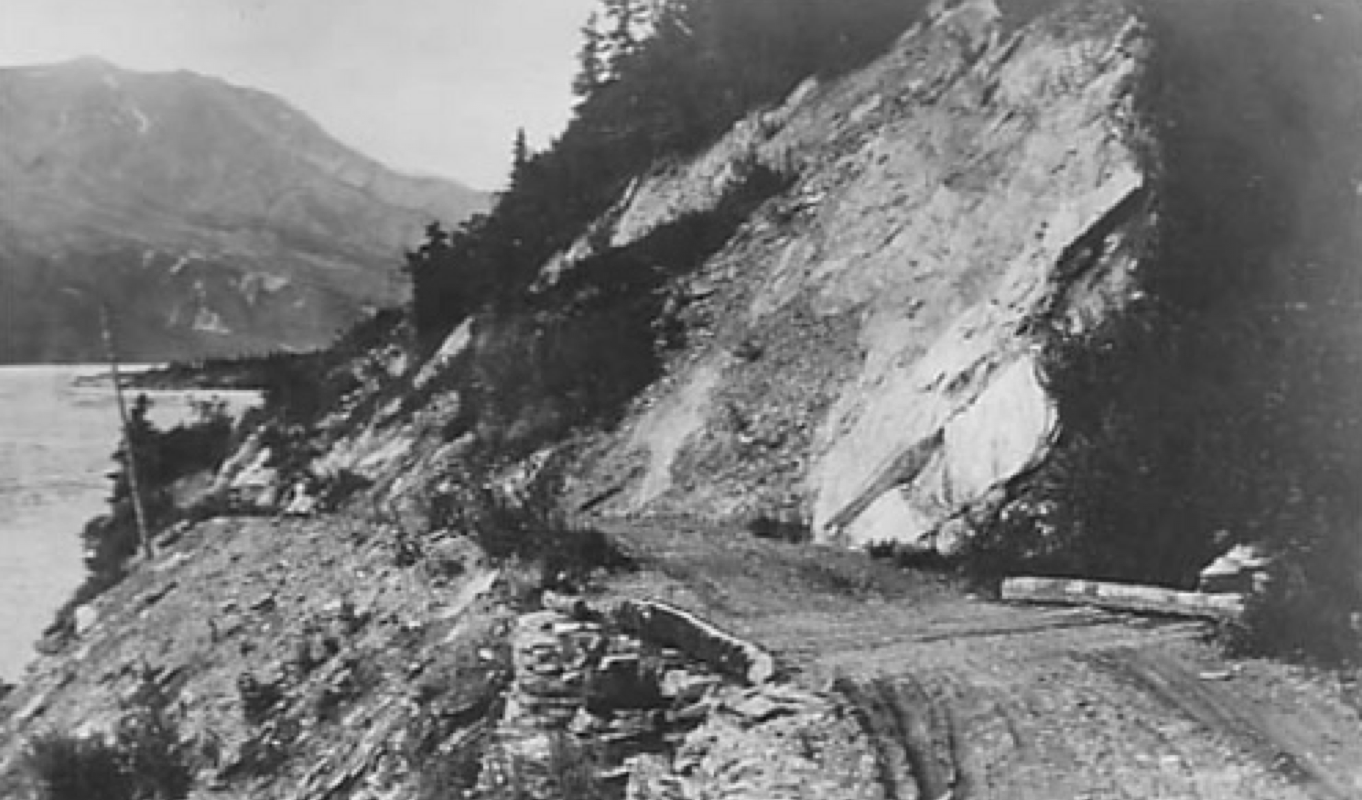
Crossing Thompson Pass on the Valdez-Fairbanks Road

Crossing Thompson Pass on the Valdez-Fairbanks Road

This history of the roads and trails of Alaska is a fascinating study, full of colorful characters and epic events. Follow a few links and spend some time learning more about the roads and highways we all use, and those who built and used them before us. It’s an important part of our history – and our future.

For more information:

A list of Alaska Routes

The Milepost

The History of Alaska’s Roads

The Evolution of the Richardson Highway

Iditarod National Historic Trail

Alaska State Parks Trail Maps and Guides

Alaska Road Commission

Posted in Alaska History | Tagged , , , , , , , , , , , , , | 1 Comment