Elizabeth “Lizzy” Geady
As an author of books on the history of Alaska, I often receive inquiries from people seeking information about long-lost relatives, and I’m always happy to help whenever I can. Family connections are important, and helping someone piece together clues to a lost relative is a fringe benefit of my work which brings happiness and often new friends.
I received one such letter recently which provides a fascinating glimpse into the life of a young roadhouse keeper along the Valdez-to-Fairbanks Trail, which would later become the Richardson Highway, in the early years of the 20th century, when travel was slow and arduous, whether by dogteam, horse-drawn wagon or sleigh, or most often, by foot.

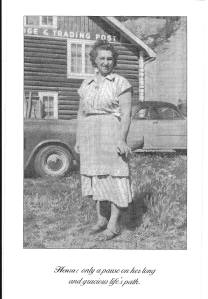
“Lizzy at Gulkana.” [UAF Archives}
There was more to Lorne’s letter to Julie, describing her great-great aunt’s 1915 letter, and she ended with this plea: “Any assistance you can offer would be greatly appreciated. She’s our lost Klondiker.”
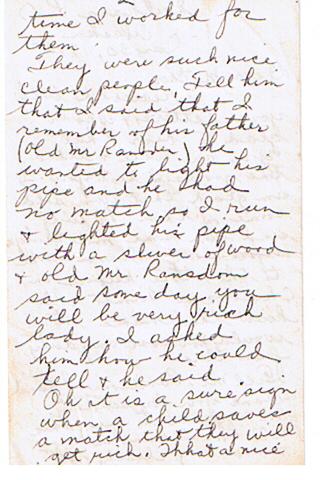
Young Elizabeth Geady wrote this letter to her mother from Gulkana in January, 1915. I’ve transcribed it for easier reading and the text of the letter is below the photos.
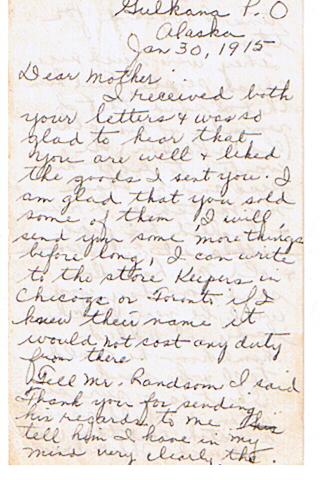


Gulkana P.O
Alaska
Jan 30, 1915
Dear Mother,
I received both your letters and was so glad to hear that you are well and liked the goods I sent you. I am glad that you sold some of them. I will send you some more things before long, I can write to the store keepers in Chicago or Toronto if I know their name it would not cost any duty from there.
Tell Mr. Randsom I said Thank you for sending his regards to me (?) tell him I have in mind very clearly the time I worked for them.
They were such nice clean people. Tell him that I said that I remember of his father (Old Mr. Randsom) he wanted to light his pipe and he had no match so I run and lighted his pipe with a sliver of wood and old Mr. Randsom said someday you will be very rich lady. I asked him how he could tell and he said oh it is a sure sign when a child saves a match that they will get rich. What a nice lady Mrs. Randsom was, and also her sister. I hope they are all well. The last time I saw Mrs. Randsom she had a little baby girl and I had lots of fun with Leslie.
Mr. Randsom might be able to give you the address of some wholesale stores in Toronto, ask him and send me the address and I will send you some things from there.
I have a store here and am doing well. I have 3 black foxes and 9 cross foxes alive. I sold a black live fox this summer for $1000 for breeding purposes. I caught him myself in a trap and I sent to the States and got a lot of goods. I got 1 ton of flour, 200 lb bacon, 500 lbs sugar and everything in proportion and lots of clothing. I sell them to the Indians. Flour is $16 a hundred, sugar $20 a hundred, tea $1.50 a lb, bacon 60¢ a lb, socks $1.50 pair (can’t decipher). Everything is high here. I have a horse and I send 150 miles for the goods after they land in Alaska.
Oh how I wish you were here with me. I am so comfortable and contented. If you were here you could get my breakfast for me. I hate to cook and do housework. I have a saddle horse to ride all over the country. I have a shotgun and shoot partridges and grouse. They are so good to eat.
I am living on the bank of the Tolsona River. The trout and greyling are so thick one can get them by the thousand
Mother, did you get my letter where I told you to give Teany my hand painted things, there are a few things
Lizzy’s letter ends there. Lorne explained “The Teany she mentions at the end is my Great Grandma Brown, Christianna (nee Geady) Brown.”
If you have any information about Elizabeth “Lizzy” Geady (possibly Kerr or Stevens) from around 1915, please get in touch with me at helenhegener@gmail.com and I will forward your information and contact details to Lizzy’s great-great niece, Lorne Brown.
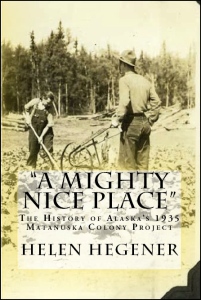 The newest book from Northern Light Media combines the history of the Matanuska Valley with the photographs of A.R.R.C. photographer Willis T. Geisman, who was charged with recording the events surrounding the 1935 Matanuska Colony Project. This book combines two earlier titles into one comprehensive history of this important era in Alaska, when the federal government took a direct hand in the future of the territory.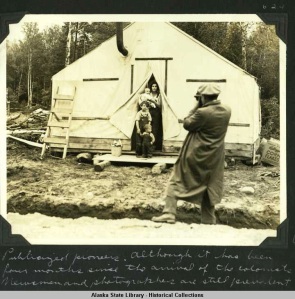

![Gakona Roadhouse, by P. S. Hunt. [AMRC-b62-1-a-151 Crary-Henderson Collection]](https://northernlightmedia.org/wp-content/uploads/2016/06/gakona-roadhouse-by-p-s-hunt-amrc-b62-1-a-151-crary-henderson-collection.jpg?w=640)
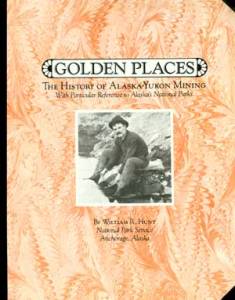
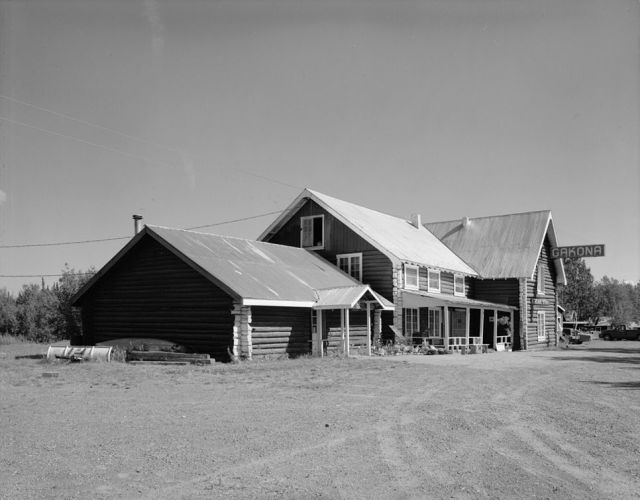
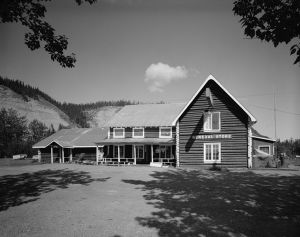 In her book, Sisters, Coming of Age and Living Dangerously in the Wild Copper River Valley [Epicenter Press, 2004], Aileen Gallaher described stopping at the roadhouse on her way north from Valdez in 1926: “Our next stop was Gakona, about thirty miles north of Copper Center. The Gakona Roadhouse there was a huge log building, which really could not be called a cabin. It had a second story and a high-pitched roof. The Gakona River flowed swiftly about fifty feet in front of it. The lobby was a large room without any decoration and only a few wooden benches for furniture. In one corner, a staircase led to the bedrooms upstairs, and the other corner was occupied by the Post Office. Across the front next to the lobby were the dining room and the kitchen, and behind were the owners’ quarters. The two men who lived there and operated Gakona Roadhouse were Arne Sundt from Norway and Herb Hyland, from Sweden. Both welcomed me warmly to Alaska, and made me feel at home in this new, amazing world.”

 An old friend, Robert Lutz, sent me the link to an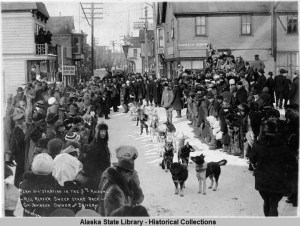


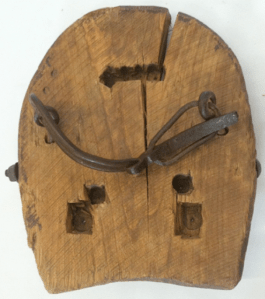


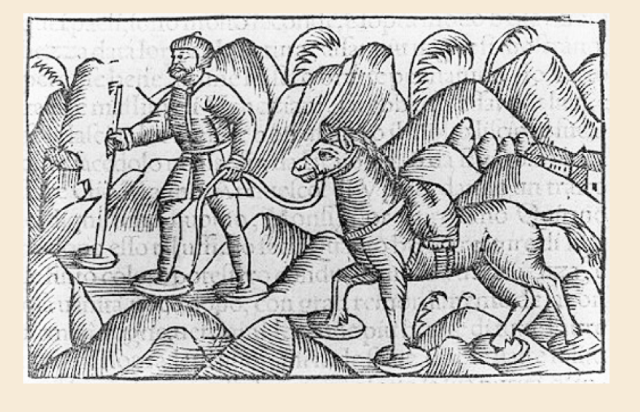
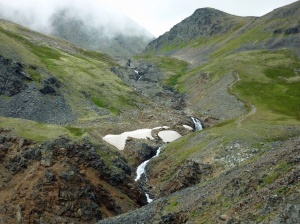
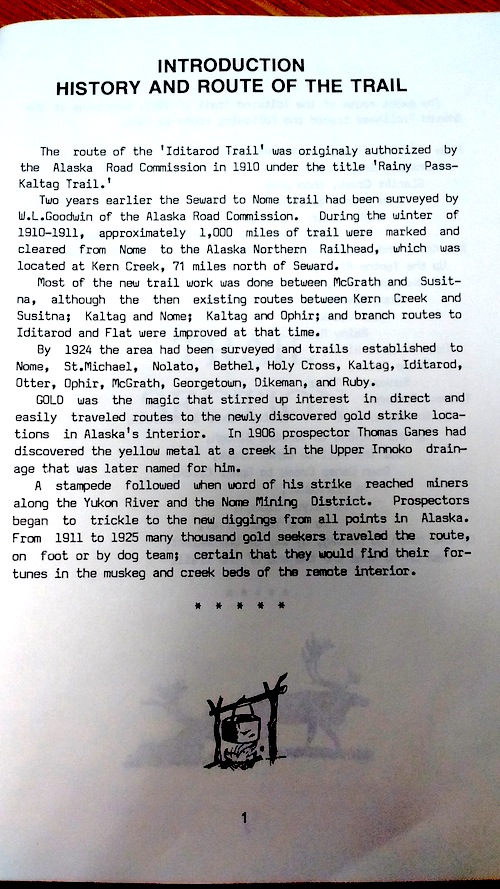
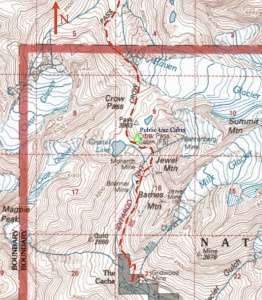 over Crow Pass before dropping down into the Eagle River Valley. From there the trail turned north and wound around Knik Arm, through the trading post of Knik and over the Alaska Range to the gold rush town of Iditarod, just south and west of Denali (Mt. McKinley), and continued on to another gold rush town on the edge of the Bering Sea called Nome.
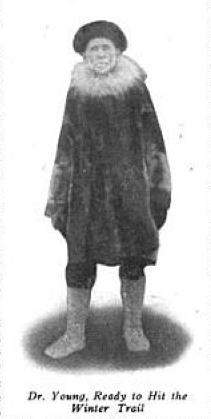 One of the early travelers over the Iditarod Trail was a hearty adventuring Presbyterian minister known as ‘the Mushing Parson.’ The Reverend Samuel Hall Young had spent time traveling in southeastern Alaska with none other than the great naturalist John Muir, who would come to be known as the “Father of the National Parks” and founder of the Sierra Club. The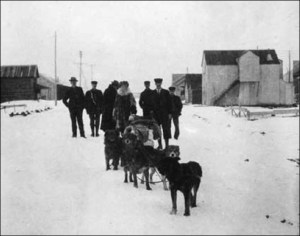
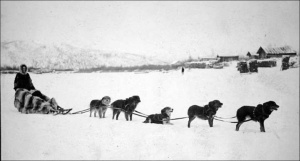
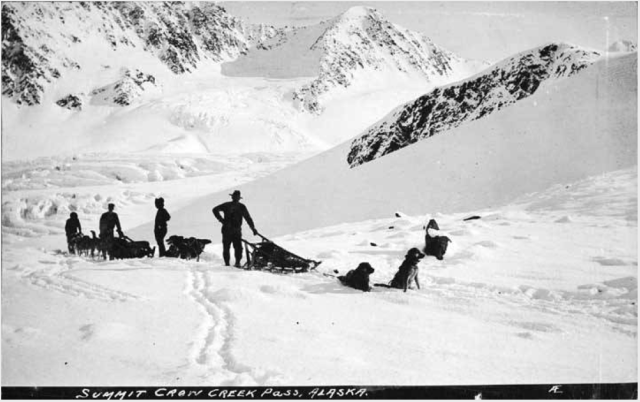
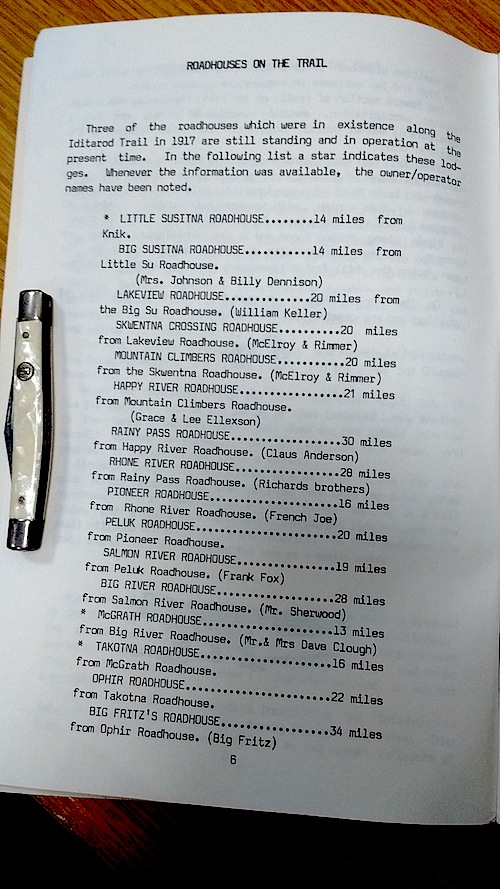
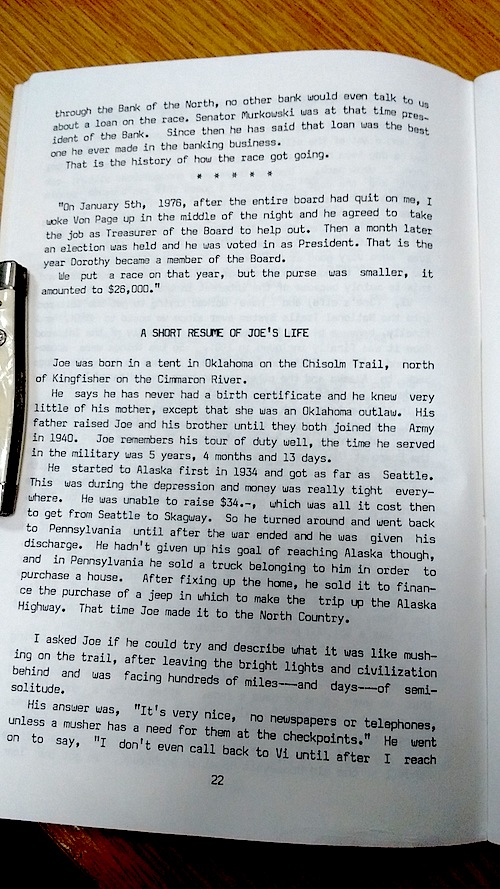
 A slim little booklet came to my attention at the Palmer library recently; if memory serves me it was tucked into their collection which cannot be checked out of the library but must remain in the building. Titled Iditarod Trail, The Old and The New, published by Alladin Publishing in Palmer, Alaska around 1990, the booklet was apparently authored by M. Carter; across the bottom of the front cover are the words “Story by Joe Redington.”





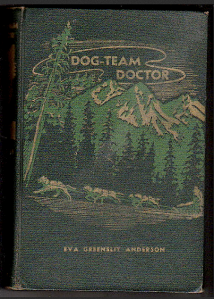 In 1896 Dr. Joseph H. Romig traveled to Bethel, Alaska, and opened the first doctor’s office and hospital west of Sitka, at a time when there were very few non-native people living in remote southwest Alaska. Four decades later a book would be written about the good doctor’s adventurous and life-saving exploits across the vast northern territory.
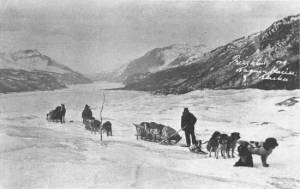
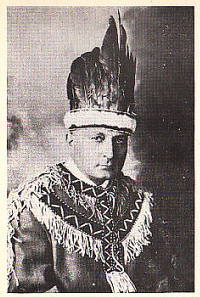 For a time, Dr. Romig was one of the only physicians in Alaska, and he became expert at dog mushing, as his practice stretched for hundreds of miles. He became known as the “dog team doctor” for traveling by dog sled throughout the Yukon-Kuskokwim Delta in the course of his work.
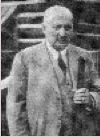 In 1939, Dr. Romig was appointed chief surgeon at Anchorage’s newly constructed state-of-the-art Providence Hospital, but he retired shortly thereafter, and purchased land on what would later be called Romig Hill. From his log cabin on the property, he started a “Board of Directors” club which eventually provided the founding members of the Anchorage Rotary Club. In the 1950’s and ’60’s
 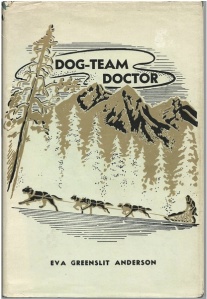 Joseph and Emily Romig moved to Colorado Springs, Colorado, where Joseph died in 1951. Although he was originally buried in Colorado, his remains were later disinterred and moved to Alaska to be buried in the family plot in
 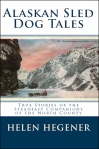 This story is excerpted from the new book Alaskan Sled Dog Tales, which will be published May 14, 2016; advance orders are available now. All advance ordered copies will be signed by the author, Helen Hegener; after May 14 books will be shipped directly from the publisher and will not be signed. Alaskan Sled Dog Tales, by Helen Hegener. $24.95 plus $5.00 shipping & handling. 320 pages, 6′ x 9″ b/w format, includes maps, charts, bibliography, indexed.