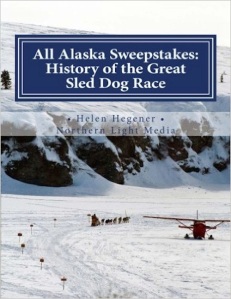
 The historic All Alaska Sweepstakes is the oldest organized distance sled dog race in the world, with records kept by the Nome Kennel Club dating back to the first race in 1908. The race, which was held from 1908 to 1917, and commemorated with 75th and 100th anniversary races in 1983 and 2008, is the subject of All Alaska Sweepstakes: History of the Great Sled Dog Race, by Helen Hegener. Hundreds of beautiful photos by Jan DeNapoli, Joe May, Donna Quante and others tell the story of the sixteen Alaskan mushers who entered their teams in the 2008 commemorative running. Each musher was hoping to have their name engraved on the Sweepstakes trophy beside the great mushing legends “Scotty” Allan and Leonhard Seppala. And, of course, they were racing for the richest purse ever offered for a sled dog race: $100,000.00 winner-take-all!
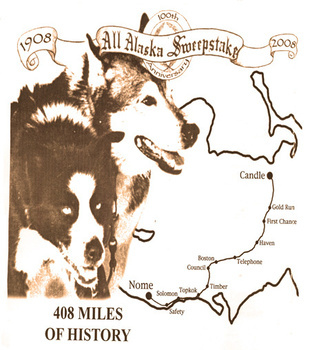
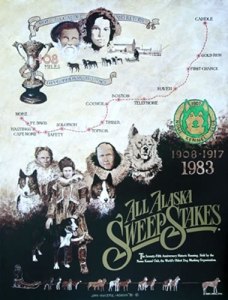 The route from Nome, on the south side of the Seward Peninsula, to the small community of Candle on the north side and return, is 408 miles, following the telegraph lines which linked camps, villages and gold mining settlements on the Peninsula. This route’s established communication lines allowed those betting on the outcome to track the race more easily from the comfort of saloons like the famed Board of Trade in Nome, where the Nome Kennel Club had been founded.
A.A. “Scotty” Allan describes the route to Candle in his classic book Gold, Men and Dogs (G.P. Putnam’s Sons, 1931): “It was selected because the trail to it from Nome goes over all kinds of country, from sea ice to high mountains, with rivers, tundra, timber, glaciers, and everything else in the way of mental and physical hardships en route. We knew there wouldn’t be any doubt about the excellence of a dog or driver that covered it.”
With colorful drivers like “Scotty” Allan and Leonhard Seppala, who each won the race three times, the All Alaska Sweepstakes was an eagerly anticipated annual event until the gold mining dropped off and Nome’s population dwindled, along with local interest in sled dog racing. In 1983 the Nome Kennel Club sponsored the 75th Anniversary race, and Rick Swenson took home the $25,000.00 purse. Then, in 2008, for the 100th Anniversary of the event, the Nome Kennel Club offered the richest purse ever for a sled dog race: $100,000.00 winner-take-all.
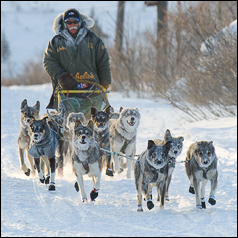
Jeff King in Council. Photo by Jan DeNapoli.
All Alaska Sweepstakes, History of the Great Sled Dog Race begins with a look at the colorful history of the race, tracing its gold rush roots and highlighting the stories of intrepid mushers like Leonhard Seppala and “Scotty” Allan, “Iron Man” Johnson and Fox Maule Ramsay, and the heroic dogs like Baldy, Togo, and Fritz. For the Centennial Race some of Alaska’s best-known mushers entered: Lance Mackey, Jeff King, Mitch Seavey, Sonny Lindner, Ramy Brooks, Jim Lanier, Cim Smyth, Aaron Burmeister, Ed Iten, Hugh Neff, and Mike Santos. And then there were the mushers who entered simply to be a part of the history of the race: Kirsten Bey, Cari Miller, Fred Moe Napoka, Connor Thomas, and Jeff Darling, whose musher profile noted that he’d entered “for the historical value and a chance to see some countryside he might not otherwise be able to see by dogteam.”
 The photo-rich, full color book covers the race from the preliminary festivities such as the crowning of the Sweepstakes Queen, Janice Doherty, and the mushers’ bib drawing, to the historically-themed finisher’s banquet and the awards, not only of the beautiful championship trophy, but also the Alec “Scotty” Allan Humanitarian Award, and the Percy Blatchford “Spirit of the Race” award. Descriptive commentaries by Race Marshal and Lead Judge Al Crane; leaderboard designer and champion musher Jodi Bailey; and dedicated race fan Marcia Claesson, who shared how the race was tracked by mushing enthusiasts from around the world, add depth and perspective to the exciting narrative of this iconic race.
“One of the pilots in Candle asked me if I’d seen any wolves, and I said no, and he said there was a big pack of wolves headed this way. I was about two hours out of Candle on my way to Gold Run and I see all these green eyes about fifty feet off the trail, a hundred yards ahead of me. So I had my headlight on bright and I’m looking at these eyes… My .44 was in my sled so I unzipped my sled bag and I’m looking, there’s a lot of sets of eyes looking at me…” ~ musher Aaron Burmeister sharing tales of the trail at the Finish Banquet.
 All Alaska Sweepstakes, History of the Great Sled Dog Race. Softcover 8.5″x 11″, published in 2013 by Northern Light Media. ISBN 978-0-9843977-0-9 • 160 pages, over 350 photos. $29.00 plus $5.00 shipping from Northern Light Media, PO Box 298023, Wasilla, Alaska 99629. For credit cards and PayPal please click here.
Share this page with your friends through social media:







![Colony kids in a tent camp. Photograph by Willis T. Geisman for the A.R.R.C. [ASL-PCA-303, Mary Nan Gamble Collection, Alaska State Library]](http://matanuskacolony.files.wordpress.com/2014/06/fera-colony-kids-in-a-tent-camp-anch-mus-fera-303.jpg)
 Excerpted from “A Mighty Nice Place,” The History of the 1935 Matanuska Colony Project, by Helen Hegener. Published in November, 2016 by Northern Light Media. 276 pages, 120 photos, 6″ x 9″ b/w format. Print book: $24.95 plus $5.00 shipping.
 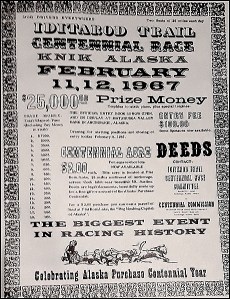 In 1967, a 50-mile sprint sled dog race was run from Knik to Big Lake, in two 25-mile heats over a two-day period, with the race route including nine miles of the original Iditarod trail.


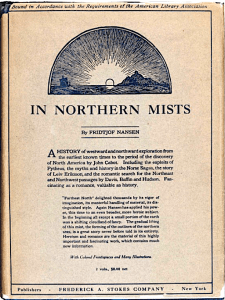 In his 1911 book, a two-volume history of arctic exploration titled Northern Mists: Arctic Exploration in Early Times, the reknowned Norwegian explorer Fridtjof Nansen quotes from the fourteenth century Arabian chronicles of Ibn Batuta, a businessman trading near what is now Kazan in Russia. The Arabian dwelled with appreciation on the sight of sled dogs, noting that “Ibn Batuta (1302-1377) has no name for this people, any more than Abu’lfeda; but he calls their country ”the Land of Darkness’ and has an interesting description of the journey thither. He himself, he says, wished to go there from Bulgar, but gave it up, as little benefit was to be expected of it. That land lies 40 days’ journey from Biilgar, and the journey is only made in small cars drawn by dogs. For this desert has a frozen surface, upon which neither men nor horses can get foot- hold, but dogs can, as they have claws. This journey is only undertaken by rich merchants, each taking with him about a hundred carriages [sledges?], provided with sufficient food, drink and wood; for in that country there is found neither trees nor stones nor soil. As a guide through this land they have a dog which has already made the journey several times, and it is so highly prized that they pay as much as a thousand dinars [gold pieces] for one. This dog is harnessed with three others by the neck to a car [sledge?], so that it goes as the leader and the others follow it. When it stops, the others do the same.”


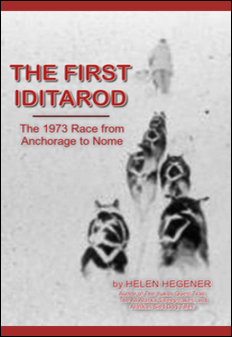
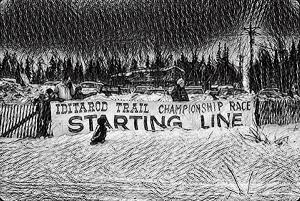 From 2007 to 2012 I travelled across Alaska to visit veteran mushers from the 1973 race who would share their memories of what has since become known as “The Last Great Race on Earth.” The bulk of my book is comprised of the verbatim words of these intrepid men who drove their teams on that first journey to Nome in 1973, captured through recorded and videotaped interviews and many notes and follow-up letters and emails. I am grateful to those who detailed their long-ago adventures, and I am equally grateful for the warm memories I brought away from our shared time together, when I would sit and listen, hands wrapped around a cup of coffee, as the years fell away and musher after musher relived that great adventure in March of 1973.