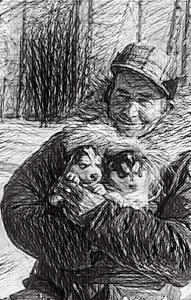
 “When I went out to the villages (in the 1950′s) where there were beautiful dogs once, a snow machine was sitting in front of a house and no dogs. It wasn’t good. I didn’t like that. I’ve seen snow machines break down and fellows freeze to death out there in the wilderness. But dogs will always keep you warm and they’ll always get you there.” ~Joe Redington, Sr., in “I’d Swap My Old Skidoo for You,” by Nan Elliot (Brimm & Heald, 1989)
Joe Redington, Sr., known as the “Father of the Iditarod,” was born on February 1, 1917, in a tent on the banks of the Cimarron River, north of Kingfisher, Oklahoma, on the famous Chisholm Trail. It was a fitting start for a man who would later spend his life traveling the trails of a far distant land.
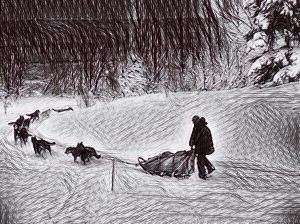 Joe Redington came to Alaska in 1948, settling on a homestead near Knik, south of Wasilla, with his family. He learned about sled dogs and how to handle a dog team from his new neighbors, mail and freight team driver Sharon Fleckenstein and Lee Ellexson, one of the last dog team mail drivers on the Iditarod Trail. He and his wife Grace had at one time been the operators of the Happy River Roadhouse in Rainy Pass. Ellexson had traveled thousands of miles with a dog team, and his stirring ‘tales of the trail’ captivated the newcomer.
Ellexson sold Joe a few dogs, and in less than a year Redington had created Knik Kennels and was feeding his own 40 huskies. He became a proficient enough dog driver to contract rescue and recovery missions for the U.S. Air Force between 1949 and 1957, using his dog teams to reach the sites of aircraft crashes. Harnessing teams of 25 to 30 dogs, Redington hauled hundreds of servicemen and millions of dollars’ worth of salvaged parts from remote areas of Alaska.
 A boat-building project took Joe to the village of Unalakleet, where he observed hundreds of huskies sitting idly around while snowmachines roared everywhere, the obvious transportation mode of choice. This alarmed Joe, and set him to thinking seriously about a one-thousand-mile race following the historic Iditarod Trail. Joe Redington promised that there would be a long-distance race to Nome by 1973, with the unheard-of purse of $50,000. Several major obstacles stood in his way, such as trail-clearing and fund-raising, but the biggest obstacle was his fellow race enthusiasts.
Undaunted by the skeptics, Redington continued making plans for his race. He wrote up incorporation papers for the Iditarod Trail Committee, or ITC, forerunner of today’s race-governing body of the same name, and his wife Vi and two schoolteacher friends, Tom Johnson and Gleo Huyck – became the first officers of the new organization.
 As Joe and his new Iditarod Trail Committee set to work, the base of opponents and naysayers grew, and chief among them were some of the mushing world’s most prominent racers. There were claims that no dog could run 1,000 miles, and that no musher could cover that distance either. The old-timers on the trail had traveled at a slower pace, and traded dogs and entire teams when necessary, and there was a network of close-set cabins and roadhouses to support them which no longer existed. Attempting to travel the entire distance with one team of dogs was considered foolhardy by many, ill-advised and reckless at best.
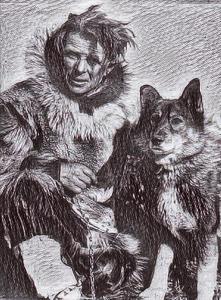 And then, quietly at first, a few advocates emerged and said it wasn’t such a far-fetched notion, and as evidence they pointed to mushers like Hudson Stuck, the Yukon River missionary whose classic book, Ten Thousand Miles with a Dog Sled, related seemingly non-stop travels to the farthest reaches of Alaska. Others had utilized dog teams on long distance trips, explorers like Ernest de Koven Leffingwell, who mapped the Arctic coastline, and Olaus Murie, the federal wildlife biologist who ran dog teams throughout Alaska for more than 30 years. Dr. Joseph Romig was known as “the dog-team doctor” for his extensive remote travels, and Father Bernard Hubbard, “the Glacier Priest,” who led an expedition 1,600 miles down the frozen Yukon River, visiting missions along the way.
The Alaska Native elders chimed in with their stories and experiences; they were recognized experts on raising and training sled dogs and they knew the dogs could travel that distance. Well-known and respected mushers like George Attla of Huslia, Ken Chase of Anvik, and Dick Mackey of Wasilla signed on for the challenge, and other mushers began declaring their interest. Attla’s joining the race was significant, because at the time he was a reigning champion in the mushing world, enjoying something akin to rock star status in the sport.
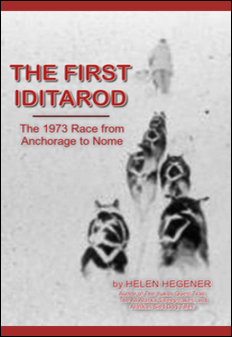 Joe Redington Sr.’s dream race became a reality which continues to enchant mushers and fans alike every March. The year after founding the race, in 1974, Joe Redington would enter and run the race along with his sons Raymie and Joee. Raymie would place seventh, followed by his brother Joee in ninth place and Joe Sr. arriving in eleventh place. That would be a banner moment for the 57-year-old founder of the race.
Edited from The First Iditarod, The 1973 Race from Anchorage to Nome, by Helen Hegener, a revised edition of the 2015 book, published by Northern Light Media. 199 pages. Format 6″ x 9,″ b/w illustrations, bibliography, resources, indexed. $24.00 plus $5.00 shipping and handling. Foreign orders please use Amazon. Click here to order from the author.
Share this page with your friends through social media:


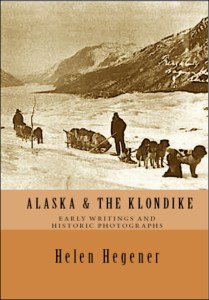 Alaska & the Klondike, Early Writings and Historic Photographs, compiled and edited by Helen Hegener, and published in 2018 by Northern Light Media, is an anthology of selected writings from a dozen northland classics by early explorers and travelers in the territories of Alaska and Canada’s Yukon at the turn of the 20th century.
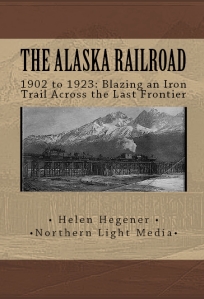
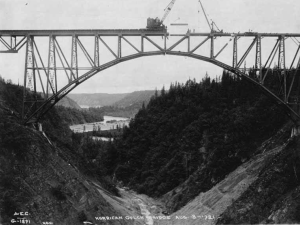
 This 400-page book is a wide-ranging look at the many ways in which the railroad played a major role in Alaska’s growth and development. From dynamiting the railbed out of the rocky cliffs along Turnagain Arm, to spanning the deep chasm of Hurricane Gulch, and from crossing the endless miles of muskeg swamp to bridging the mighty waters of the Tanana River, the story is told through historic documents, photographs, and publications.
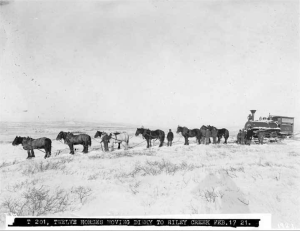 This is more than the just the story of constructing the railroad, this is also the story of how the U. S. Government built towns and cities across the territory, including Seward, Anchorage, Palmer, Wasilla, Talkeetna, Nenana, and Fairbanks. It’s the story of coal mining in Alaska, from the Guggenheim Syndicate’s notorious attempted monopoly of Alaska’s resources, to the government’s own private coal mine to service the U.S. Naval fleet in the Pacific. It’s the story of steamboat travel on Alaskan rivers, and how the railroad’s own fleet of steamers and gas-powered “tunnel boats” came to dominate the watery transportation corridors. It’s the story of the role a fledgling conservation movement played in dividing a major political party. And it’s the story of how steam shovels which dug the Panama Canal were brought north to claw at Alaskan hillsides.
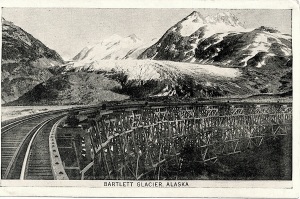
 The 500-mile long Alaska Railroad runs from the seaport town of Seward, on the Kenai Peninsula, to Fairbanks, the Golden Heart of Alaska. Along the way it crosses two formidable mountain ranges, several broad and daunting rivers, and numerous deep gorges and canyons. It winds along the tidewater edge of Turnagain Arm, past Bartlett and Spencer Glaciers, and skirts the highest point on the North American continent, the Great One, Denali. From running its own opulent luxury hotel—literally in the middle of nowhere—to developing the telephone, water, and sewer systems of Anchorage, the history of the railroad is largely the history of Alaska. Take a ride on the northernmost U. S. railroad, and gain an unusual perspective on a richly fascinating period in America’s past. ~•~
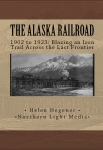 The Alaska Railroad: 1902-1923, Blazing an Iron Trail Across The Last Frontier, by Helen Hegener, published in May, 2017 by Northern Light Media. 400 pages, over 100 b/w historic photos, maps, bibliography, indexed. The book can be ordered for $24.95 plus $5.00 postage, by
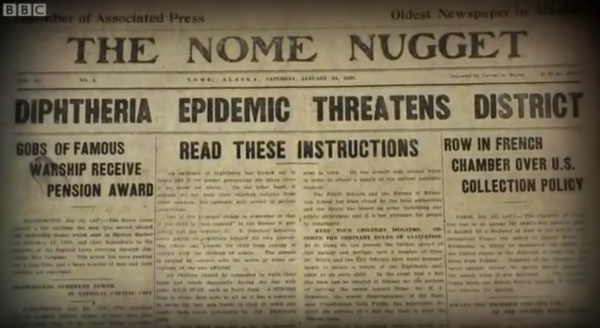
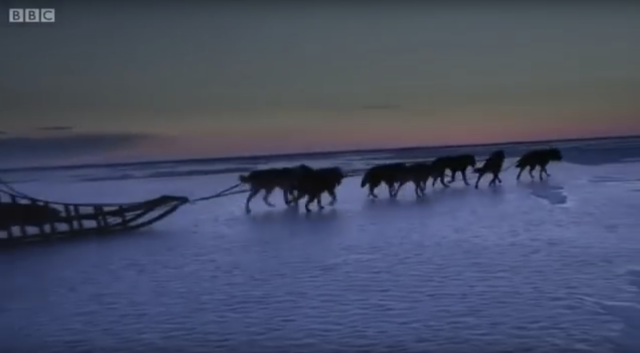
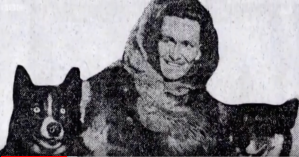
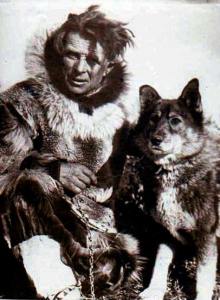

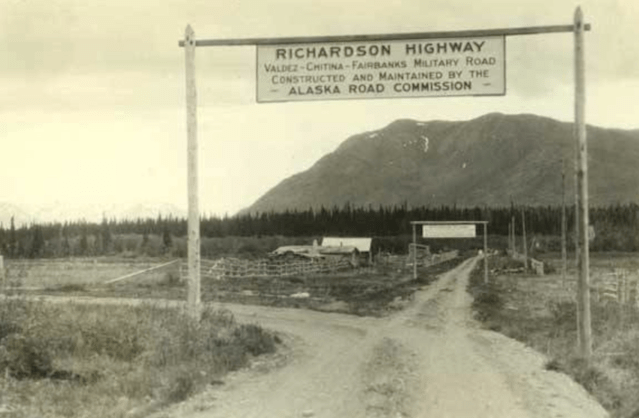

 W. A. Dikeman and Charles Peterson reported by Iditarod Nugget as “First Mushers Over the Iditarod Trail: Taking 45 Days from Seward to Otter, they meet several others on the trail including Harry Johnson and Bob Griffis.” (Iditarod Nugget, December 28, 1910)


 The resort ledgers include a hotel register for 1907-1908, three double-entry account books (1907-1911), a mess account (1907-1909), and a trial balance for 1910-1911. In addition to providing insights into the resort’s expenses, income, and operations and Frank Manley’s involvement in local mining, the various ledgers list many individuals whose names are not found in such common reference works as


 Henderson’s expedition was a tribute to the “forgotten explorer,” Ernest de Koven Leffingwell. Traveling with Leffingwell’s journals as a guide, Joe covered much of the same country, camped in many of the same localities, and experienced some of the same weather and ground conditions that Leffingwell had a century before. On the third year of the expedition, Joe found Leffingwell’s cabin during a whiteout blizzard.
 This story is excerpted from Alaskan Sled Dog Tales, by Helen Hegener (Northern Light Media, 2016).











 Northern Light Media